€ 150


Still questions? Contact us
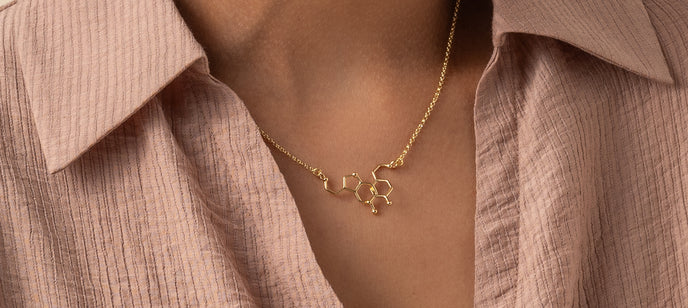
Adenine necklace | sterling silver
If you can sketch the purine ring from memory and remember why A pairs with T but not with C, the rest of this needs no introduction. Adenine is the most metabolically reused base in biology. ATP, NAD+, FAD, and coenzyme A all carry it as their core. The genetic code uses it. Energy metabolism uses it.
The Science Behind Adenine
Adenine, or 6-aminopurine, is a purine base built from a fused pyrimidine and imidazole ring with an amino group at position 6. In DNA it pairs with thymine through two hydrogen bonds, the weaker of the two Watson-Crick pairings, which is why AT-rich regions melt at lower temperatures than GC-rich ones. Beyond DNA and RNA, adenine forms the base of adenosine, which becomes ATP when triphosphorylated, and is also part of NAD+, FAD, and coenzyme A. The recognition of adenine's role in nucleic acid pairing was central to the 1953 Watson-Crick model, built on Erwin Chargaff's earlier observation that the amount of adenine in DNA always equals the amount of thymine.
Who Reaches For This
- molecular biologists and geneticists
- biochemists studying nucleotide metabolism or cellular energetics
- structural biologists and chemistry graduate students
- educators teaching the central dogma at any level
Bought most often by molecular biologists picking out a graduation gift for someone finishing a PhD on nucleic acids.
Explore Related Molecules Jewelry
- Thymine necklace | silver
- Adenine-thymine earrings | silver
- Cytosine-guanine necklace | silver
- Cytosine necklace | silver
- Guanine necklace | silver
FAQ
Why adenine on its own rather than the full DNA helix?
Because the four bases are the actual letters. The double helix is the medium, the bases are the alphabet. People who work with nucleic acids tend to find the single-base pieces more interesting than the helix, especially if their work focuses on a particular pair. Adenine on its own carries the metabolic weight as well, since it is in ATP, NAD+, FAD, and coenzyme A, which puts it across most of cellular biochemistry.
Why does adenine pair with thymine and not with cytosine?
Geometry and hydrogen-bond donors and acceptors. Adenine has the right pattern of donors and acceptors at the right positions to form two stable hydrogen bonds with thymine. Cytosine and guanine fit each other through three hydrogen bonds. The other combinations either do not match donor-acceptor patterns or produce distorted geometries that DNA polymerases reject during replication.
What size is the pendant and what is the return policy?
925 sterling silver, 21 mm pendant on a 45 cm sterling silver chain with a 5 cm extender. Nickel-free and hypoallergenic. Free worldwide DHL Express in 1-5 business days, with all import duties and taxes covered. 30-day “Love It or Return It” returns.
Are the other DNA bases available in the same style?
All four bases are available as separate sterling silver necklaces: adenine, thymine, cytosine, and guanine. There is also a cytosine-guanine pair pendant for the stronger of the two base pairs, and matching mix-and-match earrings for the AT and CG pairs.
Molecules
Delve into the hidden elegance of science with our meticulously crafted jewelry, inspired by the intricate structures of chemical molecules. Each piece serves as a tactile tribute to the building blocks of life and matter, capturing the allure of atoms and bonds in precious metals. A harmonious fusion of art and science, these creations are more than mere accessories; they're a celebration of the enigmatic beauty that underpins our universe.
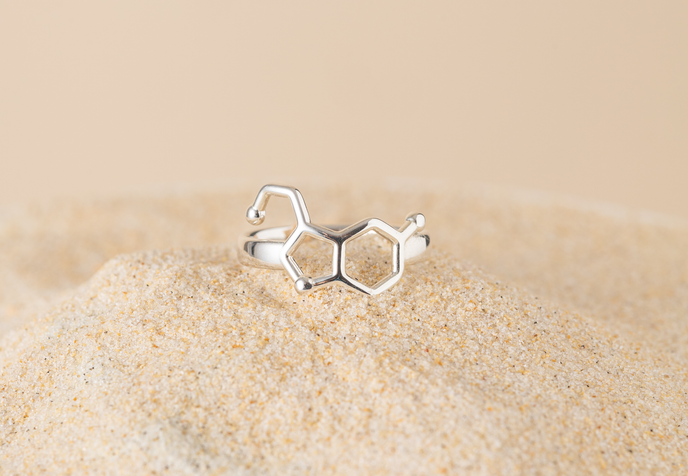
Find your perfect fit: measure an Existing Ring
Finding out your ring size at home is a simple process and can help you shop for jewelry online with confidence.
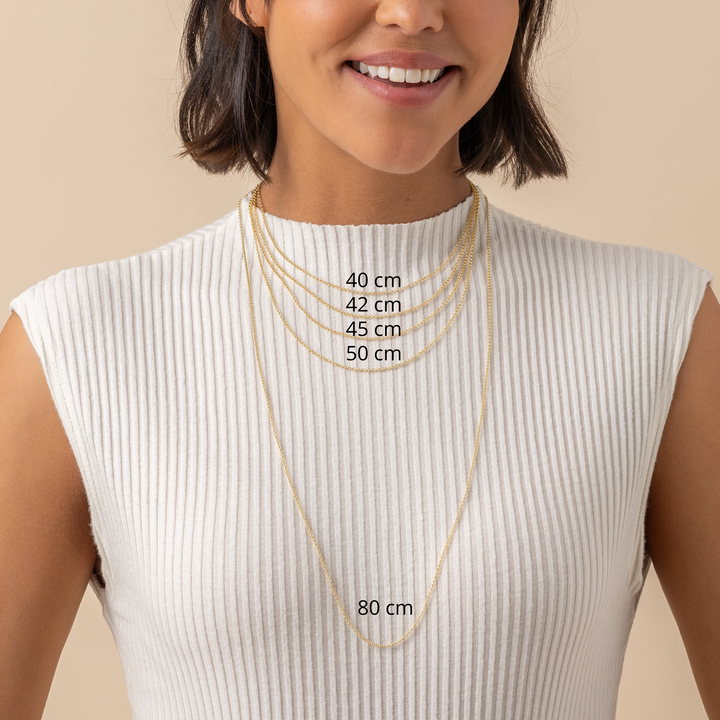
Necklace length guide