


€ 200


Still questions? Contact us
Brain necklace | sterling silver
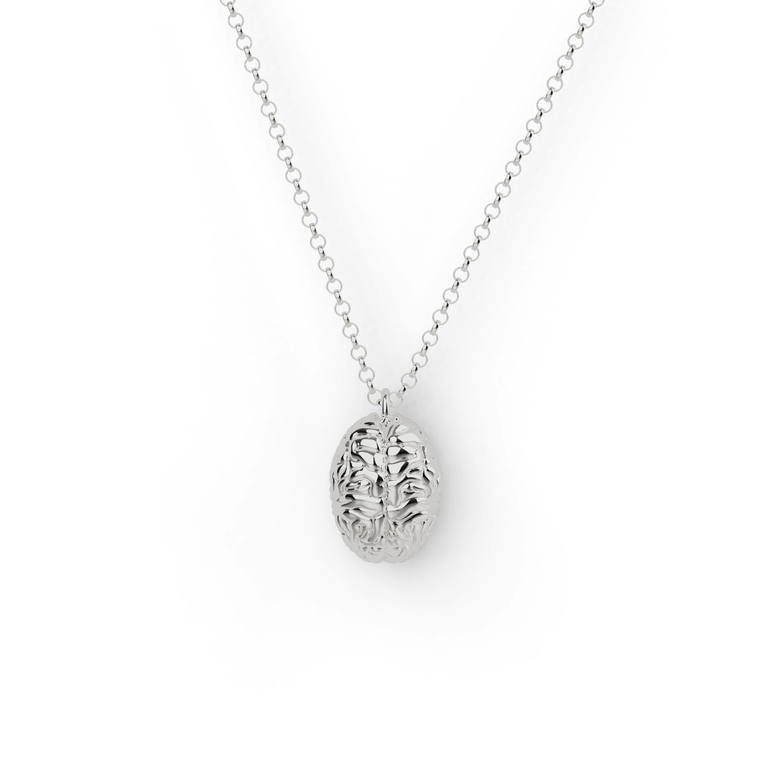
Eighty-six billion neurons, organised into folds you can see at the surface, gyri rising, sulci dividing them, the architecture of thought you learn in your first neuroscience lecture. Worn here as a superior view of the cerebral cortex, in sterling silver.
The Science Behind the Cerebral Cortex
The folded surface visible on the pendant is the cerebral cortex, the outermost layer of the brain and the seat of higher cognition, perception, language, planning, decision-making. The folding is what allows roughly 1,500 cm² of cortical sheet to fit inside a skull only a third of that surface area. The deep grooves are sulci. The raised ridges between them are gyri. From above, the longitudinal fissure runs front to back as the deep central groove that divides the brain into its left and right hemispheres. The central sulcus arches across each hemisphere from the medial edge toward the lateral edge, separating the frontal lobe (anterior, with primary motor cortex along its posterior border in the precentral gyrus) from the parietal lobe (with primary somatosensory cortex in the postcentral gyrus immediately behind). The temporal lobes sit below the lateral surface and are not visible from this superior angle, but the surface landmarks, gyri-sulci pattern, longitudinal fissure, central sulcus, are the ones any neuroscientist will name on sight.
The Audience
- neuroscientists, neurologists, and neurosurgeons
- neuroscience and psychology students through their first systems neuroscience course
- doctors and medical researchers across specialties
- science educators and communicators who teach the cortex weekly
- anyone whose professional life or personal history runs through the nervous system
The one you wear to seminars, supervisions, and the SfN poster session.
Explore Related Neuroscience Jewelry
- Brain necklace | gold vermeil
- Brain cufflinks | silver
- Neuron necklace | silver
- Neuron necklace | gold vermeil
- Spindle neuron necklace | silver
FAQ
Who buys a brain necklace?
Mostly working neuroscientists, neurologists, neurosurgeons, and the students and partners who cross paths with them every day. It also lands well with psychology and psychiatry, with science educators teaching neuroanatomy, and with people for whom the brain has become personal, through a diagnosis, a recovery, or a life shaped by someone else's. Strong as a gift for a neuroscience graduation, a board certification, or a milestone publication. Less of a generic medical-symbol piece than a stethoscope or caduceus. Recipients usually identify with the brain specifically, not medicine in general.
What anatomy does the pendant show?
A superior view of the cerebral cortex, looking down at both hemispheres from above. The longitudinal fissure runs front to back as the deep central groove dividing the hemispheres. The central sulcus arches across each hemisphere from the medial edge toward the lateral edge. Lateral landmarks (lateral fissure, temporal lobe surface, Broca's and Wernicke's areas) sit below the visible surface and are not shown from this angle. It is the cortex specifically, not a midsagittal section, not a coronal slice, not a deep-brain rendering. Subcortical structures (basal ganglia, thalamus, hippocampus) are not visible on a surface view by definition.
What size is the pendant and what does it ship with?
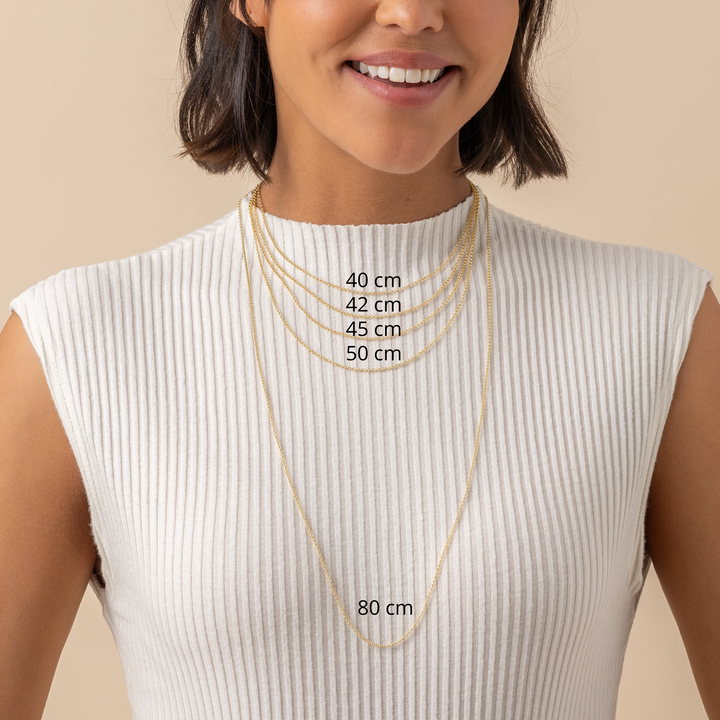
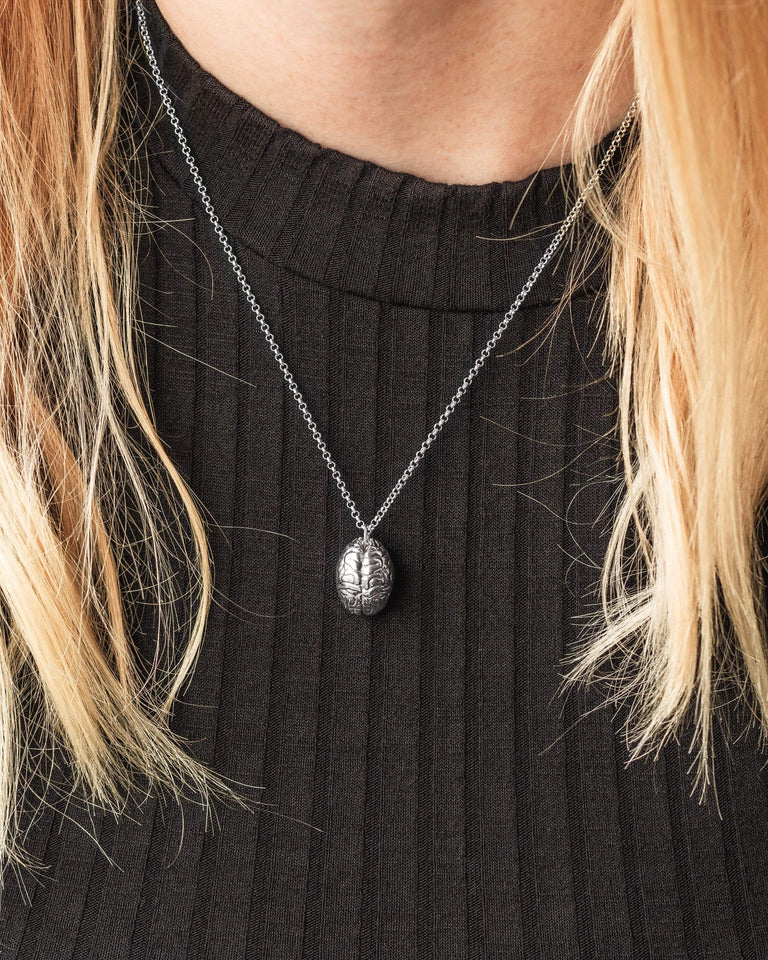
The pendant is 18 mm in sterling silver (925), nickel-free and hypoallergenic, on a 45 cm sterling silver chain (1.8 mm width, lobster clasp) with a 5 cm extender, so it sits at the collarbone or a little below. Free worldwide DHL Express shipping in 1-5 business days, all import duties covered, in a ready-to-gift jewelry box.
What's the difference between the silver and gold brain?
The anatomy is identical: same superior view, same 18 mm scale, same gyri-sulci pattern. Material is the only difference. Choose the finish the recipient already wears. Both versions carry the same design and the same meaning. Both ship on a 45 cm chain in matching material.

Neuroscience
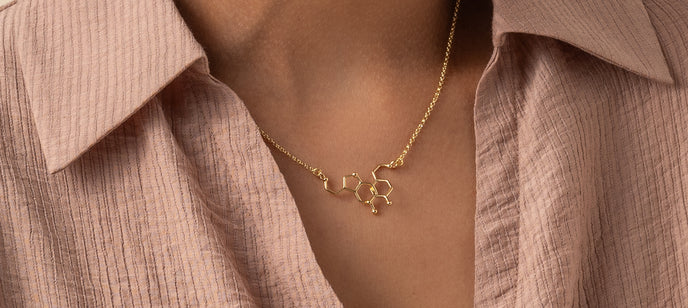
Dive into the intricacies of the human mind with our neuroscience-inspired jewelry collection. Each piece is a tactile ode to the neural networks that shape our thoughts, memories, and consciousness. Crafted with meticulous attention to detail, our designs mirror the dendritic branches and synaptic connections that form the basis of mental activity. With these elegant pieces, wear the enigma of cognition close to your skin, offering a subtle yet profound exploration of what it means to be sentient.
Find your perfect fit: measure an Existing Ring
Finding out your ring size at home is a simple process and can help you shop for jewelry online with confidence.
Necklace length guide