€ 150


Still questions? Contact us
Fz3 atomic orbital necklace | sterling silver
Under ultraviolet light, parts of a genuine euro note glow red. The light comes from europium, as electrons in its 4f orbitals drop to a lower energy level. One of those orbitals names the Fz3 orbital necklace. To a lanthanide chemist, or a student just meeting the f orbitals, that red glow is part of their subject.
Who It's For
- yourself
- a chemistry teacher
- a physicist who works on atoms and light
- a friend with a soft spot for chemistry
Susan C., who bought one to keep: “It's gorgeous, a piece of art in its own right, even without the scientific connection.” Míguel r.: “I found it very original and was the perfect gift”
The Science Behind the Fz3 Orbital
An orbital is a solution of the Schrödinger equation that describes where an electron is likely to be found. The f orbitals have angular momentum quantum number 3, and there are seven of them. In a hydrogen atom, the 4fz3 wavefunction is proportional to z(5z² − 3r²), times a factor that fades with distance. It is zero on three surfaces through the nucleus: the plane at right angles to the z axis, and two cones at about 39 degrees from that axis. A 4f orbital has no spherical node. In the lanthanides, the 4f orbitals lie inside the filled 5s and 5p shells and take little part in bonding, one reason these elements are so alike in their chemistry.
Explore Related Physics Jewelry
- Fz3 atomic orbital necklace | gold vermeil
- atom necklace 3D | silver
- atom necklace | silver
- psi necklace | silver
FAQ
How big is the pendant, and how does it sit?
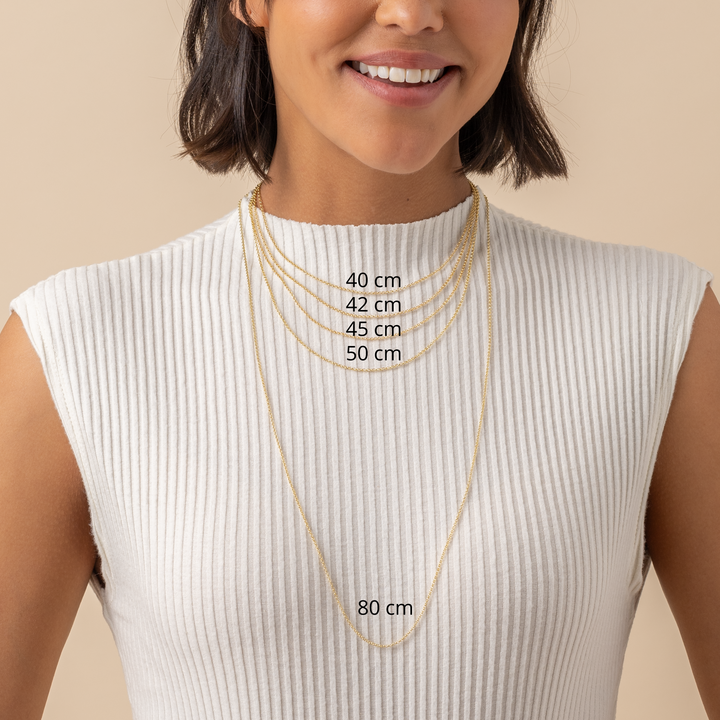
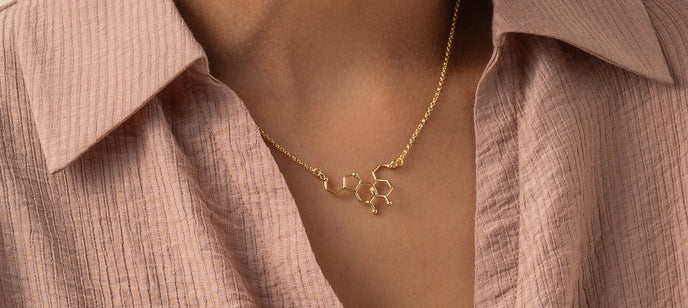
The pendant measures 23 mm (about 0.9 inch), just over 1 mm less than the width of a US quarter (24.26 mm). It hangs from a small ring at its top and sits below the collarbone on a 45 cm (17.7 inch) sterling silver chain with a 5 cm (2 inch) extender. Our 925 sterling silver is nickel-free and hypoallergenic.
Does it come in gold vermeil?
Yes. The Fz3 orbital necklace comes in sterling silver and in 18K gold vermeil, which is 2.5 microns of 18K gold over solid sterling silver. Both have a 23 mm pendant on a 45 cm chain with a 5 cm extender. Choose the finish the recipient already wears. The design is the same in both finishes.
Will it arrive in time, and what if it isn't right?
DHL Express delivers it free worldwide in 1-5 business days, and we pay the import duties and taxes, so nothing is due at the door. It arrives in a ready-to-gift jewelry box and festive envelope. If it isn't right, our 30-day “Love It or Return It” policy applies.
What did Maria Goeppert Mayer calculate about the f orbitals?
In 1941, at Columbia University and at Enrico Fermi's suggestion, Maria Goeppert Mayer used a simple statistical model to follow the 4f and 5f orbitals through the heavy elements. A year earlier, Edwin McMillan and Philip Abelson had suggested that a second group like the rare earths might start at uranium. She found that the 4f orbital suddenly shrinks inwards where the rare earths begin, and predicted the first 5f electrons at element 91 or 92. In 1944 Glenn Seaborg proposed the actinide series, the row set below the lanthanides.

Math & Physics
Unlock the elegance of the abstract with our math and physics-inspired jewelry collection. These carefully crafted pieces mirror the profound equations and natural laws that shape our understanding of the universe. Experience the allure of fractals, the rhythmic beauty of pi, and the celestial wonder of astral formations—each piece serves as a wearable homage to the artistry inherent in scientific inquiry.
Find your perfect fit: measure an Existing Ring
Finding out your ring size at home is a simple process and can help you shop for jewelry online with confidence.
Necklace length guide