€ 155


Still questions? Contact us
Graphite necklace | sterling silver
Carbon arranged into stacked hexagonal sheets gives you graphite. The same atoms arranged into a tetrahedral lattice give you diamond. Same element, opposite extremes: softest mineral versus hardest, conductor versus insulator. The molecule that proved structure matters as much as composition.
The Science Behind Graphite
Graphite consists of sp2-hybridised carbon atoms arranged in planar hexagonal sheets. Each carbon bonds to three neighbours within the sheet, with the fourth valence electron delocalised across a pi system that gives graphite both its electrical conductivity and its metallic-grey lustre. The sheets are held to each other by weak van der Waals forces, which is why graphite slides, lubricates, and marks paper. Andre Geim and Konstantin Novoselov shared the 2010 Nobel Prize in Physics for isolating a single graphene sheet using adhesive tape, one of the more improbable experimental setups to produce a Nobel result. The word 'graphite' comes from the Greek 'graphein', to write.
Who Tends to Wear This
Most graphite buyers belong to one of three communities.
- materials scientists and condensed-matter physicists
- chemists working with carbon allotropes or nanomaterials
- battery and electrode engineers
- science teachers who use the carbon-allotrope story to teach structure-function
Often given as a postdoc-leaving present in materials labs, or as a small gift for the chemist who taught structure-function in a way that finally clicked.
Explore Related Molecules Jewelry
FAQ
Will a materials scientist or a chemistry teacher recognise this?
Quickly, yes. The hexagonal carbon lattice is the textbook image for sp2 carbon, and graphite sits in every introduction to crystallography. It also reads well to anyone working on graphene, batteries, or carbon nanomaterials.
Why was isolating graphene worth a Nobel Prize?
Single-layer graphene was widely thought to be thermodynamically unstable and impossible to produce in pure form. Geim and Novoselov demonstrated otherwise in 2004 using sticky tape to peel layers off bulk graphite. The technique was almost laughably simple, but it opened a new field of two-dimensional materials with extraordinary electronic, thermal, and mechanical properties.
What are the size, material, and chain specs?
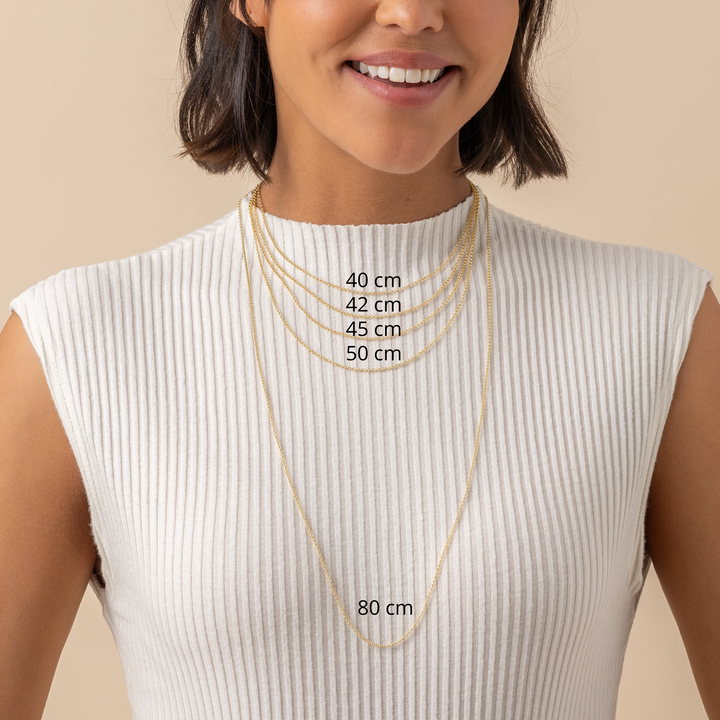
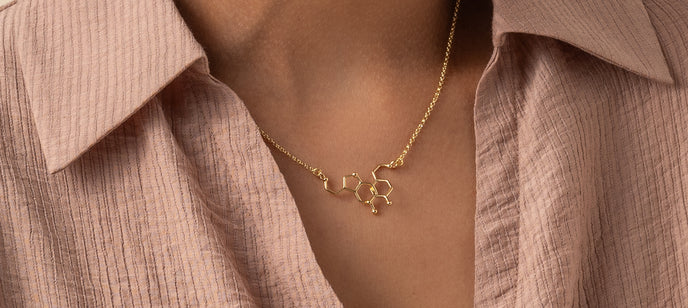
24 mm pendant in 925 polished sterling silver, nickel-free. 45 cm sterling silver chain with a 5 cm extender. Free worldwide DHL Express, 1-5 business days, all duties and taxes covered. 30-day “Love It or Return It” if it does not fit how you wear silver.
Why a graphite necklace and not, say, diamond?
Diamond is the famous one. Graphite is the working one: the carbon allotrope that runs pencils, electrodes, lubricants, and the field of two-dimensional materials. For anyone who finds the everyday-but-fundamental version of an idea more interesting than the famous version, graphite has the better story.
Molecules
Delve into the hidden elegance of science with our meticulously crafted jewelry, inspired by the intricate structures of chemical molecules. Each piece serves as a tactile tribute to the building blocks of life and matter, capturing the allure of atoms and bonds in precious metals. A harmonious fusion of art and science, these creations are more than mere accessories; they're a celebration of the enigmatic beauty that underpins our universe.
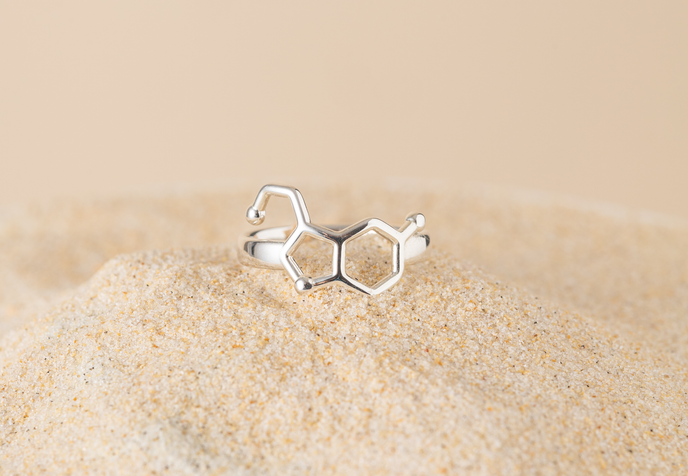

Find your perfect fit: measure an Existing Ring
Finding out your ring size at home is a simple process and can help you shop for jewelry online with confidence.
Necklace length guide