€ 175


Still questions? Contact us
Orion necklace L | gold vermeil
Orion sits on the celestial equator, which means it is the one constellation visible from almost everywhere on Earth at some point in the year. Three stars in a row mark the belt, four corners frame the figure, and a bright haze beneath the belt is the Orion Nebula: a stellar nursery 1,344 light years away where new stars are still forming.
The Astronomy of Orion
The three belt stars (Alnitak, Alnilam, Mintaka) are visible from both hemispheres and have been used as navigation references and calendar markers across most ancient cultures. The two brightest stars in the figure are very different: Betelgeuse at the upper-left shoulder is a red supergiant in late life, around 700 light years away, swollen to a size that would swallow Mars if it sat where the Sun is. Rigel at the lower-right foot is a hot blue supergiant, around 860 light years away. The Orion Nebula (M42), visible to the unaided eye as a smudge in the sword below the belt, is one of the closest active stellar nurseries to the Solar System and one of the most-studied star-formation regions in modern astrophysics. The constellation has been a fixed reference point for astronomers from Ptolemy onward and remains the brightest, most-recognisable constellation in the northern winter sky.
Who Reaches For This
The audience clusters around astronomy and adjacent fields:
- professional astronomers and astrophysicists
- astronomy educators, planetarium staff, and outreach professionals
- amateur astronomers and astrophotographers
- navigators and sailing instructors who still teach celestial navigation
- classics scholars and mythology enthusiasts working on ancient sky narratives
Buyers tend to fall into two groups: working astronomers and educators who pick the constellation that is part of their daily visual vocabulary, and people whose first telescope view, first field trip, or first dark-sky night was Orion and who want to keep that memory close.
Explore Related Math & Physics Jewelry
- Orion necklace L | sterling silver
- Saturn necklace | gold vermeil
- Ursa Major necklace | gold vermeil
- Math & Physics collection
FAQ
Why does Orion read so strongly across cultures?
Because of its visibility and geometry. Orion sits on the celestial equator, which makes it visible from both hemispheres for part of the year. The three belt stars in a near-perfect line are unusually distinctive (most constellations need imagination to read as a figure, the belt does not). Across ancient Egyptian, Greek, Mesopotamian, Babylonian, Aboriginal Australian, and Mesoamerican traditions, the belt and the surrounding bright stars were independently named and used as markers of season, navigation, or hunting time. The figure is one of the few sky features that almost every literate culture has independently chosen to encode.
What is the difference between the L and S Orion sizes?
Size only. The L is 42 mm, sized to read clearly as a constellation from across a room. The S is the smaller daily-wear version of the same design. Same constellation geometry on both, gold vermeil construction, and chain. Most buyers pick one or the other depending on whether they want the figure to be the centerpiece of the look or a quieter signal.
What is the size, material, and chain?
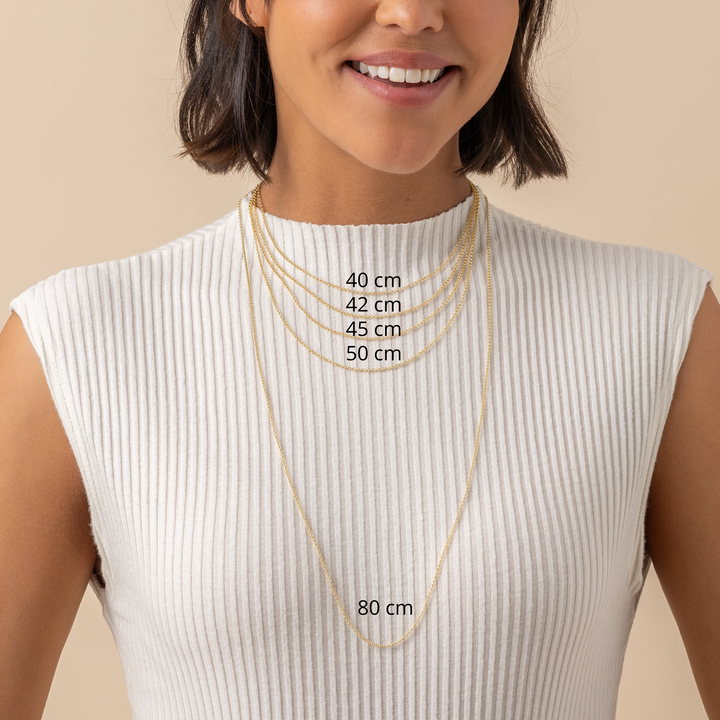
42 mm pendant (L size) in 18K gold vermeil (sterling silver core with 2.5 micron gold plating), nickel-free and hypoallergenic. 45 cm gold vermeil chain with a 5 cm extender. Ships free worldwide via DHL Express in 1-5 business days, with all import duties prepaid. Comes in a ready-to-gift jewelry box with the 30-day “Love It or Return It” policy.
What kind of gift does this tend to be?
A field-personal one. The constellation is specific enough that the recipient feels named: "you, the person who knows Orion as something more than a winter sky pattern".

Math & Physics
Unlock the elegance of the abstract with our math and physics-inspired jewelry collection. These carefully crafted pieces mirror the profound equations and natural laws that shape our understanding of the universe. Experience the allure of fractals, the rhythmic beauty of pi, and the celestial wonder of astral formations—each piece serves as a wearable homage to the artistry inherent in scientific inquiry.




Find your perfect fit: measure an Existing Ring
Finding out your ring size at home is a simple process and can help you shop for jewelry online with confidence.
Necklace length guide