€ 265


Still questions? Contact us
Pelvis necklace | gold vermeil
A pelvis necklace in gold vermeil for the women whose work centres on the pelvis: midwives, pelvic health physiotherapists, obstetricians. One midwife who chose the silver version for herself soon had compliments from colleagues and clients. It also suits anyone with a quiet love of anatomy.
Who It's For
- friends graduating together, each with a different anatomy piece
- your wife, as a present
- a colleague in obstetrics or gynaecology
- yourself, if gold is what you already wear
Donna M., from a review of the silver version: “This is a gift for a friend who specializes in Women’s Pelvic Health. She is going to love it!” Arlene C., on the silver version: “I had my eye on this piece for a while and finally gifted it to myself.”
The Anatomy of the Pelvis
The pelvis is a ring of bone: the sacrum at the back and a hip bone on each side, which meet at the front at the pubic symphysis. Each hip bone starts as three separate bones, the ilium, ischium and pubis. They meet in the hip socket, the acetabulum, at a Y-shaped plate of cartilage that turns to bone in the teens, usually around 13 to 14 in girls and 15 to 16 in boys. Only then are the three bones fused into one. Weight passes from the spine through the sacrum and the sacroiliac joints into each hip bone, and on to the legs.
Explore Related Anatomy Jewelry
- pelvis necklace | silver
- uterus necklace H | gold vermeil
- spine necklace | gold vermeil
- rib cage necklace | gold vermeil
FAQ
How big is the pendant, and how does it sit?
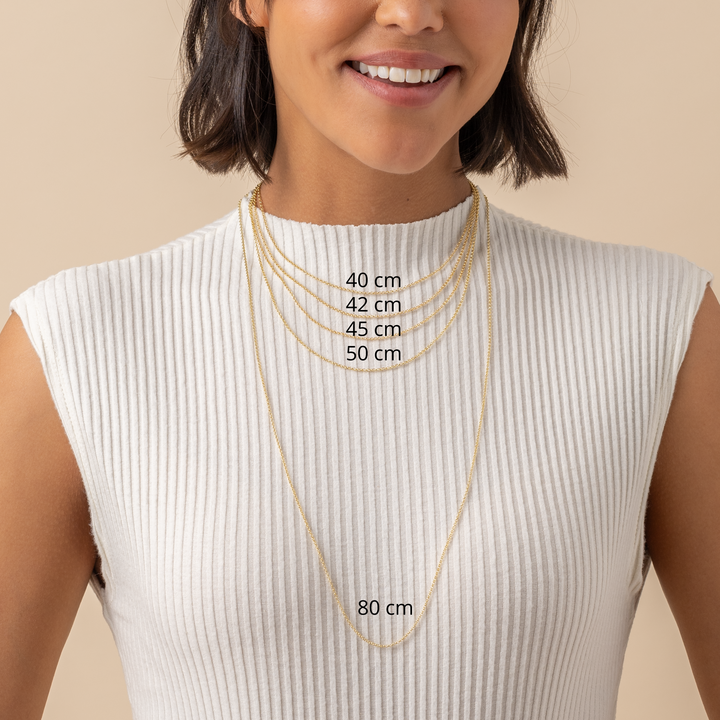
The pendant measures 27 mm (about 1.1 inches), slightly larger than a 2-euro coin (25.75 mm). It hangs below the collarbone on a 45 cm (17.7 inch) gold vermeil chain with a lobster clasp and a 5 cm (2 inch) extender. Extra chains of 40, 42, 45 or 50 cm with extender, or 80 cm, are sold on this page. It is 2.5 microns of 18K gold over solid sterling silver, nickel-free and hypoallergenic.
Is there a silver version?
Yes. The same 27 mm pelvis necklace comes in sterling silver. Choose the finish she already wears. The design is the same in both, and each comes on a 45 cm chain with a 5 cm extender in the matching metal.
Will it arrive in time, and what if it isn't right?
It ships free worldwide with DHL Express and arrives in 1-5 business days. We pay the import duties and taxes, so there is nothing to pay on delivery. It comes in a ready-to-gift jewelry box and festive envelope. If it isn't right, our 30-day “Love It or Return It” policy applies.
Is the narrow human pelvis why babies are born so helpless?
That was the classic answer. In 1960 the anthropologist Sherwood Washburn described an obstetrical dilemma: walking upright narrowed the birth canal while brains grew larger, so babies had to be born at an earlier stage of development. In 2012 the anthropologist Holly Dunsworth and colleagues challenged it in PNAS. They argued that the mother's energy limits, more than the width of the pelvis, set the length of pregnancy, and found little evidence that the pelvis has changed the timing of birth.

Human Anatomy
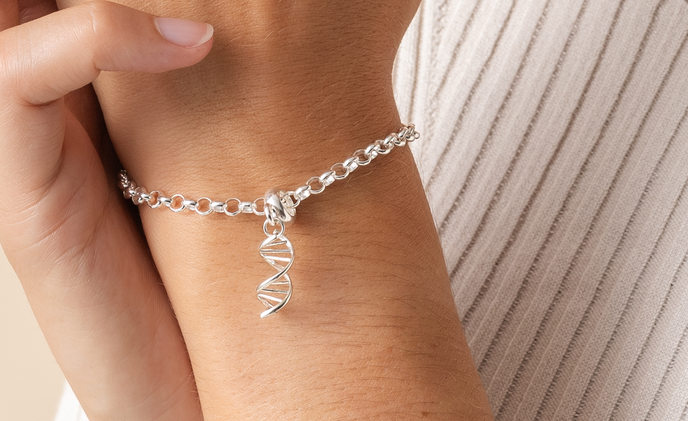
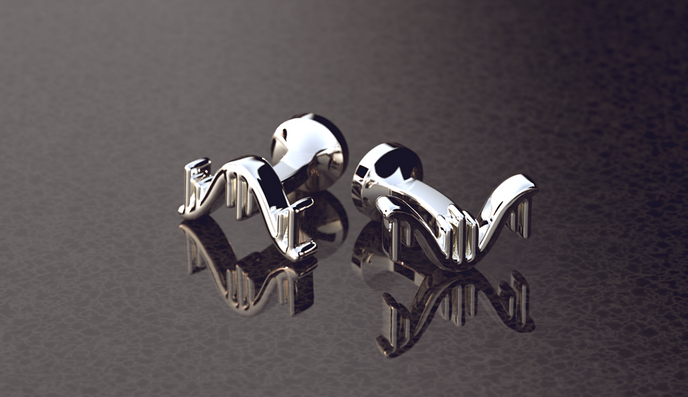
Anatomical wonders have never been so elegantly articulated. Our anatomical collection embodies the intricate and awe-inspiring structures that make us who we are. From DNA double helices to neuronal networks, our pieces don't merely imitate—they interpret. The collection serves as a tangible tribute to the hidden beauty within us all, elevating the realms of biology and medicine into wearable art. With exquisite attention to detail, each piece is a dialogue between form and function, revealing the enigmatic eloquence of the human body.
Find your perfect fit: measure an Existing Ring
Finding out your ring size at home is a simple process and can help you shop for jewelry online with confidence.
Necklace length guide