€ 175


Still questions? Contact us
Pi necklace | 18K gold vermeil
There is a small set of mathematical constants that earn a place on a graduation card or a tenured colleague's leaving gift. Pi is the most universally recognised of them. The gold version of the 14 mm pendant is meant for those moments: a thesis defended, a chair offered, a long career in the mathematical sciences marked.
The Science Behind Pi
Pi has been approximated since ancient Babylon around 1900 BC and ancient Egypt around 1650 BC. Archimedes of Syracuse gave the first rigorous bounds in roughly 250 BC, using polygons with 96 sides inscribed and circumscribed around a circle. The symbol π was introduced by Welsh mathematician William Jones in 1706 and popularised by Leonhard Euler. Johann Heinrich Lambert proved pi irrational in 1761. Ferdinand von Lindemann proved it transcendental in 1882, which also proved that squaring the circle by compass and straightedge is impossible. Pi appears in Euler's identity, in Gaussian integrals, in Heisenberg's uncertainty principle, and in the volume formula for spheres of any dimension.
The Audience
- mathematicians and mathematics educators marking a milestone
- physicists, statisticians, and engineers
- graduates of mathematics, physics, or engineering programmes
- partners and family of working mathematicians looking for a meaningful gold gift
Explore Related Math and Physics Jewelry
- Pi necklace | silver
- Phi necklace | gold vermeil
- Golden ratio necklace | gold vermeil
- Integral necklace | gold vermeil
- E=mc² necklace | gold vermeil
FAQ
Gold or silver?
Same 14 mm pendant, same chain length, same symbol, also in sterling silver. Choose the finish the recipient already wears. Both versions carry the same design and the same meaning.
Why does pi turn up in so many places that have nothing to do with circles?
Because anywhere a problem can be set up in terms of rotations, oscillations, or distributions of randomness, pi shows up in the answer. The normal distribution, the Gaussian integral, Heisenberg's uncertainty principle, and the volume formula for an n-dimensional ball all contain pi. The constant generalises beyond geometry once the underlying structure becomes apparent.
What size is the pendant and how is it shipped?
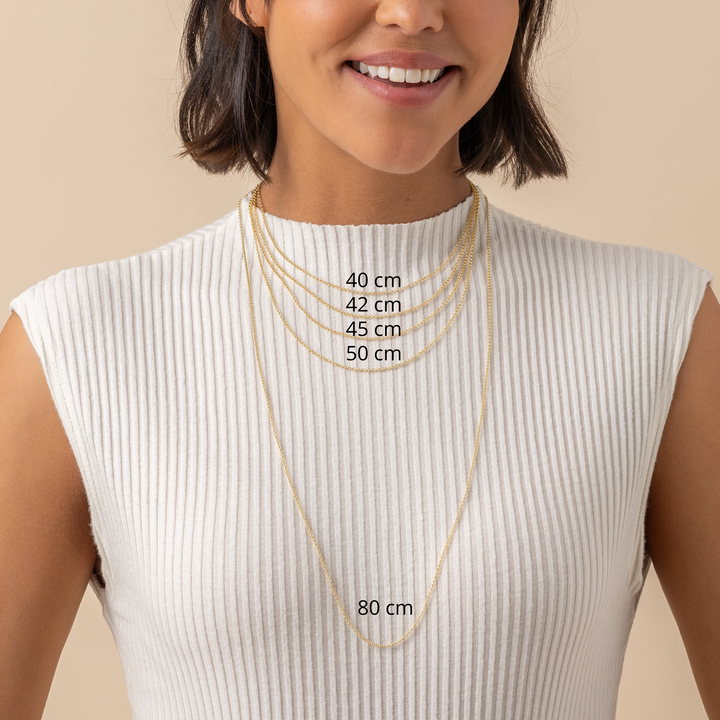
18K gold vermeil over a sterling silver core, 14 mm pendant on a 45 cm gold vermeil chain with a 5 cm extender. Nickel-free and hypoallergenic. Free worldwide DHL Express in 1-5 business days, with all import duties and taxes covered. 30-day “Love It or Return It” returns.
Is there a silver version?
Yes. The same 14 mm pi pendant comes in sterling silver at the same chain length.
Math & Physics
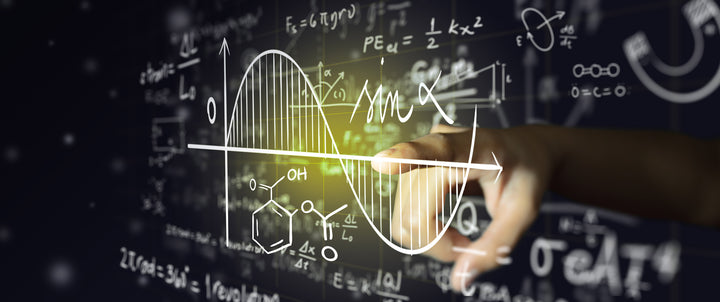
Unlock the elegance of the abstract with our math and physics-inspired jewelry collection. These carefully crafted pieces mirror the profound equations and natural laws that shape our understanding of the universe. Experience the allure of fractals, the rhythmic beauty of pi, and the celestial wonder of astral formations—each piece serves as a wearable homage to the artistry inherent in scientific inquiry.
Find your perfect fit: measure an Existing Ring
Finding out your ring size at home is a simple process and can help you shop for jewelry online with confidence.
Necklace length guide