€ 145


Still questions? Contact us
Ursa minor necklace | sterling silver
For most of recorded human history, finding north meant finding Polaris. The star at the tip of Ursa Minor's tail sits within a degree of the celestial pole, and the entire northern night sky appears to rotate around it. Sailors, navigators, hikers, and anyone who has ever needed to know which way they were facing has used this small constellation as the anchor.
The Science of Ursa Minor
Ursa Minor is a small northern constellation of seven main stars in the shape of a smaller, reversed Big Dipper. Its brightest star, Polaris (Alpha Ursae Minoris), currently lies within 0.7 degrees of the north celestial pole, which is why it stays nearly fixed while the rest of the northern sky rotates around it. Polaris is a Cepheid variable supergiant at about 433 light years from Earth and roughly fifty times the diameter of the Sun. The current alignment is not permanent. Earth's rotational axis traces a 26,000-year precessional circle through the sky, which means the pole star changes over time. Polaris will be closest to the celestial pole around the year 2100. After that it will drift away, and Vega will become the nominal pole star around the year 13,700 CE.
Who Will Recognise It
The audience splits into two reasonably distinct groups:
- astronomers, astrophysicists, and amateur observers who know the northern sky
- sailors, hikers, mountaineers, and anyone whose work or play involves celestial navigation
- history-of-science readers who appreciate the longevity of stellar wayfinding
- science teachers and planetarium staff who use Polaris as the gateway to celestial mechanics
- people who find meaning in the idea of a single fixed reference point in a moving sky
Explore Related Astronomy Jewelry
- Ursa major necklace | silver
- Ursa major necklace | gold vermeil
- Cassiopeia necklace | silver
- Orion necklace L | silver
FAQ
Is this for a sailor or for an astronomer?
Either, in practice. Polaris is the working anchor for celestial navigation, so anyone who has used the night sky to find north (sailors, traditional navigators, long-distance backcountry hikers) tends to find the piece resonant. Astronomers and amateur observers receive it as a constellation piece in its own right, with the small bonus of pointing to the pole. Astrophysicists tend to be a fraction more interested in the precessional story than in the celestial-pole alignment itself.
Will Polaris always be the North Star?
No. Earth's rotational axis traces a 26,000-year precessional circle through the sky, which means the celestial pole moves slowly across the constellations. Polaris is closest to the pole right now (within about 0.7 degrees, reaching its minimum around the year 2100). Before Polaris took the role, Thuban in Draco was the pole star around 2700 BCE, when the Egyptian pyramids were being built. After Polaris drifts away, the pole will pass near Errai in Cepheus around the year 4000, then near Alderamin around 7500, and Vega will become the pole star around 13,700.
What's the size, material, and chain?
30 mm pendant in 925 sterling silver, nickel-free. 45 cm sterling silver chain with a 5 cm extender. Ships free worldwide via DHL Express in 1-5 business days, with all import duties prepaid. Comes in a ready-to-gift jewelry box with the 30-day “Love It or Return It” policy.
Is there a gold version?
Not currently. Ursa Minor is silver only. The catalog has gold versions of Ursa Major and several other constellation pieces, but the Little Bear is single-material for now.

Math & Physics
Unlock the elegance of the abstract with our math and physics-inspired jewelry collection. These carefully crafted pieces mirror the profound equations and natural laws that shape our understanding of the universe. Experience the allure of fractals, the rhythmic beauty of pi, and the celestial wonder of astral formations—each piece serves as a wearable homage to the artistry inherent in scientific inquiry.
Find your perfect fit: measure an Existing Ring
Finding out your ring size at home is a simple process and can help you shop for jewelry online with confidence.
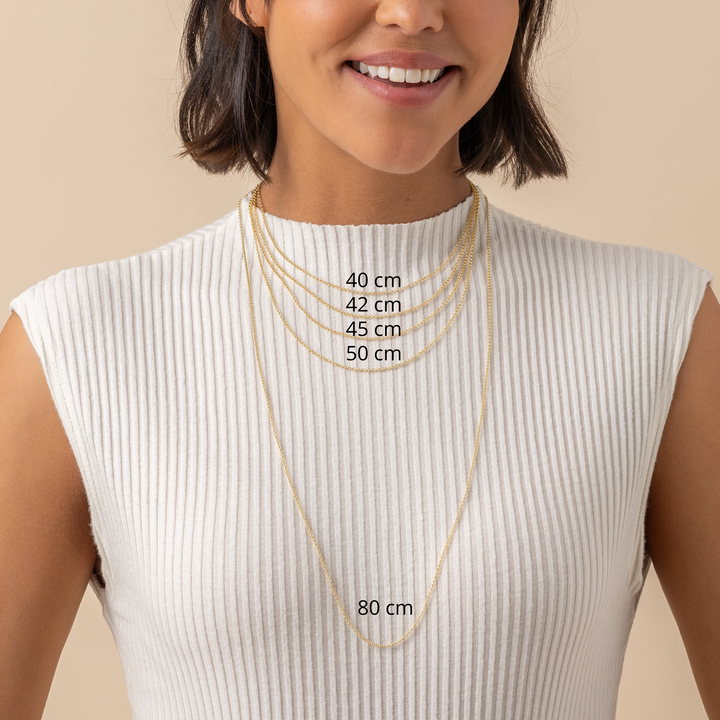
Necklace length guide