


Picking jewelry for a doctor is rarely about jewelry. It's about which part of the body they spent ten years learning. The cardiologist who can name every coronary artery wants something different from the neurologist who reads cerebellums for a living. Each specialty carries its own anatomy and its own sense of what counts as meaningful.
The pieces that work for doctors aren't generic medical-themed gifts. They're specific. A neuron pendant for the neurologist. An anatomical heart for the cardiologist. A uterus for the OB-GYN. Worn small, often, by people who recognize what they're looking at.
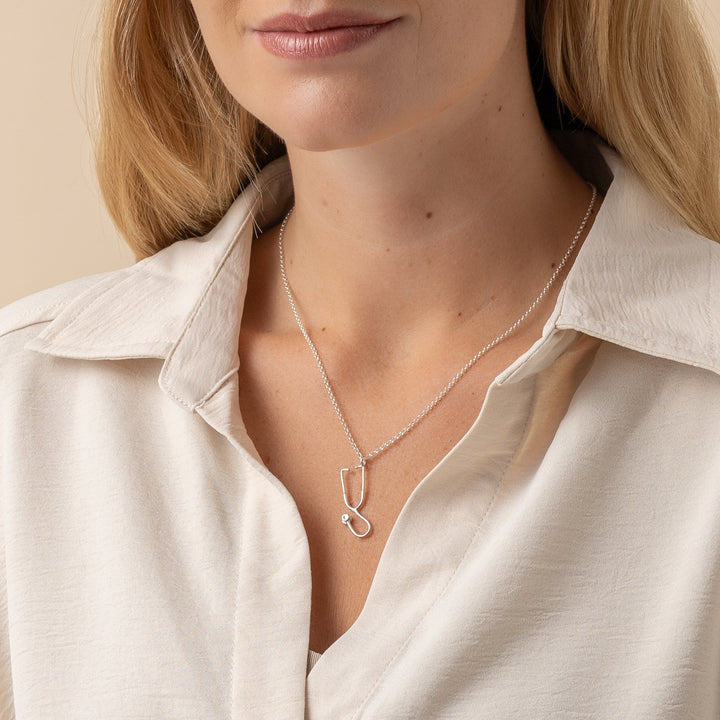
If you already know the specialty, jump to the section below. If you don't, the stethoscope necklace works as the universal default, and the medical and lab tools collection gathers every other piece in this guide, organized by design rather than profession.
What is the best jewelry for a doctor?
Sterling silver is the safe default for daily wear in clinical settings. Gold vermeil works for occasions: graduation, residency match, board certification. By specialty, the anatomical heart fits cardiology, the neuron fits neurology, the scalpel fits surgery, the uterus fits OB-GYN, the antibody fits immunology and oncology. The stethoscope is the universal doctor piece when you don't know their specialty or when they've moved between fields.
Specialty-specific designs land harder than generic medical symbols if you know what they trained in. Most doctors already own the obvious gifts. Few own a piece that names their specialty exactly.
Why doctors wear specialty pieces
Medical jewelry breaks an unwritten rule that says professional identity stops at the white coat. The pieces that work aren't tributes to the profession in general. They're a specific molecule, a specific cell, a specific bone, made small enough to be worn under a collar and read only by people in the field. That's the appeal. It's a private signal, not a uniform.
We see this often. Cardiologists buy anatomical hearts for themselves. PhD students give neurons to their supervisors. Residents get scalpel pendants from their cohort the day they finish surgery rotation. The accuracy of the design is the gift.
Specialty matched to design
| Specialty | Recommended design | Why it fits |
|---|---|---|
| Cardiology | Anatomical heart | The literal organ they spend a career studying. |
| Neurology / Psychiatry | Neuron, or single-molecule pendants | The cell type the field is built on, or the molecules the pharmacology runs on. |
| Surgery | Scalpel | The instrument that defines the work. |
| Orthopedics | Femur, vertebra, spine | Bones they handle daily. |
| OB-GYN, Fertility | Uterus, blastocyst, fetus | Anatomy and stages that define obstetrics. |
| Hematology, Oncology, Immunology | Antibody, red blood cells, mitosis | Cells they spend the day analyzing. |
| Pulmonology | Alveolus | The single functional unit of gas exchange. |
| General medicine | Stethoscope | The universal symbol every doctor recognizes. |
What is the best jewelry gift for a doctor in general practice?
The stethoscope is the most legible piece in the medical jewelry catalog. It reads instantly across specialties, which makes it the right answer when you don't know what they trained in or when the recipient has moved between fields. It works for a freshly minted intern, a senior consultant, a GP, a pediatrician.
The pendant sits small, discreet under a collar, hangs flat. In sterling silver it disappears into a clinical setting. In gold vermeil it carries a clear signal that this was meant for an occasion.
Other broad-medicine options that read across specialties: the rod of Asclepius for those who lean classical, the caduceus for international audiences and US military medicine, and the awareness ribbon for those whose work tracks one cause.

Shop the stethoscope necklace →
What is a thoughtful gift for a cardiologist?
For cardiology, the anatomical heart is the obvious answer and the right one. It's the literal organ they spend a career studying: coronary arteries, chambers, the geometry that no Valentine's heart ever respects. Worn small on a slim chain, it lands sharper than any tribute card.
We've gone deep on the cardiology family in our anatomical heart guide, which covers the heart section, aorta, heartbeat, and the cardiac conduction system. For a quick pick: anatomical heart in sterling silver for daily wear, gold vermeil for graduation.
The heartbeat necklace works as a discreet alternative, recognizable to medical readers and more abstract to everyone else. Heartbeat studs and rings exist for those who want something even smaller.

Shop the anatomical heart necklace →
What jewelry works for a neurologist or psychiatrist?
The neuron is the foundational unit of every neurology textbook ever written, and the design that lands hardest in our medical line. It works for a clinical neurologist, a neurosurgeon, a researcher, or a psychiatrist whose mental model still runs on synapses.
The Purkinje cell is the variant for cerebellum specialists. Spindle neurons fit those drawn to higher-order cortex. The astrocyte and DRG neuron pendants extend the line for cell-type specificity.
For psychiatry, single-molecule pendants like serotonin, dopamine, GABA, and the dopamine-serotonin combo translate the pharmacology into something quietly worn. A psychiatrist wearing serotonin in silver isn't advertising. It's a private signal that gets recognized maybe once a year by someone who notices. We've written more about the neuroscience family in our neuroscience jewelry guide.

Which design suits a surgeon?
Surgery splits two ways. For general and visceral surgery, the scalpel is the instrument that defines the work, visible at every operation from a registrar's first appendectomy to the Whipple at the end of a long career. The pendant is sharp, narrow, sits flat.
For orthopedics the answer shifts to bones: the femur, the vertebra, the spine, what they actually handle on the table. Hand and foot anatomy pieces fit hand surgeons specifically. The skull family rounds it out for craniofacial and neurosurgery overlap.
Across the surgical specialties, sterling silver is the working choice. Gold vermeil reads as a graduation or fellowship marker rather than a daily piece. For residents finishing surgery rotation, the scalpel earrings or femur ring exist as smaller-format alternatives.

What is a meaningful gift for an OB-GYN or fertility specialist?
For OB-GYN, the uterus pendant is the answer, plain. Worn horizontally on a fine chain (the H orientation, our default for this design), it reads anatomically rather than decoratively, which is the whole point.
The blastocyst, the fetus, and the twin fetus extend the same logic for clinicians whose practice centers on early pregnancy and IVF. The egg and sperm pendant is the entry-level fertility piece, often picked by patients themselves rather than gifted to clinicians.
We've written a separate guide on fertility journey jewelry for the patient and family side of this conversation. For endocrinology and reproductive health, the estrogen molecule pendant is a quieter alternative. The XX-chromosomes ring works as a women-in-medicine piece beyond reproductive specialties.

What is a strong gift for a hematologist, oncologist, or immunologist?
Hematology, oncology, and immunology share a vocabulary built on cells. The antibody pendant is the most recognized of the lot, Y-shaped, instantly readable to anyone who has trained in the field, abstract enough to slip into clinical settings.
Red blood cells suit hematology more directly. The lymphocyte, monocyte, neutrophil, eosinophil, and macrophage pendants fit immunology and the diagnostic side of hematology. For oncology specifically, the mitosis pendant is a literal moment of cell division frozen in silver, which lands hard if the recipient spent years studying it.
Doxorubicin and arsenic trioxide pendants exist as more clinical statements for those whose research or practice is built around specific compounds. Sterling silver works well for daily wear. Gold vermeil suits a board certification or a milestone in a long research program.

What jewelry suits a pulmonologist?
For pulmonology the alveolus is the natural pick, the single functional unit of gas exchange, the design every chest physician recognizes. The pendant sits small and detailed, a cluster of grape-shaped structures rendered in sterling silver.
The lungs pendant works for those who prefer the larger anatomical view, and reads as a clearer entry point for non-specialist viewers. The alveolus cufflinks are the formal-event option for clinicians who attend conferences, graduations, or end-of-residency dinners in suit and tie.
The hemoglobin necklace bridges to hematology if the recipient sits at the intersection of the two fields. For respiratory therapists and ICU clinicians whose work overlaps with pulmonology, both alveolus and lungs read accurately.

How to choose
Some recipient-by-recipient guidance for narrowing it down:
- Newly graduated doctor: stethoscope in gold vermeil, or the specialty piece they've matched into.
- Senior consultant: the specialty piece in sterling silver for daily wear, gold vermeil reserved for the occasion.
- Female doctor: the same pendants on a slim 40-45 cm chain. Most pieces in the medical line scale down for daily wear under a coat or scrub top. Studs and rings exist for those who prefer to skip a chain entirely.
- Researcher rather than clinician: the molecular and cellular pieces tend to land harder than the iconic symbols. Antibody, mitosis, doxorubicin, neuron.
- Doctor moving between fields: stethoscope, rod of Asclepius, or caduceus. They stay accurate across specialties.
- Conference or formal event: cufflinks (alveolus, brain) or studs (heartbeat, brain, antibody, neuron).
- Long-distance gift: all orders ship via DHL Express with import duties included. Standard delivery is 1 to 5 business days.
For the broader doctor and nurse audience, our nurse and doctor gift guide covers gifts that work across the full healthcare team.
Custom designs
If the specialty isn't covered in the catalog, custom is open. We've made one-off pieces for ophthalmology subspecialties, niche surgical instruments, and individual molecules from a researcher's own work. Standard turnaround is roughly five to seven weeks from brief to delivery, in sterling silver or 18K gold vermeil. Send a brief through our contact page with the structure or instrument you have in mind.
Frequently asked questions
What is the best jewelry for a doctor?
Sterling silver is the safe default for daily wear in clinical settings. Gold vermeil works for occasions: graduation, residency match, board certification. By specialty, the anatomical heart fits cardiology, the neuron fits neurology, the scalpel fits surgery, the uterus fits OB-GYN, the antibody fits immunology and oncology. The stethoscope is the universal doctor piece when you don't know their specialty.
What is a thoughtful gift for a cardiologist?
The anatomical heart necklace. It's the literal organ they spend a career studying, rendered with the right anatomy rather than a Valentine's-card shape. Sterling silver works for daily wear, gold vermeil for graduation or a major milestone. For cardiologists who already own the heart, the heartbeat necklace, aorta pendant, or cardiac conduction system pendant extend the same theme.
What jewelry works for a neurologist or psychiatrist?
The neuron necklace works across both. For neurologists with a cerebellum focus, the Purkinje cell pendant is more specific. Psychiatrists tend to prefer single-molecule pendants like serotonin, dopamine, or the dopamine-serotonin combo, which read as quiet professional signals rather than overt tributes.
Which jewelry suits a surgeon?
For general and visceral surgery, the scalpel necklace is the instrument that defines the work. For orthopedics the answer shifts to bones: femur, vertebra, or spine pendants. Hand and foot anatomy pieces fit hand surgeons. The skull family covers craniofacial overlap and neurosurgery.
What is a meaningful gift for an OB-GYN or fertility specialist?
The uterus necklace, worn horizontally on a fine chain. The blastocyst, fetus, and twin fetus pendants extend the same anatomical logic for clinicians whose practice centers on early pregnancy and IVF. For the patient side of fertility, our IVF jewelry guide covers a separate audience.
Or start from our curated gifts for doctors edit.
All our jewelry is 3D printed in sterling silver or 18K gold vermeil, nickel-free and hypoallergenic. Every order ships worldwide via DHL Express (1-5 business days), and all import taxes and duties are included. No surprise fees at your door.
Member of the Science Club? Don't forget to use your loyalty points at checkout.
Browse the full medical and lab tools collection.