
€ 145


Still questions? Contact us
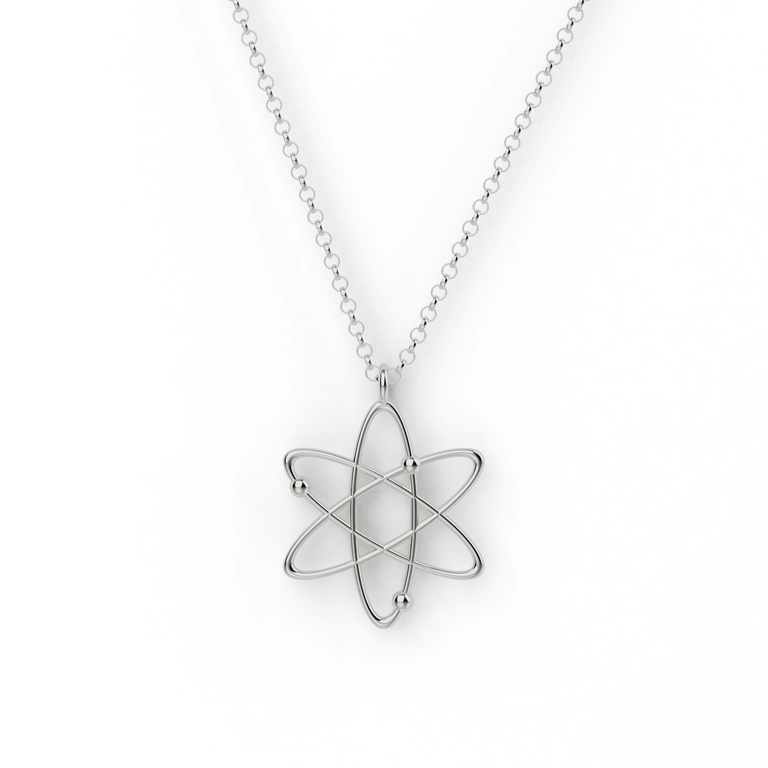
Atom necklace | sterling silver
The atom is the most universally recognised symbol in science. It crosses disciplines, languages, and decades without ever needing translation. A nucleus with electrons looping around it: shorthand for chemistry, physics, biology, and most of what gets taught in any science classroom on Earth. Worn here as a 25 mm flat sterling silver pendant.
The Science Behind the Atom
The modern atomic model was built through a series of experiments that overturned what physicists thought they knew. Ernest Rutherford's 1911 gold foil experiment fired alpha particles at gold and observed that some bounced straight back, revealing the nucleus: a tiny, dense, positive core surrounded by mostly empty space. Niels Bohr refined this in 1913 by proposing that electrons orbit in discrete energy levels, which explained the hydrogen emission spectrum for the first time. Quantum mechanics later replaced the Bohr orbit picture with probability clouds. The Rutherford-Bohr atom remains the most recognisable scientific image in the world.
A Quiet Symbol For
- physicists, chemists, and materials scientists at any career stage
- science teachers and science communicators
- students entering university in any science field
- anyone who identifies with science as a way of seeing the world
About a third of orders ship to working scientists or science educators. The rest go to gift-givers picking the safest science piece for someone who works across the field.
Explore Related Math and Physics Jewelry
- Atom necklace | gold vermeil
- Atom necklace 3D | silver
- Atom necklace 3D | gold vermeil
- E=mc² necklace | silver
- Fz3 atomic orbital necklace | silver
FAQ
Why pick the flat atom over the 3D version?
The flat version is the schematic atom, the form most people picture when they hear the word. It is minimal, sits cleanly on the chest, and reads instantly to anyone in or near the sciences. The 3D version is more sculptural and shows the spatial geometry of nucleus and orbits. Both are biologically and physically valid representations of the same Rutherford-Bohr model. The flat is the daily-wear pick. The 3D is the statement piece.
Is the flat atom a literal quantum-mechanics depiction?
No, and that is the point. Real atoms have probability clouds rather than fixed orbits. The Rutherford-Bohr atom is a simplified classical model that turned out to be useful for spectroscopy and intuition even after quantum mechanics displaced it as the rigorous picture. The pendant carries the symbol, not the modern wave-equation reality.
What size is the pendant and what is the return policy?
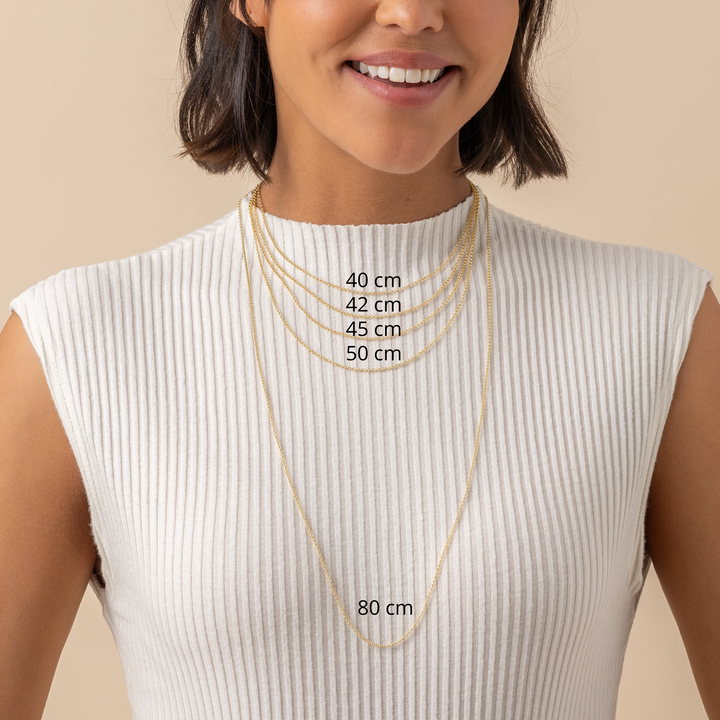
925 sterling silver, 25 mm pendant on a 45 cm sterling silver chain with a 5 cm extender. Nickel-free and hypoallergenic. Free worldwide DHL Express in 1-5 business days, with all import duties and taxes covered. 30-day “Love It or Return It” returns.
Is there a gold version, or a 3D version?
Both. The same 25 mm flat atom pendant is available in 18K gold vermeil at the same chain length. A 3D atom is also available in sterling silver and in gold vermeil for buyers who prefer the spatial form over the flat schematic.
Math & Physics
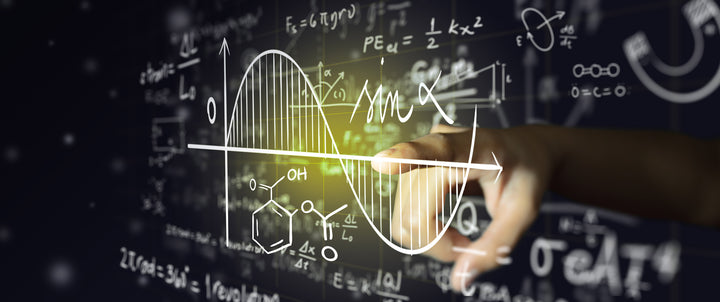
Unlock the elegance of the abstract with our math and physics-inspired jewelry collection. These carefully crafted pieces mirror the profound equations and natural laws that shape our understanding of the universe. Experience the allure of fractals, the rhythmic beauty of pi, and the celestial wonder of astral formations—each piece serves as a wearable homage to the artistry inherent in scientific inquiry.
Find your perfect fit: measure an Existing Ring
Finding out your ring size at home is a simple process and can help you shop for jewelry online with confidence.
Necklace length guide