€ 180


Still questions? Contact us
Diamond crystal structure necklace | sterling silver
If you teach crystallography or have memorised the tetrahedral bonding patterns of carbon, you know that diamond and graphite are both pure carbon. Same element, opposite properties. Diamond's hardness comes entirely from how the atoms are arranged in three-dimensional space, not from anything special about the atoms themselves.
The Science Behind Diamond
Diamond is pure carbon with every atom sp3-hybridised and bonded tetrahedrally to four neighbours in an infinite covalent network. This geometry creates a material with no weak planes, no delocalized electrons to conduct electricity, and a thermal conductivity that exceeds copper. The result is the hardest natural mineral known. Graphite is carbon atoms bonded in flat sheets with weak van der Waals interactions between layers, soft enough to write with. Diamond forms at depths of 150-200 kilometres under pressures of 4-6 GPa and temperatures exceeding 1000°C. Synthetic diamonds made by HPHT (high-pressure high-temperature) or CVD (chemical vapour deposition) are chemically identical to natural diamonds. The distinction is now economically irrelevant. The chemistry and structure are the point.
The Audience
- materials scientists and condensed matter physicists
- chemistry students who have worked through crystal structures
- geologists and mineralogists who understand allotropic forms
- anyone fascinated by how atoms arranging differently makes everything different
Explore Related Molecules Jewelry
- Graphite necklace | silver
- Caffeine necklace | silver
- Glucose necklace | silver
- DNA necklace H | silver
FAQ
Is this a real diamond?
No. This is the crystal structure of diamond rendered in sterling silver. It shows the tetrahedral arrangement of carbon atoms that makes diamond hard and thermally conductive. The structure is what matters. You wear the geometry, not the gem.
Why does the tetrahedral bonding pattern make diamond so hard?
Because there are no slip planes. Every carbon atom is bonded to four others in a rigid, three-dimensional lattice. There is nowhere for atoms to shift without breaking strong covalent bonds. This complete mechanical lock is why diamond scores 10 on the Mohs hardness scale. Nothing scratches it except another diamond.
What is the size, material, and chain?
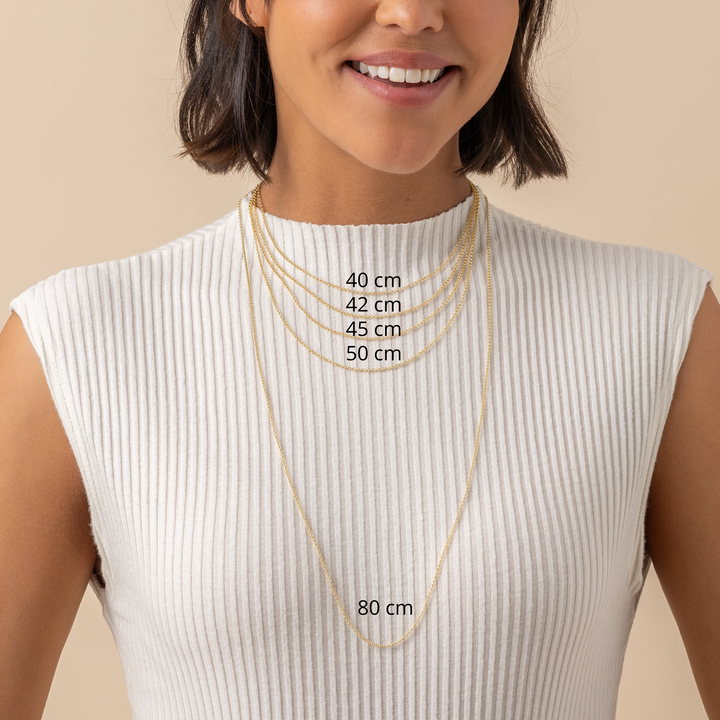
27 mm pendant in 925 polished sterling silver, nickel-free and hypoallergenic. 45 cm sterling silver chain with 5 cm extender. Ships free worldwide via DHL Express in 1-5 business days. Comes ready-to-gift with the 30-day “Love It or Return It” policy.
What about the graphite allotrope?
Graphite is in the catalog and shows the layered bonding of the same carbon. Same element, opposite properties: graphite is soft and conductive, diamond is hard and insulating.
Math & Physics
Unlock the elegance of the abstract with our math and physics-inspired jewelry collection. These carefully crafted pieces mirror the profound equations and natural laws that shape our understanding of the universe. Experience the allure of fractals, the rhythmic beauty of pi, and the celestial wonder of astral formations—each piece serves as a wearable homage to the artistry inherent in scientific inquiry.
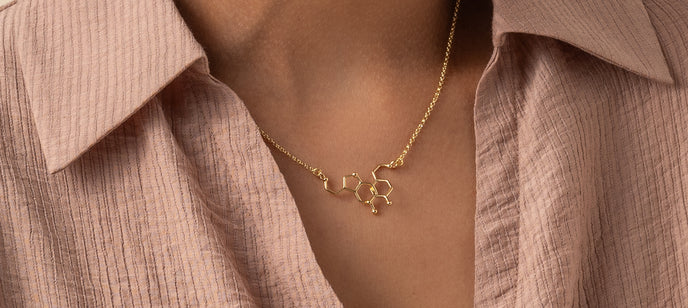
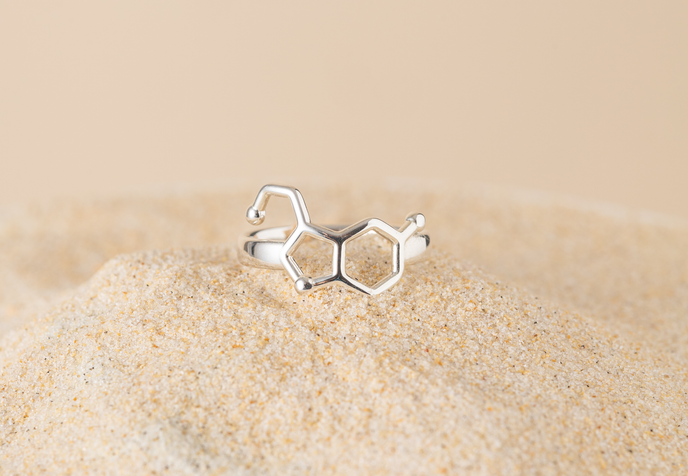
Find your perfect fit: measure an Existing Ring
Finding out your ring size at home is a simple process and can help you shop for jewelry online with confidence.
Necklace length guide