€ 215


Still questions? Contact us
Diamond crystal structure necklace | 18K gold vermeil
If you have spent enough time on solid-state physics to draw the diamond cubic lattice without thinking, this is the same geometry, in 27 mm of 18K gold vermeil. Carbon atoms bonded tetrahedrally in an infinite covalent network, the arrangement that makes diamond the hardest natural mineral and that silicon and germanium share, one row down.
The Science Behind the Diamond Lattice
The diamond cubic structure is a face-centred cubic lattice with a two-atom basis. Each conventional cubic unit cell contains eight carbon atoms, with a lattice parameter of 3.567 Å and a carbon-carbon bond length of 1.54 Å, identical to the C-C single bond in organic chemistry. The same structure is shared by silicon and germanium, the next two elements down Group 14, which is why diamond cubic is one of the most heavily studied unit cells in solid-state physics. The same geometry produces an electrical insulator with the largest known band gap (diamond), an indirect-band semiconductor (silicon), and a smaller-band-gap semiconductor (germanium). Atomic size, electronegativity, and orbital overlap shift down the column. The lattice stays the same.
A Quiet Symbol For
- materials scientists and solid-state physicists
- semiconductor engineers and device physicists
- crystallographers and inorganic chemists
- graduate students who have just defended on bandstructure or lattice dynamics
Strong as a milestone in materials science: a graduation, a first chair, or a long-running research programme on covalent solids.
Explore Related Math and Physics Jewelry
- Diamond crystal structure necklace | silver
- Graphite necklace | silver
- Feynman scattering necklace | gold vermeil
- Buckyball necklace | silver
- Atom necklace | gold vermeil
FAQ
Is this a real diamond?
No, and that is the point. The pendant is the geometric structure of diamond, not a diamond stone. What makes diamond hard is not the carbon itself but the arrangement of the bonds. Putting that arrangement in 18K gold vermeil makes the geometry the gift, rather than the gemstone. People who work on materials science tend to find that more interesting than a conventional diamond.
Why does silicon share the same crystal structure as diamond?
Because silicon and carbon both sit in Group 14 of the periodic table, with four valence electrons each. Both prefer tetrahedral covalent bonding to four neighbours. Germanium does the same thing for the same reason. The shared lattice is why undergraduate solid-state courses introduce the diamond cubic structure once and reuse it for the entire Group 14 column. The differences in electronic properties come from atomic size and orbital overlap, not from the lattice itself.
What size is the pendant and what is the return policy?
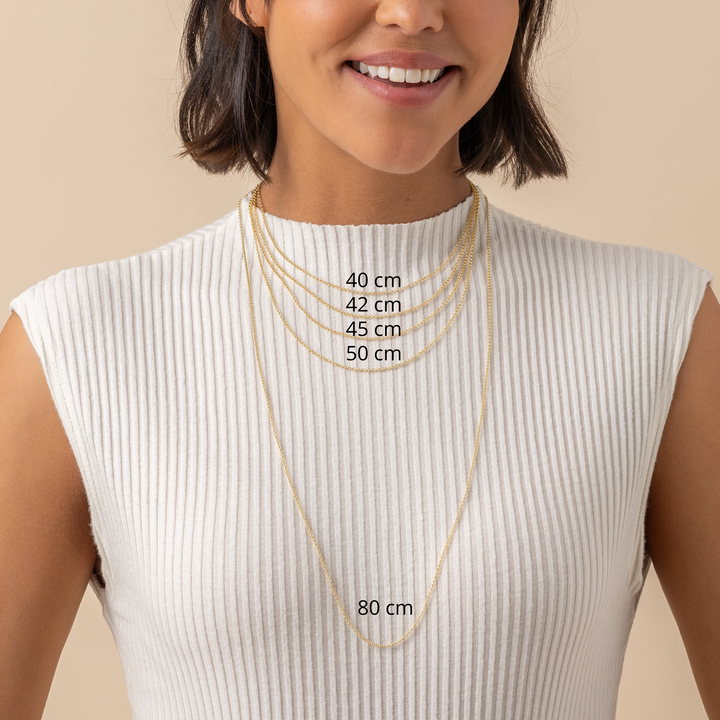
18K gold vermeil over a sterling silver core, 27 mm pendant on an 80 cm gold vermeil chain with lobster clasp. The longer chain sits at sternum height when worn over a sweater or a layer. Nickel-free and hypoallergenic. Free worldwide DHL Express in 1-5 business days, with all import duties and taxes covered. 30-day “Love It or Return It” returns.
Is there a silver version?
Yes. The silver counterpart is the same 27 mm pendant on the same 80 cm chain. Same lattice, same dimensions, different metal.
Math & Physics
Unlock the elegance of the abstract with our math and physics-inspired jewelry collection. These carefully crafted pieces mirror the profound equations and natural laws that shape our understanding of the universe. Experience the allure of fractals, the rhythmic beauty of pi, and the celestial wonder of astral formations—each piece serves as a wearable homage to the artistry inherent in scientific inquiry.
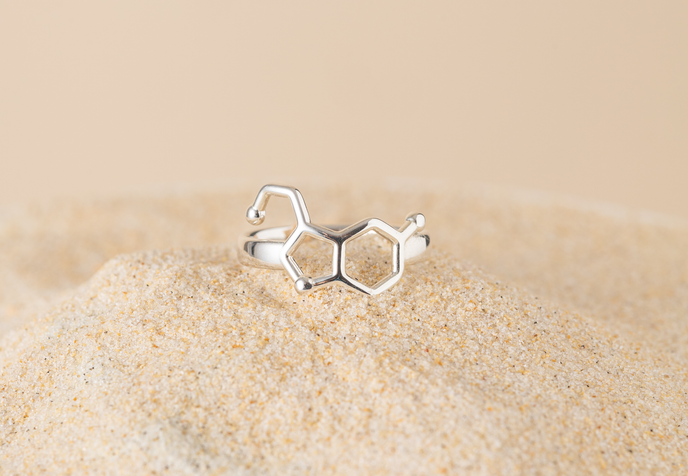
Find your perfect fit: measure an Existing Ring
Finding out your ring size at home is a simple process and can help you shop for jewelry online with confidence.
Necklace length guide