€ 195


Still questions? Contact us
Golden ratio necklace | 18K gold vermeil
The golden ratio in 18K gold vermeil at 33 mm tends to come out for moments where the maths marks something specific: a thesis defended, a chair taken, a first paper accepted. The ratio that turns up across mathematics, plant biology, and design.
The Science Behind the Golden Ratio
The golden ratio φ = (1+√5)/2 ≈ 1.61803 was first formally defined by Euclid around 300 BC: the division of a line where the whole is to the larger part as the larger part is to the smaller. Its connection to the Fibonacci sequence (1, 1, 2, 3, 5, 8, 13, 21) emerges as consecutive Fibonacci numbers grow and their ratio converges on φ. The golden spiral, a logarithmic spiral whose growth factor equals φ, appears in phyllotaxis because it maximises packing density without two seeds ever lying along the same radial line. The mathematical properties are clean: 1/φ = φ−1, and φ² = φ+1. Claims about facial proportion and ancient architecture are more contested than usually presented.
Worn By
- mathematicians marking a graduation, fellowship, or tenure decision
- biologists studying plant morphology or evolutionary biology
- architects and designers with a mathematical background
- partners and family of working mathematicians looking for a meaningful gold gift
Explore Related Math and Physics Jewelry
- Golden ratio necklace | silver
- Golden ratio earring hoops | silver
- Phi necklace | gold vermeil
- Pi necklace | gold vermeil
- Mobius strip necklace | silver
FAQ
Gold or silver?
Same 33 mm pendant, same chain length, same spiral, also in sterling silver. Choose the finish the recipient already wears. Both versions carry the same design and the same meaning.
Is the gold spiral an exact golden spiral, or an approximation?
It is the geometric construction of a golden spiral, drawn from concentric quarter-arcs of squares whose side lengths follow the Fibonacci sequence. The result is a piecewise approximation of the true logarithmic spiral with growth factor φ. The visual effect is the same. The mathematics is honest about the construction.
What size is the pendant and how is it shipped?
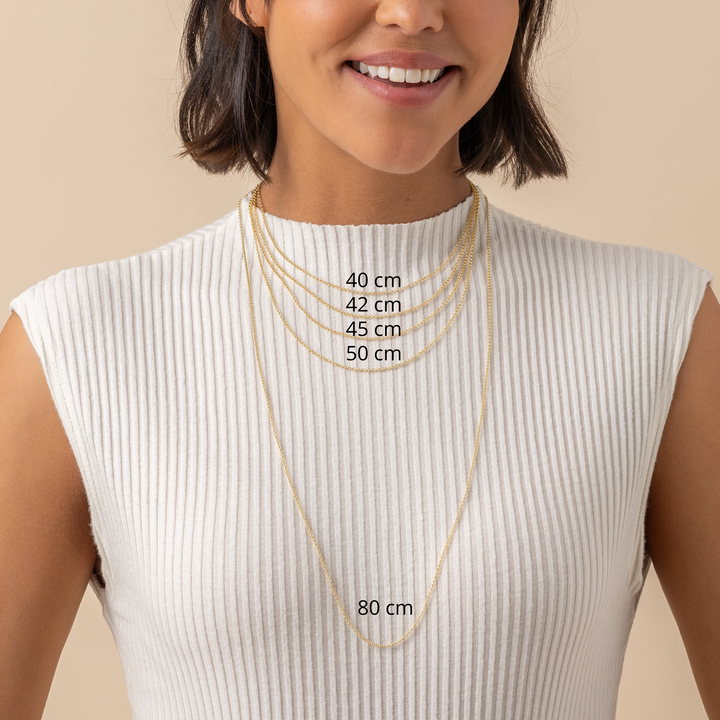
18K gold vermeil over a sterling silver core, 33 mm pendant on a 45 cm gold vermeil chain with a 5 cm extender. Nickel-free and hypoallergenic. Free worldwide DHL Express in 1-5 business days, with all import duties and taxes covered. 30-day “Love It or Return It” returns.
Is there a silver version or matching earrings?
Yes to both. The same 33 mm golden ratio pendant comes in sterling silver at the same chain length. Matching golden ratio earring hoops exist in 18K gold vermeil and in sterling silver.

Math & Physics
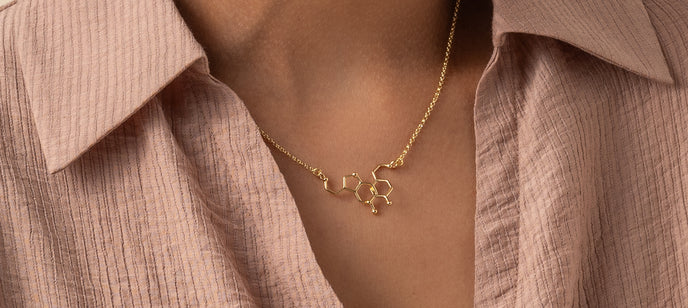
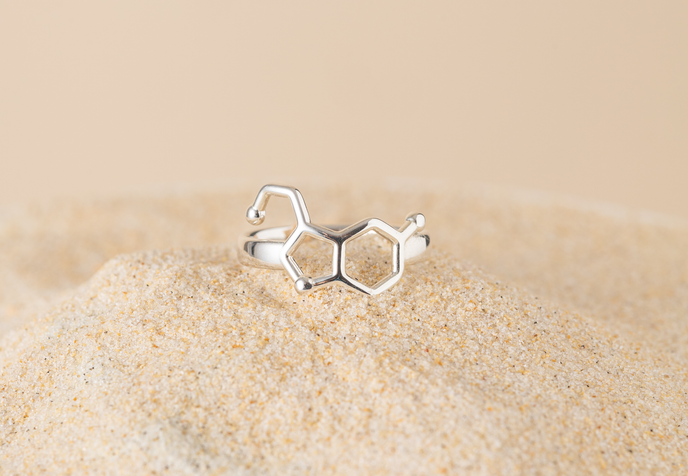
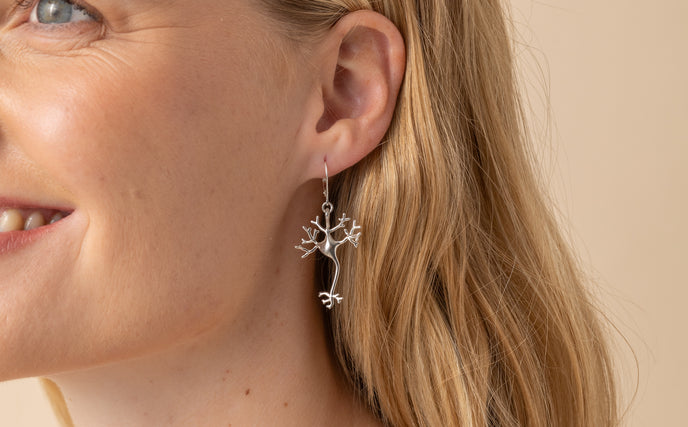
Unlock the elegance of the abstract with our math and physics-inspired jewelry collection. These carefully crafted pieces mirror the profound equations and natural laws that shape our understanding of the universe. Experience the allure of fractals, the rhythmic beauty of pi, and the celestial wonder of astral formations—each piece serves as a wearable homage to the artistry inherent in scientific inquiry.
Find your perfect fit: measure an Existing Ring
Finding out your ring size at home is a simple process and can help you shop for jewelry online with confidence.
Necklace length guide