

€ 145


Still questions? Contact us
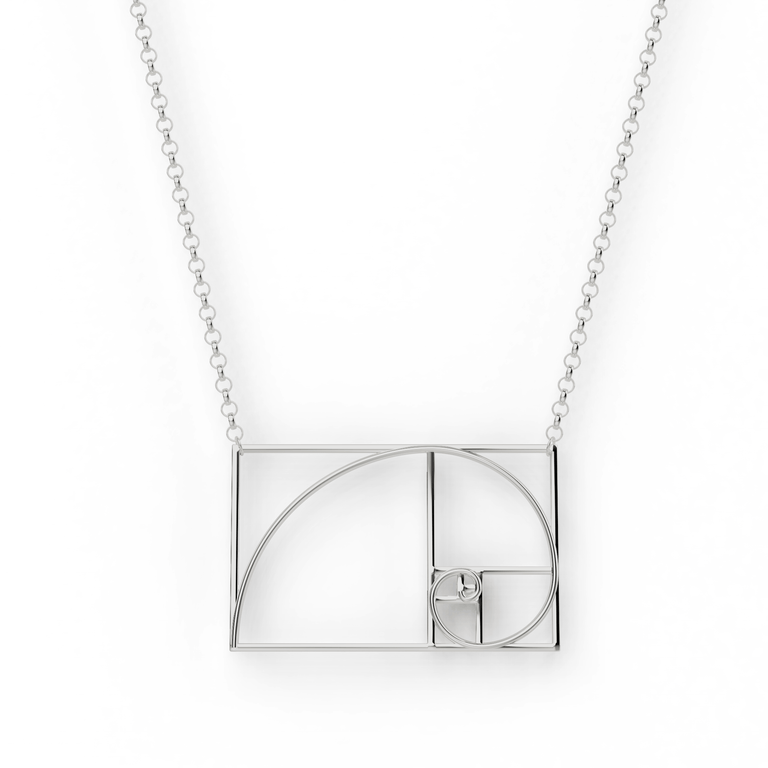
Golden ratio necklace | sterling silver
The constant that turns up where the maths and the biology agree. Sunflower seed spirals, nautilus shells, the branching of trees, the pattern of a pine cone. Not because nature follows a rule but because this particular ratio happens to be optimal for packing growth into limited space. Worn here as a 33 mm sterling silver pendant.
The Science Behind the Golden Ratio
The golden ratio φ = (1+√5)/2 ≈ 1.61803 was first formally defined by Euclid around 300 BC: the division of a line where the whole is to the larger part as the larger part is to the smaller. Its connection to the Fibonacci sequence (1, 1, 2, 3, 5, 8, 13, 21) emerges as consecutive Fibonacci numbers grow and their ratio converges on φ. The golden spiral, a logarithmic spiral whose growth factor equals φ, appears in phyllotaxis because it maximises packing density without two seeds ever lying along the same radial line. The mathematical properties are clean: 1/φ = φ−1, and φ² = φ+1. Claims about facial proportion and ancient architecture are more contested than usually presented.
A Quiet Symbol For
- mathematicians and mathematics educators
- biologists studying plant morphology or phyllotaxis
- architects, designers, and anyone who has read Mario Livio's book on φ
- anyone who finds the Fibonacci sequence quietly thrilling
For the mathematician or biologist who has spotted the golden spiral in a sunflower head and could not stop thinking about it.
Explore Related Math and Physics Jewelry
- Golden ratio necklace | gold vermeil
- Golden ratio earring hoops | silver
- Phi necklace | silver
- Pi necklace | silver
- Mobius strip necklace | silver
FAQ
Is the golden ratio mystical, or is it overclaimed?
Overclaimed in some places, real in others. The mathematical properties are clean: φ is irrational, φ² = φ+1, and Fibonacci ratios converge on it. The biology is also real: phyllotaxis and packing optimisation give the golden spiral a structural reason to appear in plants. The claims about ancient architecture and facial beauty are more contested than usually presented. The pendant carries the mathematics and biology, not the mysticism.
Why does the golden spiral appear in plants?
Because it solves a packing problem. If a plant grows new leaves or seeds at a constant angle around the stem, only the irrational angle 360°/φ² (about 137.5°) avoids two leaves ever lining up along the same radius. Any rational angle eventually creates gaps. Phyllotaxis is not a plant being aesthetic. It is a plant being efficient.
What size is the pendant and what is the return policy?
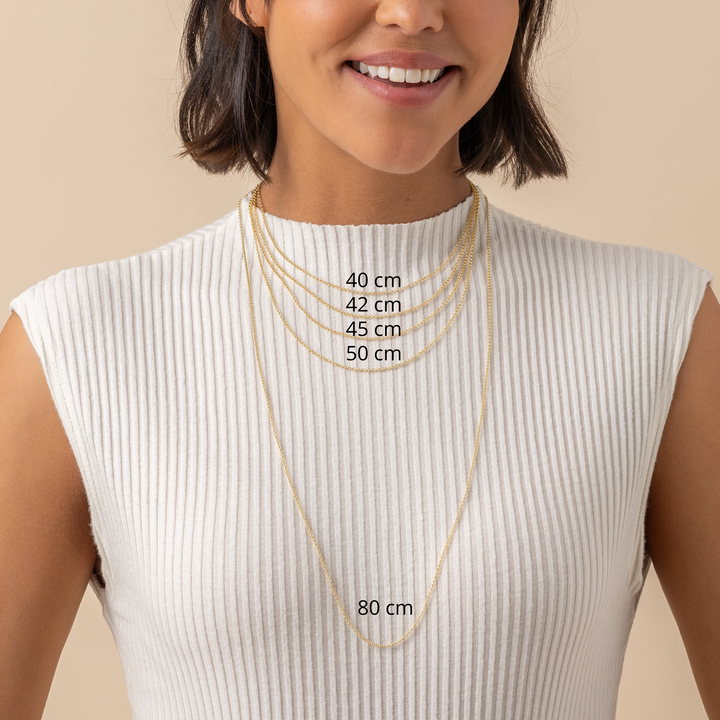
925 sterling silver, 33 mm pendant on a 45 cm sterling silver chain with a 5 cm extender. Nickel-free and hypoallergenic. Free worldwide DHL Express in 1-5 business days, with all import duties and taxes covered. 30-day “Love It or Return It” returns.
Is there a gold version, or matching earrings?
Both. The same 33 mm golden ratio pendant is available in 18K gold vermeil at the same chain length. Matching golden ratio earring hoops exist in sterling silver and in 18K gold vermeil.
Math & Physics
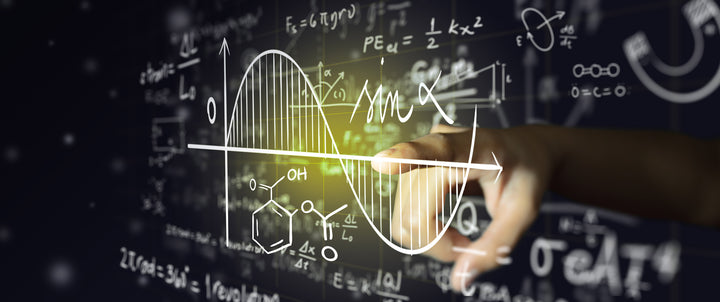
Unlock the elegance of the abstract with our math and physics-inspired jewelry collection. These carefully crafted pieces mirror the profound equations and natural laws that shape our understanding of the universe. Experience the allure of fractals, the rhythmic beauty of pi, and the celestial wonder of astral formations—each piece serves as a wearable homage to the artistry inherent in scientific inquiry.
Find your perfect fit: measure an Existing Ring
Finding out your ring size at home is a simple process and can help you shop for jewelry online with confidence.
Necklace length guide