€ 175


Still questions? Contact us
golden ratio earring hoops | sterling silver
Some women see the maths in things other people simply find pretty. These golden ratio earring hoops are for her, and for the person who has watched her do it and wants to give her something that says so.
Who It's For
- your wife, for the idea behind them as well as the look
- someone who already wears the golden ratio necklace, to make a set
- a daughter in architecture or design
- a maths teacher, as a birthday or Christmas present
- yourself, if you like your maths worn rather than framed
Josh gave them to his wife: “These are beautiful. My wife loves them.” Haris E., who gave them as a gift: “Very happy with these earrings. They are approximately 25mm x 35mm, nicely polished, and feel solid (not likely to bend/break).”
How the Golden Rectangle Repeats Itself
The golden ratio, φ, is about 1.618. Take 1 away from it and you get 1 divided by it: about 0.618, with the same decimals. No other positive number does that, and it is why a golden rectangle, with its sides in the ratio φ to 1, repeats itself. Cut a square from one end and the piece left over is a smaller golden rectangle, turned a quarter turn. Keep cutting and the squares close in on a single point, and every rectangle along the way is golden.
Explore Related Math and Physics Jewelry
- golden ratio earring hoops | gold vermeil
- golden ratio necklace | silver
- golden ratio necklace | gold vermeil
- phi necklace | silver
FAQ
How big are the hoops, and how do they fasten?
Each hoop measures 34 mm (about 1.3 inches) at its longest, about 8 mm longer than a 2-euro coin is wide. They fasten with a post and an ear nut: the post goes through the earlobe, the nut holds it at the back, and the hoop hangs below the lobe. They are 925 sterling silver, nickel-free and hypoallergenic. If the silver darkens over time, a soft polishing cloth brings back the shine.
Is there a gold pair, or a matching necklace?
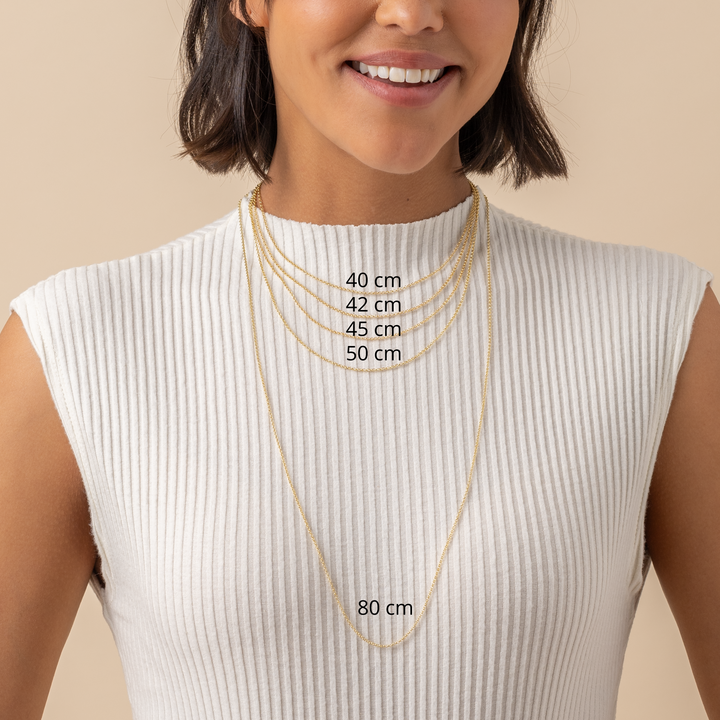
Yes to both. The same golden ratio earring hoops come in 18K gold vermeil, at the same 34 mm, on gold vermeil posts. Choose the finish she already wears. The design is the same in silver and gold vermeil. For a set, the golden ratio necklace also comes in both finishes, with a 33 mm pendant on a 45 cm chain and 5 cm extender, so the necklace can match the metal of her earrings.
Will they arrive in time, and what if they aren't right?
DHL Express delivers free in 1-5 business days worldwide, and we pay the import duties and taxes, so nothing is due at the door. They arrive in a ready-to-gift jewelry box and festive envelope. If they aren't right, our 30-day “Love It or Return It” policy applies to unworn earrings.
Who first wrote the golden ratio as a decimal?
The earliest known example is in a letter of 1597 from Michael Mästlin, astronomer and mathematician at the University of Tübingen, to his former student Johannes Kepler. Mästlin gave the longer part of a line of length 1, cut in the golden ratio, as about 0.6180340, the same decimals as φ. The true value, 0.61803398…, rounds to exactly that. Kepler had studied under him from 1589 to 1594 and credited him with introducing him to the ideas of Copernicus.

Math & Physics
Unlock the elegance of the abstract with our math and physics-inspired jewelry collection. These carefully crafted pieces mirror the profound equations and natural laws that shape our understanding of the universe. Experience the allure of fractals, the rhythmic beauty of pi, and the celestial wonder of astral formations—each piece serves as a wearable homage to the artistry inherent in scientific inquiry.
Find your perfect fit
Necklace length guide