€ 150


Still questions? Contact us
Photoreceptor necklace | sterling silver
The photoreceptor is the cell that turns a photon into a signal. Two types do most of the work in the human eye: rods, which see in the dark, and cones, which see in colour. Everything we know visually has been through one of them first.
The Science of the Photoreceptor
The human retina contains about 120 million rods and 6 million cones. Rods carry rhodopsin and respond to single photons under dark-adapted conditions, providing the slow, monochromatic, peripheral vision used at night. Cones come in three variants tuned to short, medium, and long wavelengths, and concentrate in the fovea where they support sharp central vision and colour perception. Both work by the same physics: a photon hits the retinal chromophore bound inside an opsin GPCR and isomerises it from 11-cis to all-trans. The opsin activates transducin, transducin activates phosphodiesterase, cGMP levels drop, and a cation channel closes. The cell hyperpolarises and reduces glutamate release onto downstream bipolar cells, which the visual system reads as a signal.
The Audience
This piece tends to find a specific audience:
- visual neuroscientists, retinal physiologists, and ophthalmologists
- optometrists and clinical vision scientists
- researchers in retinal disease (retinitis pigmentosa, age-related macular degeneration, Leber's)
- structural biologists working on opsins or other GPCRs
- biology students who have just covered the phototransduction cascade
Often picked as the everyday lab piece for working vision scientists, or as a graduation gift after a doctorate in visual neuroscience.
Explore Related Cellular Biology Jewelry
- Photoreceptor necklace | gold vermeil
- 7TMR necklace | silver
- Melanocyte necklace | silver
- Mammalian cell necklace | silver
FAQ
Who buys a photoreceptor necklace?
Mostly visual neuroscientists, ophthalmologists with a research interest, optometrists, and the partners and grad students of any of the above. It also lands well with structural biologists who have spent time on opsins or other GPCRs, since the photoreceptor is the canonical example of a cell built around a single GPCR family. Less common as a gift to non-scientists, who tend not to recognise the cell on first sight.
Why are rods so much more sensitive than cones?
Two reasons stack. Rods pack their outer segments with rhodopsin at very high density, increasing the probability that a photon entering the cell will hit a chromophore. The phototransduction cascade is also tuned for high gain: a single activated rhodopsin produces enough downstream signal to close hundreds of cation channels and noticeably hyperpolarise the cell. Together that makes rods responsive to single photons under dark-adapted conditions, but the trade-off is that they saturate quickly in bright light and cannot resolve colour. Cones sacrifice this sensitivity for faster recovery and three-spectral-channel discrimination, which is why daylight vision is sharper and colourful but useless once the light drops.
What's the size, material, and chain?
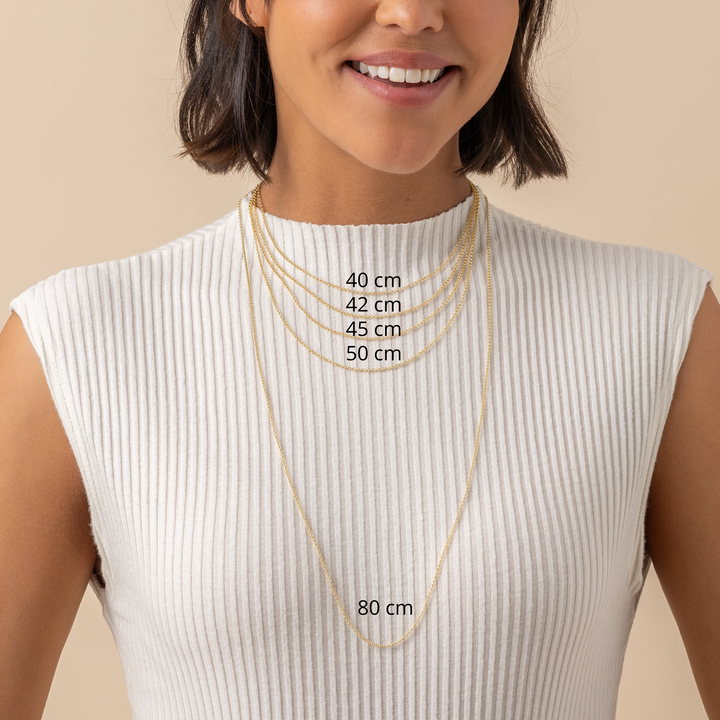
29 mm pendant in 925 sterling silver, nickel-free. 45 cm sterling silver chain with a 5 cm extender. Ships free worldwide via DHL Express in 1-5 business days, with all import duties prepaid. Comes in a ready-to-gift jewelry box with the 30-day “Love It or Return It” policy.
Is there a gold version?
Yes. The photoreceptor is also available in 18k gold vermeil at the same 29 mm size. Same model, warmer finish, more formal register.
Cellular Biology
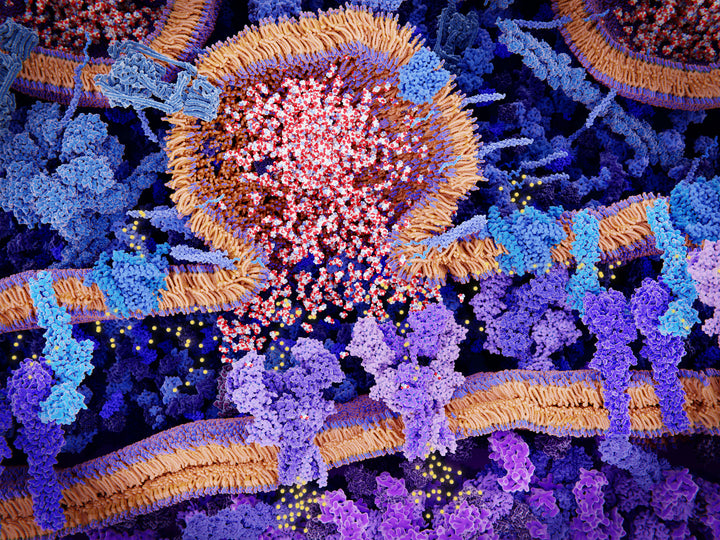
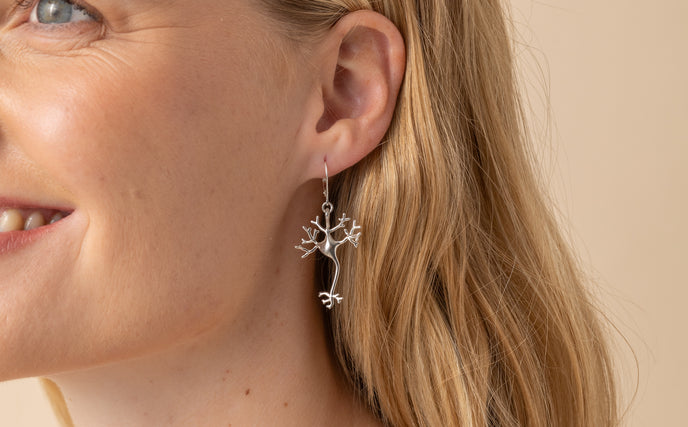
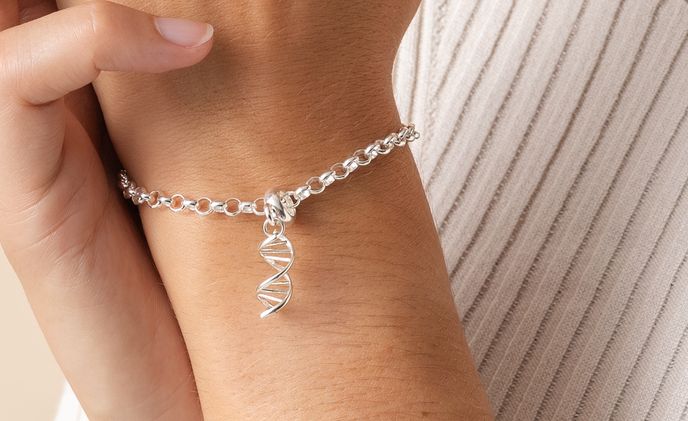
Step into the fascinating world of cellular biology through our unique jewelry designs. These pieces serve as wearable reflections of life's microscopic wonders, capturing the aesthetics of DNA strands, cellular formations, and more. Far from simple adornments, they spark dialogue and honor the captivating complexities found within biological research. Merging scientific accuracy with artistic flair, each creation offers a tactile experience that bridges the gap between scientific inquiry and aesthetic appreciation.
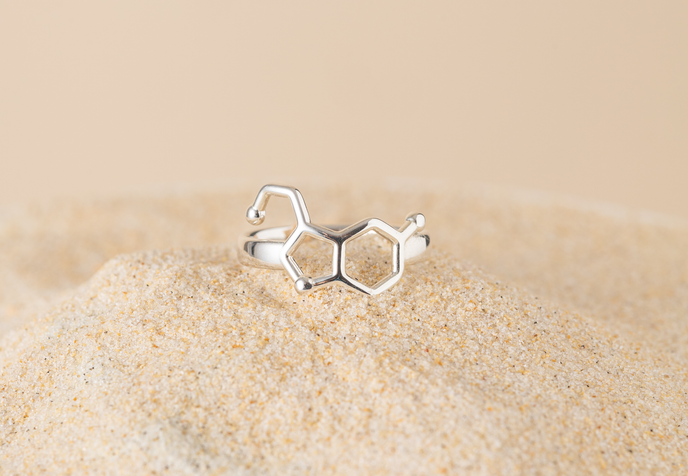
Find your perfect fit: measure an Existing Ring
Finding out your ring size at home is a simple process and can help you shop for jewelry online with confidence.
Necklace length guide