€ 175


Still questions? Contact us
Photoreceptor necklace | 18k gold vermeil
If you have spent twenty years on rhodopsin, arrestin, or retinal degeneration, you already know how strange this cell is. The photoreceptor is the only neuron in the body whose normal job is to fire less when stimulated, not more. Light hyperpolarises it. Darkness is when it talks.
The Science of the Photoreceptor
The photoreceptor outer segment is a stack of membrane discs (about a thousand in rods, fewer and tapered in cones) packed with opsin GPCRs at densities approaching the upper physical limit for membrane proteins. The cell renews this entire structure continuously: roughly ten per cent of disc length is shed at the distal tip each day and phagocytosed by the underlying retinal pigment epithelium, while new discs form at the base of the outer segment. Disruption of either side of this turnover causes inherited retinal degeneration. The synaptic logic is also inverted compared to most neurons. In darkness, the photoreceptor releases glutamate tonically onto bipolar cells. Light drives a phototransduction cascade that hyperpolarises the cell and reduces glutamate release, which the downstream circuit reads as the visual signal.
Who Reaches For This
The audience is narrower than the silver version:
- retinal neuroscientists and visual physiologists
- ophthalmologists and retinal surgeons in academic practice
- researchers in retinal degeneration, gene therapy, or phototransduction
- structural biologists working on opsins and other GPCRs
- scientists who have built a career on this cell and want a piece in gold
Explore Related Cellular Biology Jewelry
- Photoreceptor necklace | silver
- 7TMR necklace | gold vermeil
- Melanocyte necklace | gold vermeil
- Mammalian cell necklace | gold vermeil
FAQ
What do you give a visual neuroscientist who has spent twenty years on photoreceptors?
The cell itself, in gold. People who have spent that long on a single cell type tend to find a piece naming it directly more meaningful than a generic neuroscience symbol.
Why is the photoreceptor's inverted signalling logic interesting beyond the retina?
Because it's a clean example of how neural circuits use any reliable change in transmitter release as a signal, regardless of direction. Most neurons fire more when stimulated. Photoreceptors fire less. The downstream bipolar and ganglion cells just need to read that change reliably, and the rest of the visual system is built to interpret it. The same logic applies more broadly to GPCR signalling, where activation can mean either an increase or a decrease in downstream activity depending on which G protein the receptor couples to. Photoreceptors are the textbook case of decreased signalling carrying the meaningful information.
What's the size, material, and chain?
29 mm pendant in 18k gold vermeil over a sterling silver core, nickel-free. 45 cm gold vermeil chain with a 5 cm extender. Ships free worldwide via DHL Express in 1-5 business days, with all import duties prepaid. Comes in a ready-to-gift jewelry box with the 30-day “Love It or Return It” policy.
Same design as the silver photoreceptor?
Yes. Same model, same 29 mm size. Material is the only difference.
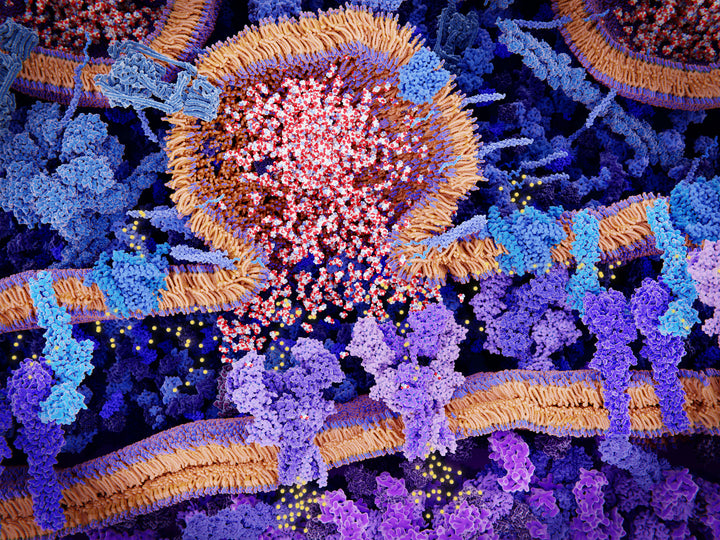
Cellular Biology
Step into the fascinating world of cellular biology through our unique jewelry designs. These pieces serve as wearable reflections of life's microscopic wonders, capturing the aesthetics of DNA strands, cellular formations, and more. Far from simple adornments, they spark dialogue and honor the captivating complexities found within biological research. Merging scientific accuracy with artistic flair, each creation offers a tactile experience that bridges the gap between scientific inquiry and aesthetic appreciation.


Find your perfect fit: measure an Existing Ring
Finding out your ring size at home is a simple process and can help you shop for jewelry online with confidence.
Necklace length guide