



€ 190


Still questions? Contact us
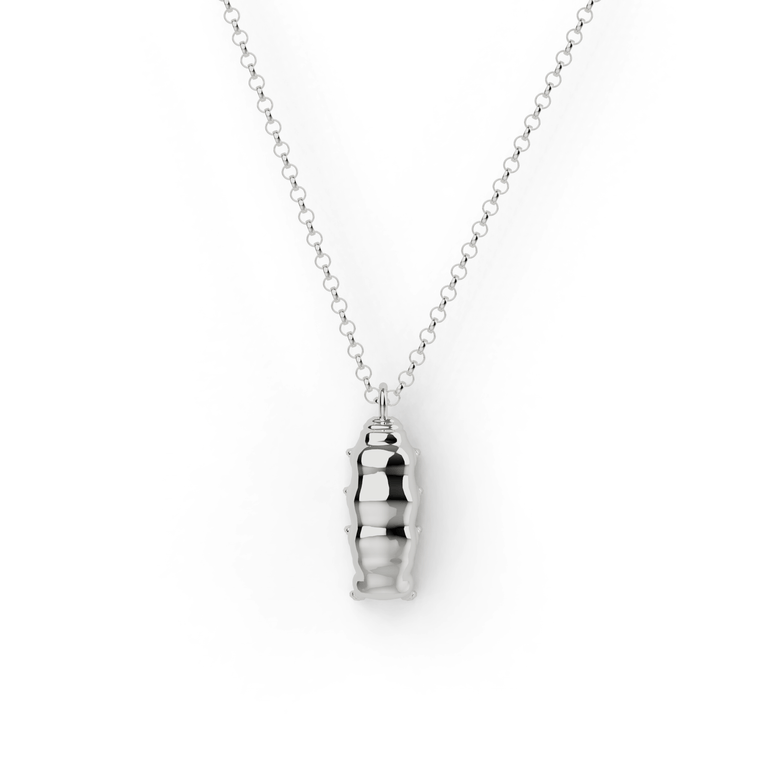
Tardigrade necklace | sterling silver
In 2007, a sample of tardigrades was launched into low Earth orbit, exposed to vacuum and unfiltered solar radiation for ten days, then returned. Most of them came back alive. The tardigrade is the only animal known to have survived direct exposure to space, and it managed it without any specialised equipment beyond its own biology.
The Science of the Tardigrade
Tardigrades are microscopic eight-legged animals (phylum Tardigrada) ranging from about 0.1 to 1.5 mm in length. The two common names, water bears and moss piglets, refer to their lumbering gait and preferred habitats. Under hostile conditions, tardigrades enter cryptobiosis: they expel almost all of their body water, retract their legs, and contract into a barrel-shaped tun. In this state they have survived vacuum, ionising radiation at doses around a thousand times lethal for humans, temperatures from -272°C to +150°C, hydrostatic pressures of about 600 megapascals (six times the deepest ocean trench), and direct exposure in low Earth orbit. The molecular basis of their resilience includes intrinsically disordered proteins called Dsup (damage suppressor) that physically coat DNA and protect it from radiation-induced strand breaks. Tardigrade-derived proteins are now being studied as potential additives for radioprotection in human cells.
The Audience
The audience is broader than for most cellular pieces:
- microbiologists, invertebrate zoologists, and astrobiologists
- radiation biologists and researchers in extremophile biology
- science teachers who use the tardigrade to teach extremes of biology
- biology students and amateur microscopists who have actually found one
- anyone who needs a small reminder that survival is possible in unreasonable conditions
Buyers tend to fall into two groups: scientists who study extremophiles or radiation biology professionally, and a much broader group of people who have heard the tardigrade story once and never quite let it go.
Explore Related Cellular Biology Jewelry
- Tardigrade necklace | gold vermeil
- Tardigrade earrings | silver
- Rotifer necklace | silver
- Pollen grain necklace | silver
FAQ
Is this just for biologists, or does it land more broadly?
It lands well outside biology too. The tardigrade has a broader cultural reach than almost any other microorganism, partly because the survival story (vacuum, extreme cold, radiation, low Earth orbit) is genuinely unusual and partly because the animal is unexpectedly charismatic at the microscope. Working biologists pick it up for the science. Most other buyers pick it up because the resilience story has stuck with them since they first read it.
How does cryptobiosis actually work?
By replacing the cell's water with a sugar called trehalose, supplemented in tardigrades by intrinsically disordered proteins that vitrify into a glass-like state. With water gone, the chemistry that normally damages biological molecules (free radical reactions, hydrolysis, ice crystal formation) effectively stops. The cell becomes a chemically stable solid rather than a metabolically active fluid. When water returns, the proteins refold, the metabolism restarts, and the animal walks away. The process can take minutes to hours depending on the species and the duration of dormancy. Tardigrades have been revived from samples that were preserved for decades.
What's the size, material, and chain?
22 mm pendant in 925 sterling silver, nickel-free. 45 cm sterling silver chain with a 5 cm extender. Ships free worldwide via DHL Express in 1-5 business days, with all import duties prepaid. Comes in a ready-to-gift jewelry box with the 30-day “Love It or Return It” policy.
Is there a gold version?
Yes. The tardigrade is also available in 18k gold vermeil at the same 22 mm size. Same model, warmer finish, more formal register. Earrings are also available in silver.

Other
In a world where art and science often exist in separate realms, our "Curiosities" collection serves as a harmonious confluence. Drawing inspiration from an eclectic range of scientific phenomena not covered elsewhere. Each piece is meticulously crafted to evoke a sense of wonder. It's jewelry that doesn't just adorn; it educates and fascinates, sparking conversations about the lesser-explored but equally awe-inspiring facets of our universe.



Find your perfect fit: measure an Existing Ring
Finding out your ring size at home is a simple process and can help you shop for jewelry online with confidence.
Necklace length guide