€ 180


Still questions? Contact us
Ammonite necklace | sterling silver
The ammonite is the index fossil of the Mesozoic. For over 300 million years they were among the dominant cephalopods of the world's oceans, and a single species often defines a stratigraphic zone with enough resolution to identify rock layers a few hundred thousand years apart. Then, 66 million years ago, the same impact that took the dinosaurs took the ammonites with them.
The Science of the Ammonite
Ammonites were marine cephalopods, more closely related to modern squid, octopus, and cuttlefish than to the nautilus they superficially resemble. They first appeared in the Devonian and survived four major mass extinctions before disappearing in the Cretaceous-Paleogene event. The shell is a logarithmic spiral, mathematically a self-similar curve where each whorl is a constant ratio larger than the last. Internally the shell is divided by septa into a chambered phragmocone, with a connecting siphuncle that allowed the animal to regulate buoyancy by adjusting the gas-to-fluid balance in each chamber. The suture lines visible on a cleaned ammonite are the intersections of those septa with the shell wall, and their complexity is one of the diagnostic features used to classify ammonite genera. Because individual ammonite species evolved rapidly and dispersed widely through the oceans, palaeontologists and stratigraphers use them as the gold-standard biostratigraphic marker for the Mesozoic, with biozonation often resolving to a few hundred thousand years.
Who Tends to Wear This
The audience clusters around the geological and palaeontological:
- palaeontologists, biostratigraphers, and invertebrate fossil specialists
- geologists working on Mesozoic stratigraphy or basin analysis
- geology and earth-sciences students through their first palaeontology block
- museum curators and natural-history educators
- fossil collectors and amateur palaeontologists with field-trip memories of cracking open an ammonite
Buyers tend to fall into two groups: working geoscientists who pick the silver as the everyday lab or field piece, and people whose first encounter with deep time happened with an ammonite in their hand and who want to keep that memory close.
Explore Related Earth Sciences Jewelry
FAQ
Why is the ammonite such a useful index fossil?
Because ammonites combined two features that biostratigraphers want from a marker: rapid evolutionary turnover and wide geographic dispersal. New species appeared and went extinct on the order of a few hundred thousand years, which is enough resolution to separate rock layers that look identical at outcrop scale. And because ammonites lived in the open ocean, the same species shows up across continents, which lets geologists correlate Mesozoic strata between Europe, North America, and South America without ambiguity. No other marine fossil group covers the Mesozoic with the same precision, which is why ammonite biozonation is still the standard for that era.
Are ammonites related to the nautilus?
Only distantly. Ammonites and nautiluses are both shelled cephalopods with chambered phragmocones, which is what makes them look similar in a fossil drawer, but the two groups split early in cephalopod evolution. The closest living relatives of the ammonites are coleoid cephalopods (squid, octopus, cuttlefish), most of which lost the external shell entirely. The nautilus is a separate lineage that retained the shell and the chambered structure but evolved very slowly: modern Nautilus pompilius is morphologically similar to its Cretaceous ancestors, while ammonites are gone.
What is the size, material, and chain?
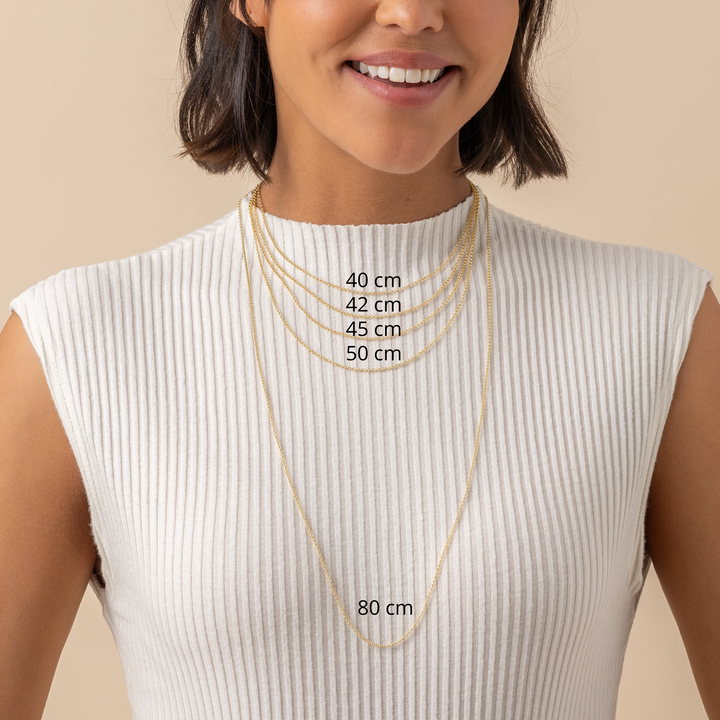
23 mm pendant in 925 sterling silver, nickel-free. 45 cm sterling silver chain with a 5 cm extender. Ships free worldwide via DHL Express in 1-5 business days, with all import duties prepaid. Comes in a ready-to-gift jewelry box with the 30-day “Love It or Return It” policy.
Same design as the gold ammonite?
Yes. Same 23 mm pendant, identical logarithmic-spiral geometry. Material is the only difference. Choose the finish the recipient already wears. Both versions carry the same design and the same meaning.
Other
In a world where art and science often exist in separate realms, our "Curiosities" collection serves as a harmonious confluence. Drawing inspiration from an eclectic range of scientific phenomena not covered elsewhere. Each piece is meticulously crafted to evoke a sense of wonder. It's jewelry that doesn't just adorn; it educates and fascinates, sparking conversations about the lesser-explored but equally awe-inspiring facets of our universe.
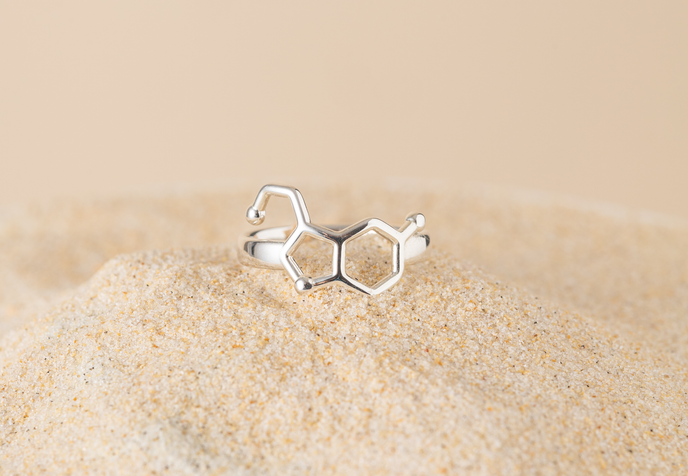
Find your perfect fit: measure an Existing Ring
Finding out your ring size at home is a simple process and can help you shop for jewelry online with confidence.
Necklace length guide