€ 135


Still questions? Contact us
Feynman scattering necklace | sterling silver
If you can sketch a Feynman diagram from memory, the vertices for interactions and the lines for propagators of electrons and photons, you already know what the pendant carries. The shorthand for perturbative quantum field theory drawn the way Feynman drew it. Worn here as a 34 mm sterling silver pendant.
The Science Behind Feynman Scattering
Richard Feynman introduced his diagram notation at the 1948 Pocono Conference, where Schwinger's competing analytical approach to quantum electrodynamics dominated the room and Feynman's pictures left most of the audience confused. Within a few years the diagrams became the standard tool. Each Feynman diagram is a graphical bookkeeping device for a term in the perturbative expansion of a scattering amplitude: vertices represent interactions, internal lines represent virtual particles propagating between them, external lines represent observable particles entering or leaving the process. The 1965 Nobel Prize in Physics went jointly to Feynman, Schwinger, and Tomonaga for the renormalisation of QED. The diagrams now reach into condensed matter many-body theory, particle physics calculations at the LHC, and lattice gauge theory.
Who Will Recognise It
- theoretical and experimental particle physicists
- condensed matter theorists working on many-body Green's functions
- graduate students learning QED, QCD, or perturbative quantum field theory
- physics educators and the people who keep a Feynman diagram on the office wall
For someone who reads scattering amplitudes the way other people read sentences, and for whom QED is still the cleanest example of a quantum field theory ever calibrated against experiment.
Explore Related Math and Physics Jewelry
- Integral necklace | silver
- Integral necklace | gold vermeil
- Buckyball necklace | silver
- Phi necklace | silver
- Trefoil knot necklace | silver
FAQ
Is this for a working theorist or for a physics enthusiast?
Both, in roughly equal measure. Theoretical and experimental physicists buy it as a working reference to the calculation tool they use daily. Physics enthusiasts and educators buy it because Feynman diagrams are the most-recognised image of how particles interact, the diagrammatic shorthand that even non-physicists associate with quantum field theory. The pendant works for either reading.
Why are Feynman diagrams more than just a drawing convention?
Because each diagram corresponds to an integral. The Feynman rules for QED translate any diagram into a precise mathematical expression for a scattering amplitude, whose square gives a measurable scattering rate. The notation looks like cartooning until you realise it is a complete computational system for perturbation theory. Schwinger never trusted them, then converted. By the late 1960s every paper in particle physics carried diagrams in the introduction.
What size is the pendant and what chain comes with it?
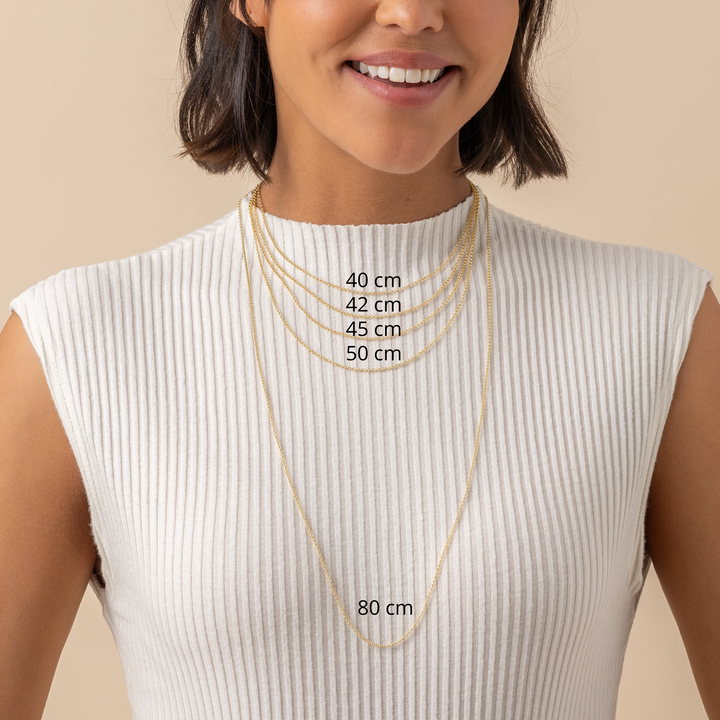
925 sterling silver, 34 mm pendant on a 45 cm sterling silver chain (ø 1.8 mm) with a 5 cm extender. Nickel-free and hypoallergenic. Free worldwide DHL Express in 1-5 business days, with all import duties and taxes covered. 30-day “Love It or Return It” returns.
Is there a gold version?
Not at present. Feynman scattering is sterling silver only. Other Math and Physics designs in the catalogue exist in 18K gold vermeil, including the integral, the phi, and the trefoil knot, if a gold counterpart in the same field is the goal.
Math & Physics
Unlock the elegance of the abstract with our math and physics-inspired jewelry collection. These carefully crafted pieces mirror the profound equations and natural laws that shape our understanding of the universe. Experience the allure of fractals, the rhythmic beauty of pi, and the celestial wonder of astral formations—each piece serves as a wearable homage to the artistry inherent in scientific inquiry.
Find your perfect fit: measure an Existing Ring
Finding out your ring size at home is a simple process and can help you shop for jewelry online with confidence.
Necklace length guide