€ 175


Still questions? Contact us
Trefoil Knot Necklace in Sterling Silver: The Simplest Knot That Cannot Be Untied
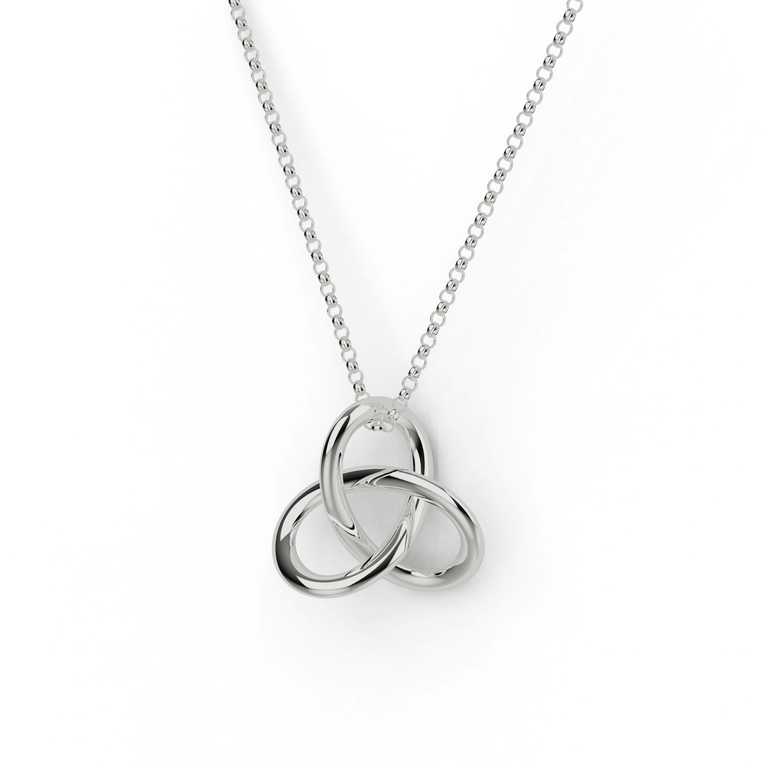
The trefoil knot is the simplest non-trivial knot in mathematical knot theory: the minimum number of crossings required to form a knot that genuinely cannot be untangled into a simple loop. It comes in two mirror-image forms that look identical but are topologically distinct. This sterling silver pendant renders it at 22 mm.
The Science Behind the Trefoil Knot
Mathematical knot theory is the study of closed curves in three-dimensional space that cannot be untangled without cutting. The trivial knot (unknot) is a simple loop; the trefoil is the simplest knot that requires at least three crossings, making it the first non-trivial entry in the knot table. The two forms of the trefoil — left-handed (S-form) and right-handed (Z-form) — are mirror images and cannot be deformed into each other without cutting, a property called chirality. Knot theory has direct applications in molecular biology: DNA topoisomerases manage the knotting and unknotting of DNA strands during replication and transcription, and knotted structures in proteins affect their folding and function. In chemistry, the first molecular trefoil knot was synthesized by Jean-Pierre Sauvage's group in 1989, work that contributed to his 2016 Nobel Prize in Chemistry for the development of molecular machines.
A Meaningful Gift for Science Lovers
A topologically rigorous piece for mathematicians, structural biologists, and anyone fascinated by the mathematics of knots:
- Mathematicians working in topology or knot theory
- Structural biologists and biochemists studying DNA topology
- Chemistry students interested in molecular machines
- Anyone who finds the relationship between topology and biology genuinely interesting
For the mathematician or biologist who has looked at a knotted DNA strand and felt topology become suddenly practical.
Explore Related Math and Physics Jewelry
- Trefoil Knot Necklace in Gold Vermeil
- Mobius Strip Necklace
- Golden Ratio Necklace
- Integral Necklace
- Buckyball Necklace
FAQ
Q: What is a trefoil knot?
A: The simplest nontrivial knot in topology - three loops interlocked in a way that cannot be untangled in 3D space. It appears in quantum field theory and knot theory.
Q: Who would wear this?
A: Mathematicians, topologists, theoretical physicists, and anyone drawn to the unexpected complexity hiding in simple forms.
Q: How large is the pendant?
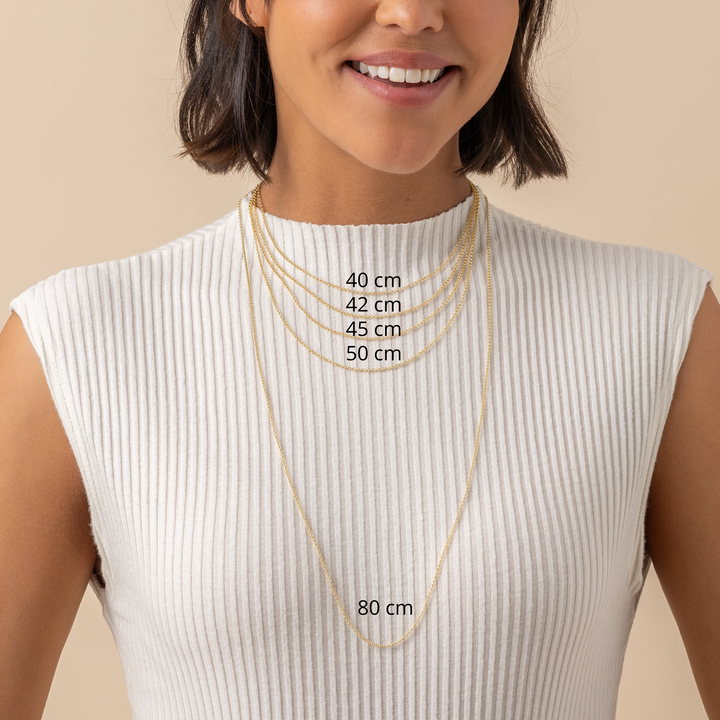
A: 22 mm on a 45 cm sterling silver chain with a 5 cm extender. 925 sterling silver, nickel-free and hypoallergenic.
Q: How does shipping work?
A: Free worldwide DHL Express. 1-5 business days. All import duties and taxes are covered.

Math & Physics
Unlock the elegance of the abstract with our math and physics-inspired jewelry collection. These carefully crafted pieces mirror the profound equations and natural laws that shape our understanding of the universe. Experience the allure of fractals, the rhythmic beauty of pi, and the celestial wonder of astral formations—each piece serves as a wearable homage to the artistry inherent in scientific inquiry.
Find your perfect fit: measure an Existing Ring
Finding out your ring size at home is a simple process and can help you shop for jewelry online with confidence.
Necklace length guide