$235


Still questions? Contact us
Dopamine necklace V | sterling silver
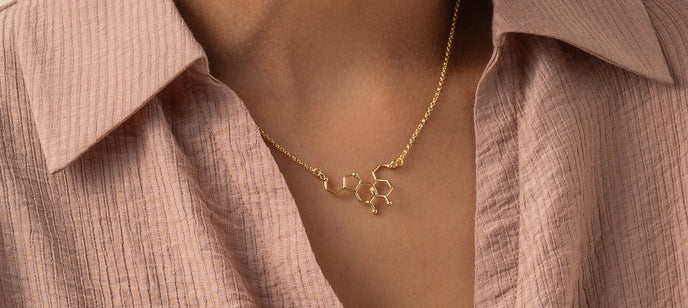
Grandparents who wanted something special for their granddaughter chose this dopamine necklace, the vertical version, where a small silver pendant hangs upright from the chain. Dopamine is one of the brain's signals for drive and motivation, so it makes a quiet vote of confidence for someone who goes after what she wants.
Who It's For
- a granddaughter, as a gift from both of you
- your daughter, the biologist in the family
- a fiancée, as one of the simplest and most beautiful necklaces she owns
- yourself, worn every day on a longer chain
Susann S. gave it as a present: “Was highly appreciated”. Mick O., on the gold vermeil version: “The pieces are in mint condition and very beautiful.”
One Molecule, Two Kinds of Receptor
Dopamine carries no fixed message. What it does depends on the receptor it meets on the cell it reaches. Mammals have five dopamine receptors, in two families. The D1 family, D1 and D5, raises the level of cyclic AMP, a messenger inside the cell. The D2 family, D2, D3 and D4, lowers it. So the same molecule can turn a signal up in one cell and down in another. Some D2 receptors sit on dopamine neurons themselves. When dopamine builds up around them, they slow the neuron's firing and the amount it releases, a feedback loop built into the system.
Explore Related Molecules Jewelry
- dopamine necklace V | gold vermeil
- dopamine necklace H | silver
- dopamine studs | silver
- serotonin necklace V | silver
FAQ
How big is the pendant, and how does it sit?
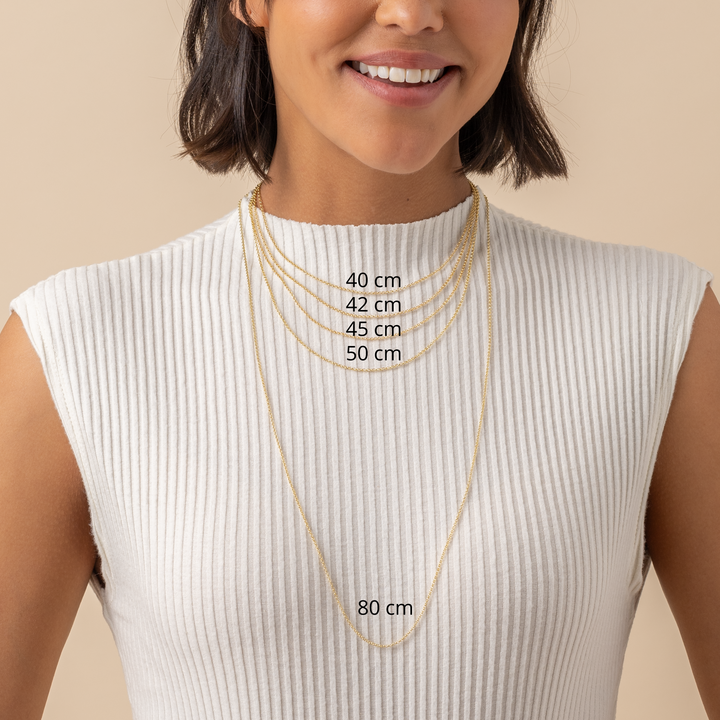
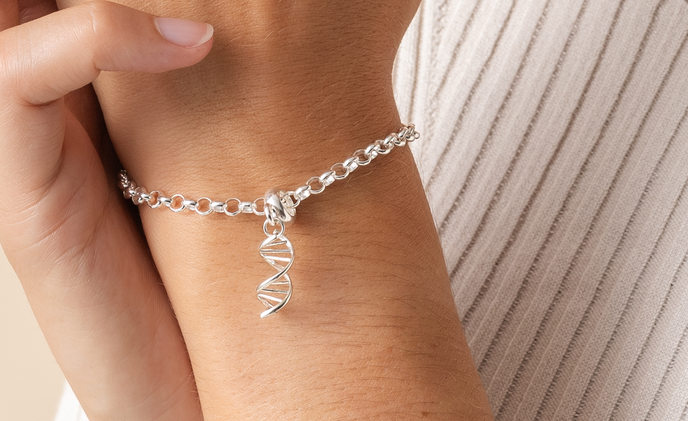
The pendant measures 20 mm (about 0.8 inch), close to a 10-cent euro coin and about 2 mm larger than a US dime. It hangs upright from the chain and sits around the collarbone, on a 45 cm (17.7 inch) sterling silver chain with a lobster clasp and a 5 cm (2 inch) extender. An extra chain can be added on this page for layering: 40, 42, 45 or 50 cm with a 5 cm extender, or 80 cm. The necklace is 925 sterling silver, nickel-free and hypoallergenic.
Is there a gold version, or a horizontal one?
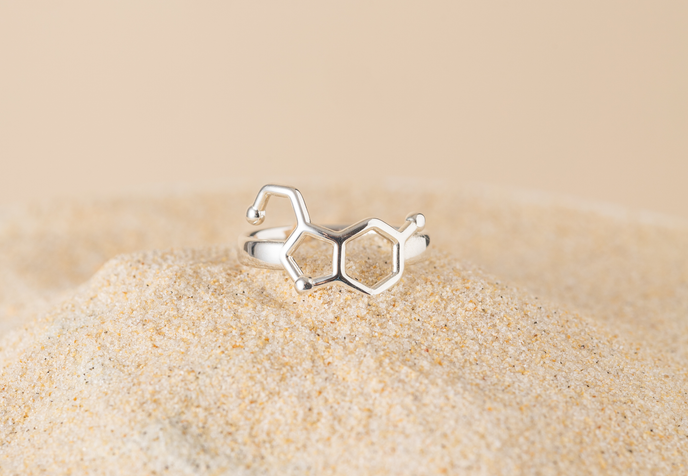
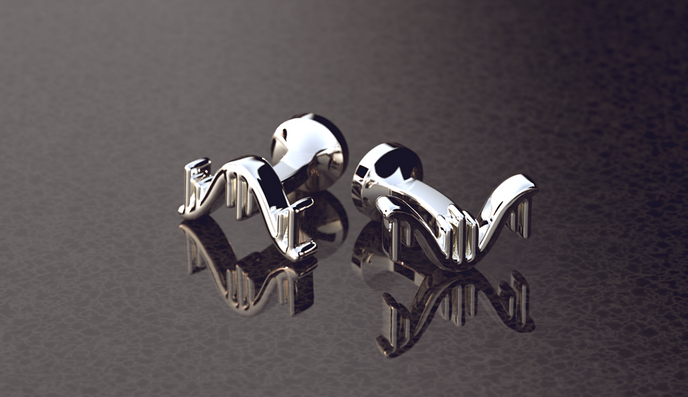
Yes. The vertical pendant also comes in 18K gold vermeil, 2.5 microns of 18K gold over sterling silver, at the same 20 mm. Choose the finish the recipient already wears: the design is the same in both. On the horizontal dopamine necklace, in silver or gold vermeil, the chain runs through both ends of the 20 mm pendant, so it lies level instead of hanging. There are also dopamine studs (15 mm) in both finishes, and a dopamine ring and bracelet in silver.
Will it arrive in time, and what if it isn't right?
DHL Express delivers free in 1-5 business days worldwide, and we pay the import duties and taxes, so nothing is due at the door. It arrives in a ready-to-gift jewelry box and festive envelope. If it isn't right, our 30-day “Love It or Return It” policy applies.
How did scientists find out that dopamine has more than one receptor?
Partly through an enzyme. In 1972 John Kebabian, Gary Petzold and Paul Greengard reported an enzyme in rat brain that low concentrations of dopamine switch on, making cyclic AMP, and suggested it might be the dopamine receptor. From 1975, drug-binding studies found dopamine sites that did not match the enzyme. In 1979 Kebabian and the neurologist Donald Calne sorted the receptors into two classes: D-1, linked to the enzyme, and D-2, not linked. Greengard later shared the 2000 Nobel Prize for discoveries concerning signal transduction in the nervous system.

Molecules
Delve into the hidden elegance of science with our meticulously crafted jewelry, inspired by the intricate structures of chemical molecules. Each piece serves as a tactile tribute to the building blocks of life and matter, capturing the allure of atoms and bonds in precious metals. A harmonious fusion of art and science, these creations are more than mere accessories; they're a celebration of the enigmatic beauty that underpins our universe.
Find your perfect fit: measure an Existing Ring
Finding out your ring size at home is a simple process and can help you shop for jewelry online with confidence.
Necklace length guide