€ 170


Still questions? Contact us
Purkinje cell necklace | sterling silver
An emergency nurse was given this Purkinje cell necklace by a spouse who wanted “something different but beautiful”, and her medical friends asked where she had found it. A neuron is an unexpected thing to wear, and for a woman in medicine that is much of its appeal.
Who It's For
- a friend who works in medicine
- a friend at school, as a present
- a woman who sees the beauty in nature and science
- yourself, if the brain is your field of study
Evelyn A.: “My friend LOVED this necklace. She now is going around school wearing it every day and telling everyone, ‘I'm wearing my brain!’” Eloise A.: “I ordered this because I love brains and it's related to my MSc dissertation on movement learning. I had to have it!”
Most of the Brain's Neurons, One Way Out
The cerebellum makes up only about a tenth of the brain's weight, yet it holds around 80 per cent of its neurons, some 69 billion in a 2009 count. Almost all of them are granule cells, small neurons packed into the innermost layer of the cerebellar cortex. Their fibres reach up to the branches of the Purkinje cells, which are far fewer, about 30 million in an adult, set in a single layer. Purkinje cells are the only route out of the cerebellar cortex. Whatever it adds to balance and the timing of movement, it passes on through them to nuclei deeper in the cerebellum and brainstem.
Explore Related Neuroscience Jewelry
- purkinje cell necklace | gold vermeil
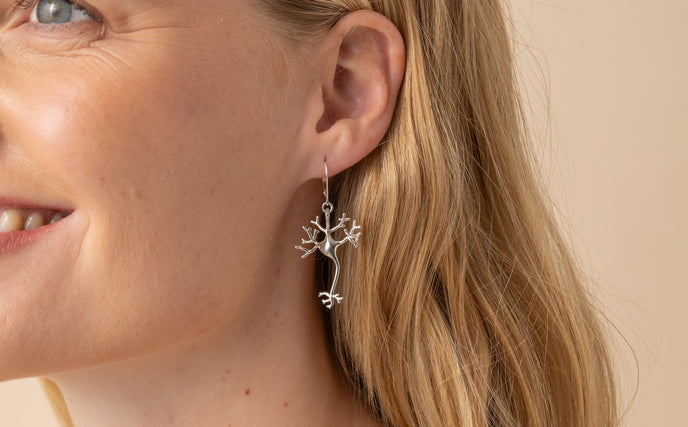
- purkinje cell earrings | silver
- neuron necklace | silver
- spindle neuron necklace | silver
FAQ
How big is the pendant, and how does it sit?
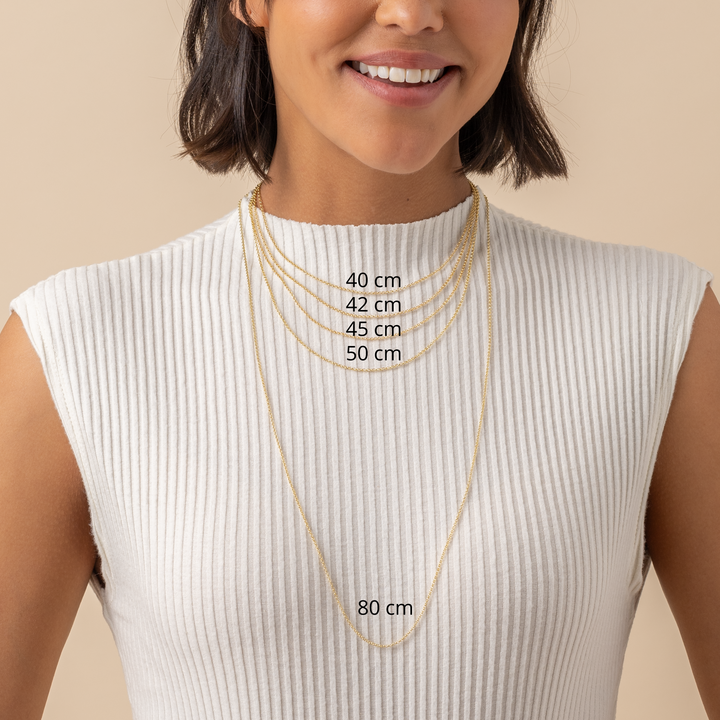
The pendant measures 47 mm (1.85 inches), a little shorter than two 2-euro coins side by side (51.5 mm), so it is a statement piece rather than a small charm. It hangs from a small ring at the top, on a 45 cm (17.7 inch) sterling silver chain with a 5 cm (2 inch) extender, and sits on the upper chest, below the collarbone. The fine branches can bend if knocked, so keep it in its box when you are not wearing it. Our sterling silver is nickel-free and hypoallergenic.
Is there a gold version, or matching earrings?
Yes. The same Purkinje cell necklace comes in 18K gold vermeil, also 47 mm on a 45 cm chain with a 5 cm extender. Choose the finish the recipient already wears: the design is the same in both. For a set, there are Purkinje cell earrings in sterling silver and in gold vermeil. Each earring measures 39 mm, not counting the leverback hook.
Will it arrive in time, and what if it isn't right?
DHL Express delivers free in 1-5 business days worldwide, and we pay the import duties and taxes, so nothing is due at the door. It arrives in a ready-to-gift jewelry box and festive envelope. If it isn't right, our 30-day “Love It or Return It” policy applies.
Who was Purkinje?
Jan Evangelista Purkyně (1787-1869), a Czech physiologist who often published in German as Purkinje, the spelling the cell still carries. He taught physiology at Breslau, then from 1850 in Prague. His work reached well beyond this cell. In a thesis delivered at Breslau in 1823, he described the ridges on human fingertips and sorted them into nine patterns. He was studying the skin as an organ of touch. Using the patterns to identify people came later, and Francis Galton credited the thesis in his 1892 book Finger Prints.

Neuroscience
Dive into the intricacies of the human mind with our neuroscience-inspired jewelry collection. Each piece is a tactile ode to the neural networks that shape our thoughts, memories, and consciousness. Crafted with meticulous attention to detail, our designs mirror the dendritic branches and synaptic connections that form the basis of mental activity. With these elegant pieces, wear the enigma of cognition close to your skin, offering a subtle yet profound exploration of what it means to be sentient.
Find your perfect fit: measure an Existing Ring
Finding out your ring size at home is a simple process and can help you shop for jewelry online with confidence.
Necklace length guide