€ 195


Still questions? Contact us
Cardiac conduction system necklace | 18k gold vermeil
A signal starts in the sinoatrial node, sweeps across both atria, slows at the atrioventricular node, then races down the bundle of His and out through the Purkinje fibres to fire both ventricles in synchrony. That signal is the cardiac conduction system, the heart's electrical circuit. The pendant traces the entire path, in 18k gold vermeil.
The Science Behind the Cardiac Conduction System
The cardiac conduction system is the specialised electrical pathway that synchronises every heartbeat. The sinoatrial (SA) node, in the wall of the right atrium, is the heart's intrinsic pacemaker. The cells there depolarise spontaneously about 60 to 100 times a minute and set the rhythm. The signal spreads through both atria, then converges at the atrioventricular (AV) node, where it deliberately slows down to give the atria time to empty into the ventricles. From the AV node it travels into the bundle of His, which splits into left and right bundle branches, then fans out through the Purkinje fibres to depolarise the ventricular muscle in a coordinated wave from apex to base. Cardiac electrophysiology, the clinical specialty built around this system, uses catheter ablation to interrupt aberrant conduction circuits in atrial fibrillation, atrial flutter, ventricular tachycardia, and Wolff-Parkinson-White syndrome. The same anatomy that the pendant traces is the territory those catheters work in every day.
Who Tends to Wear This
- cardiac electrophysiologists who ablate arrhythmias and implant pacemakers
- cardiologists, cardiac surgeons, and cardiac anaesthetists
- cardiac nurses, cardiac physiologists, and electrophysiology fellows
- cardiovascular researchers studying conduction biology, channelopathies, or arrhythmia genetics
- medical students whose first ECG made the system click
Most often picked as a milestone gift after fellowship completion, after a first solo ablation, or for an electrophysiologist who has spent years inside this exact anatomy.
Explore Related Cardiology Jewelry
- Cardiac conduction system necklace | silver
- Heart necklace | gold vermeil
- Heart section necklace | gold vermeil
- Aorta necklace | gold vermeil
- Heartbeat necklace | gold vermeil
FAQ
What is the cardiac conduction system, exactly?
The specialised tissue inside the heart that generates and propagates the electrical impulse driving each beat. It is not the same as the coronary arteries (the blood supply to the heart muscle) or the cardiac chambers themselves. The conduction system has five named components: the sinoatrial node, the atrioventricular node, the bundle of His, the left and right bundle branches, and the Purkinje fibres. An arrhythmia almost always traces back to a specific point along that path. The pendant shows the full pathway from atrial origin down to the ventricular Purkinje network.
What does the pendant actually depict?
A stylised rendering of the conduction-system pathway rather than a literal anatomical view of the heart. The atrial conduction loops at the top, the bundle of His descends through the centre, and the Purkinje fibres fan out at the base. The pendant focuses on the electrical pathway itself. The chambers, valves, and surrounding heart muscle are not drawn, so the rendering reads more as a 3D version of the circuit diagram you'd see in a cardiology textbook than as a literal heart. That is closer to how electrophysiologists already think about the system.
What size is the pendant and what does it ship with?
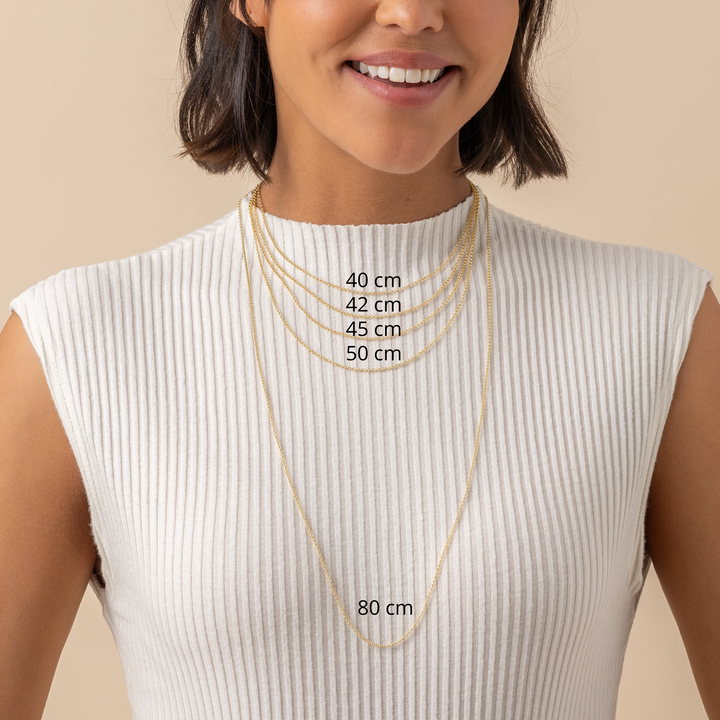
The pendant is 35 mm in 18k gold vermeil, a 2.5 micron gold layer over a sterling silver core, nickel-free and hypoallergenic, on a 45 cm gold vermeil chain (1.8 mm width, lobster clasp) with a 5 cm extender, so it sits at the collarbone or a little below. Free worldwide DHL Express shipping in 1-5 business days, all import duties covered, in a ready-to-gift jewelry box.
What's the difference between this and the silver cardiac conduction necklace?
The anatomy is identical: same circuit, same 35 mm scale, same conduction landmarks. Material is the only difference. Choose the finish the recipient already wears. Both versions carry the same design and the same meaning. Both ship on a 45 cm chain in matching material.

Human Anatomy
Anatomical wonders have never been so elegantly articulated. Our anatomical collection embodies the intricate and awe-inspiring structures that make us who we are. From DNA double helices to neuronal networks, our pieces don't merely imitate—they interpret. The collection serves as a tangible tribute to the hidden beauty within us all, elevating the realms of biology and medicine into wearable art. With exquisite attention to detail, each piece is a dialogue between form and function, revealing the enigmatic eloquence of the human body.

Find your perfect fit: measure an Existing Ring
Finding out your ring size at home is a simple process and can help you shop for jewelry online with confidence.
Necklace length guide