€ 160


Still questions? Contact us
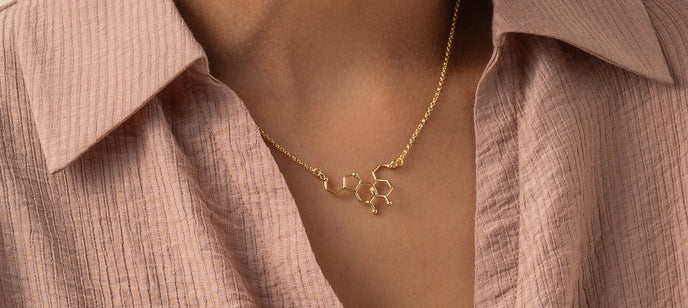
Dopamine serotonin necklace V | sterling silver
A group of colleagues bought this dopamine serotonin necklace as a retirement gift for one of their own, and it suits that kind of goodbye: two of the brain's chemical messengers, linked in sterling silver on one vertical pendant. Give it to a colleague moving on after a long career, or keep it for yourself.
Who It's For
- a sister or friend who has just graduated from nursing school
- a daughter leaving for university to study biology, or celebrating her 21st
- a friend training as a hypnotherapist who is fascinated by how the brain works
- a science teacher, for a milestone birthday
- a friend who could use something to smile about
- yourself, as a conversation piece for the science you love
Shain W. gave it to a friend training as a hypnotherapist: “It looks delicate and I really like that you have to look carefully to see what it is.” Dianne P., who bought one to keep: “It's fun for us science nerds and it's a great conversation piece.”
How the Body Breaks Down Dopamine and Serotonin
Once dopamine or serotonin has passed on its signal, it is pumped back into the nerve cell. Some is reused and the rest is broken down, much of it by an enzyme called monoamine oxidase, or MAO, which sits on the outer membrane of mitochondria. It comes in two forms. MAO-A has a strong preference for serotonin, while dopamine is broken down by both. Dopamine also has a second route, an enzyme called COMT, which needs the two neighbouring hydroxyl groups on dopamine's ring. Serotonin doesn't have them. MAO works in the gut and liver too, where it breaks down tyramine from aged cheese and other fermented foods. Tyramine differs from dopamine by a single hydroxyl group.
Explore Related Molecules Jewelry
- dopamine-serotonin necklace V | gold vermeil
- dopamine serotonin necklace H | silver
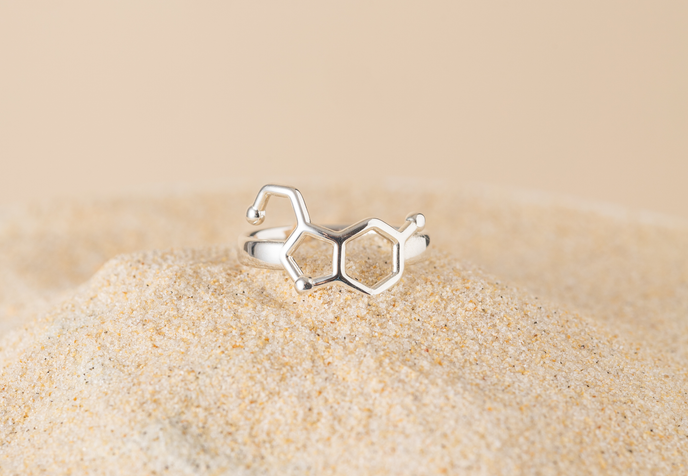
- dopamine - serotonin ring | silver
- dopamine serotonin earrings | silver
FAQ
How big is the pendant, and how does it sit?
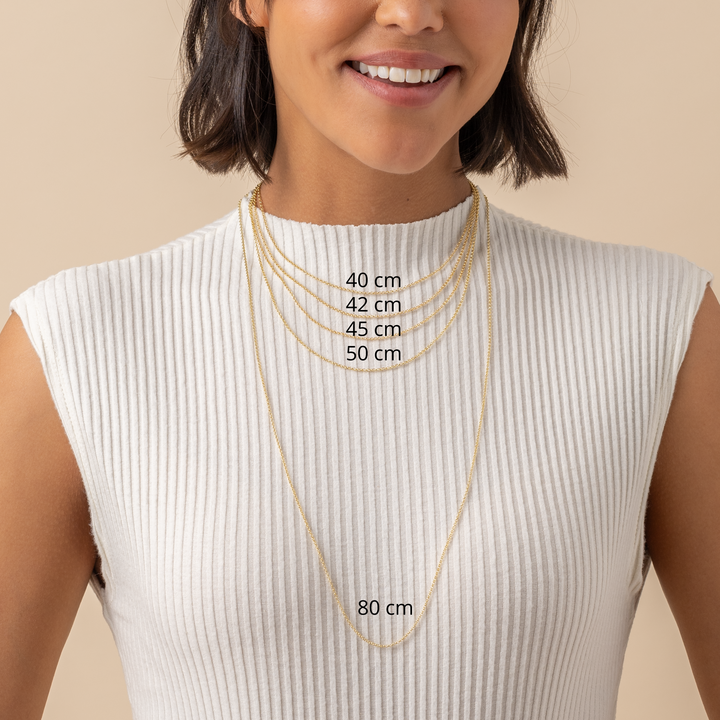
The pendant measures 40 mm (about 1.6 inches), about one and a half times the width of a 2-euro coin. It hangs from a single point at the top, so it sits upright on the upper chest, a little below the collarbone, on a 45 cm (17.7 inch) sterling silver chain with a 5 cm (2 inch) extender. Extra chains of 40, 42, 45 or 50 cm with extender, or 80 cm, can be added on this page. Our sterling silver pendant and chain are nickel-free.
Is there a gold version, or a horizontal one?
Yes to both. The same vertical pendant comes in 18K gold vermeil, also 40 mm. Choose the finish she already wears. The horizontal dopamine serotonin necklace is the same 40 mm pair, fixed at both ends so it lies across the collarbone, in sterling silver, 18K gold vermeil or two-tone. Every version uses the same two interlocked molecules. Only the metal and the hang change. For matching earrings, there is a pair with dopamine on one ear and serotonin on the other, in silver or gold vermeil.
Will it arrive in time, and what if it isn't right?
It ships free worldwide with DHL Express and arrives in 1-5 business days. We pay the import duties and taxes, so there is nothing to pay on delivery. It comes in a ready-to-gift jewelry box and festive envelope. If it isn't right, our 30-day “Love It or Return It” policy applies.
Who discovered the enzyme that breaks down dopamine and serotonin?
Mary Hare, a PhD student in biochemistry at Cambridge. In 1928 she reported an enzyme in liver that breaks down tyramine and named it tyramine oxidase. Over the following decades others showed that the same enzyme system also breaks down adrenaline, dopamine, serotonin and other amines, and it was renamed monoamine oxidase. Later in 1928 Hare married the American scientist Frederick Bernheim. As Mary Bernheim she joined the founding faculty of Duke University's medical school and taught there for more than fifty years.
Molecules
Delve into the hidden elegance of science with our meticulously crafted jewelry, inspired by the intricate structures of chemical molecules. Each piece serves as a tactile tribute to the building blocks of life and matter, capturing the allure of atoms and bonds in precious metals. A harmonious fusion of art and science, these creations are more than mere accessories; they're a celebration of the enigmatic beauty that underpins our universe.
Find your perfect fit: measure an Existing Ring
Finding out your ring size at home is a simple process and can help you shop for jewelry online with confidence.
Necklace length guide