€ 180


Still questions? Contact us
interlocked DNA necklace | gold vermeil
Seen on Facebook, this interlocked DNA necklace struck one customer in Germany as a great gift, and the order went in right away. It is a gift about connection, told in the language of biology, and in gold vermeil it suits a friend whose everyday jewelry is already gold.
Who It's For
- your twin sister
- a biochemist or a cell biologist
- a teacher of biology or chemistry
- yourself, as an everyday piece
From reviews of the silver version: Aisling C.: “Great quality design and beautiful idea for a necklace.” Daniele C.: “it is even better than the picture, really lovely!”
How a Cell Separates Its Copied DNA
Every time the gut bacterium E. coli divides, the links between its two new chromosomes have to be brought down to exactly zero. The links come from the copying itself. The two strands of the parent DNA are twisted about each other, and some of that winding passes to the copies as they are made, so two closed circles would finish linked unless something undid it. The main enzyme that separates them, topoisomerase IV, opens a break through both strands of one copy, lets the other copy slip through and closes the break. Human chromosomes are not circles, yet their two copies still end up twisted about each other, and topoisomerase II separates them as the cell divides.
Explore Related Genetics Jewelry
- interlocked DNA necklace | silver
- circular DNA necklace | gold vermeil
- DNA necklace H | gold vermeil
- DNA earring hoops - crossed | gold vermeil
FAQ
How big is the pendant, and how does it sit?
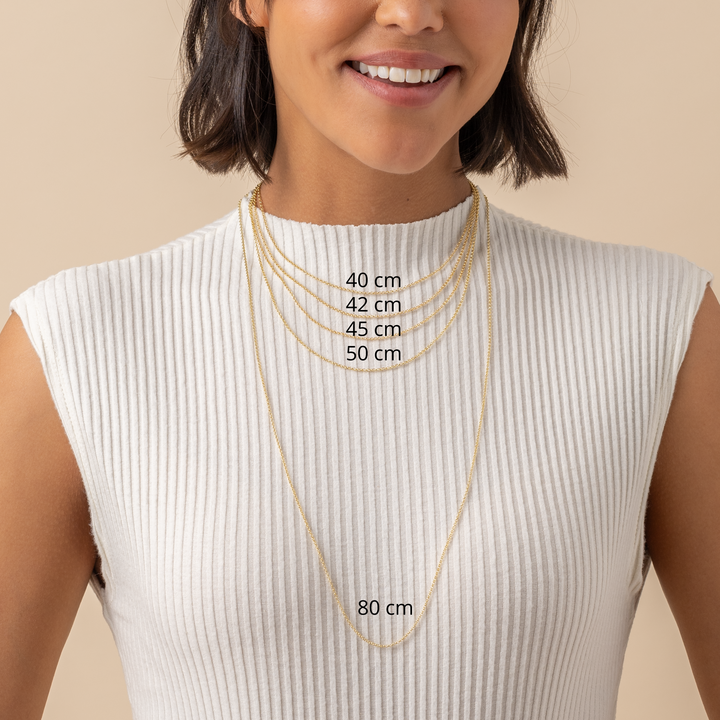
The pendant measures 36 mm (1.42 inches), about 10 mm more than a 2-euro coin. The chain is joined to the top of each ring, so the two linked rings hang side by side below the collarbone, on a 45 cm (17.7 inch) gold vermeil chain with a 5 cm (2 inch) extender. Extra chains for layering are sold on this page: 40, 42, 45 or 50 cm with a 5 cm extender, or 80 cm. It is 2.5 microns of 18K gold over solid sterling silver, nickel-free and hypoallergenic.
Is there a silver version?
Yes. The interlocked DNA necklace also comes in sterling silver, at the same 36 mm on a 45 cm sterling silver chain with a 5 cm extender. Choose the finish the recipient already wears: the design is the same in both. To go with the gold vermeil necklace, the crossed DNA earring hoops come in gold vermeil too, 20 mm, with ear nuts.
Will it arrive in time, and what if it isn't right?
DHL Express delivers free in 1-5 business days worldwide, and we pay the import duties and taxes, so nothing is due at the door. It arrives in a ready-to-gift jewelry box and festive envelope. If it isn't right, our 30-day “Love It or Return It” policy applies.
How did scientists learn that cells must unlink their DNA to divide?
Much of the evidence came from yeast. In 1984 DiNardo, Voelkel and Sternglanz described a yeast with a heat-sensitive topoisomerase II. At the higher temperature the cells copied their DNA once, then stopped halfway through nuclear division, and the yeast's small natural DNA circles turned up as pairs linked many times over. A year later, Holm, Botstein and colleagues showed that the enzyme is needed right at mitosis. Their results fit the idea that its essential job is to let intertwined chromosomes separate.
Genetics
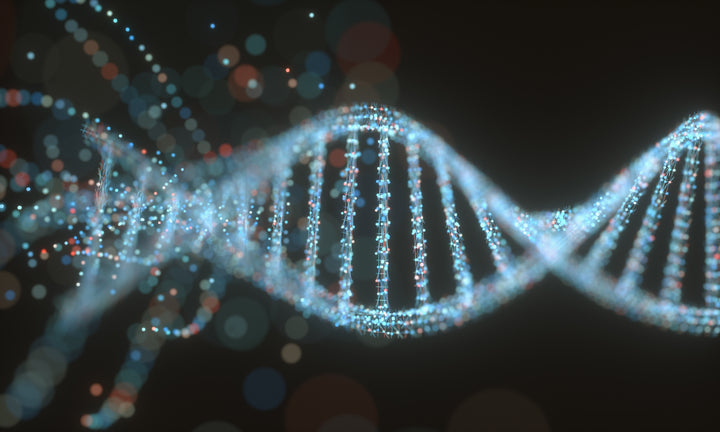
Our genetics-inspired jewelry captures the essence of life's code in striking detail. Crafted to mirror the DNA double helix, each piece is more than an aesthetic marvel—it's a tribute to the complexity of our genetic makeup. Far from ordinary, this collection combines scientific precision with artistic flair, making each item a captivating blend of form and function. It's not just an accessory; it's a meaningful representation of the miracle that is genetics.
Find your perfect fit: measure an Existing Ring
Finding out your ring size at home is a simple process and can help you shop for jewelry online with confidence.
Necklace length guide