€ 145


Still questions? Contact us
Round chromosome necklace | sterling silver
A friend graduating with her PhD is the occasion in a review of this round chromosome necklace. Between divisions, chromosomes unwind, yet each keeps to its own region of the nucleus, known to cell biologists as a chromosome territory.
Who It's For
- a teacher, as a thank-you from her class
- your partner, to wear with a dress
- an aunt who is a geneticist
- yourself, if chromosomes are part of your working day
Chris B., on the gold vermeil version: “My wife loves this necklace as it goes with many of her outfits, and she is immensely proud of wearing it in front of her students.”
The Science Behind Chromosome Number
Humans have 46 chromosomes in a typical body cell, in 23 pairs. Chimpanzees, gorillas and orangutans have 48. The difference lies in human chromosome 2, which formed when two ancestral chromosomes joined end to end. The join still shows. Near the middle of chromosome 2 sit telomere repeats, the sequence that normally caps the ends of a chromosome, arranged head to head, along with the remains of a second centromere. A 2022 study puts the fusion at about 900,000 years ago, within a range of roughly 400,000 to 1.5 million. The number on its own says little about a species: the common potato has 48 too.
Explore Related Genetics Jewelry
- round chromosome necklace | gold vermeil
- round chromosome studs | silver
- flat chromosome necklace | silver
- mitosis necklace | silver
FAQ
How big is the pendant, and how does it sit?
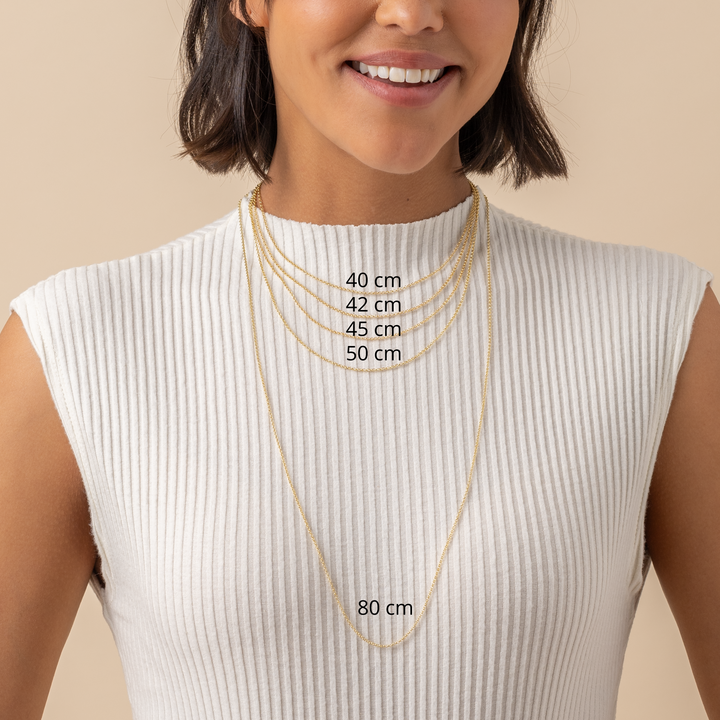
The pendant measures 21 mm (about 0.8 inch), almost 5 mm less than the width of a 2-euro coin (25.75 mm). It lies sideways, fixed to the chain at both ends, and sits around the collarbone on a 45 cm (17.7 inch) sterling silver chain with a 5 cm (2 inch) extender. Our 925 sterling silver is nickel-free and hypoallergenic.
Does it come in gold vermeil, flat, or as studs?
Yes to all three. The round chromosome necklace comes in sterling silver and in 18K gold vermeil, with the same 21 mm pendant and chain length. Choose the finish the recipient already wears. The design is the same in both finishes. The flat chromosome necklace, also 21 mm and in both finishes, has flat arms where this one has rounded ones. The round chromosome studs, 11 mm each with ear nuts, come in sterling silver only, so they go with this necklace for a set in one metal.
Will it arrive in time, and what if it isn't right?
DHL Express delivers it free worldwide in 1-5 business days, and we pay the import duties and taxes, so nothing is due at the door. It arrives in a ready-to-gift jewelry box and festive envelope. If it isn't right, our 30-day “Love It or Return It” policy applies.
How did scientists find out that we have 46 chromosomes?
By counting again in Lund. For some 30 years the accepted human number had been 48. Over the winter of 1955 to 1956, Joe Hin Tjio and Albert Levan used colchicine to hold cultured cells mid-division and a brief dilute soak to spread their chromosomes. Of 265 cells they counted, all but four showed 46. Their paper also reports what Eva Hansen-Melander told them afterwards: the spring before, she and two colleagues had studied human liver cells, but stopped when they could not find all 48. They kept counting 46.
Genetics
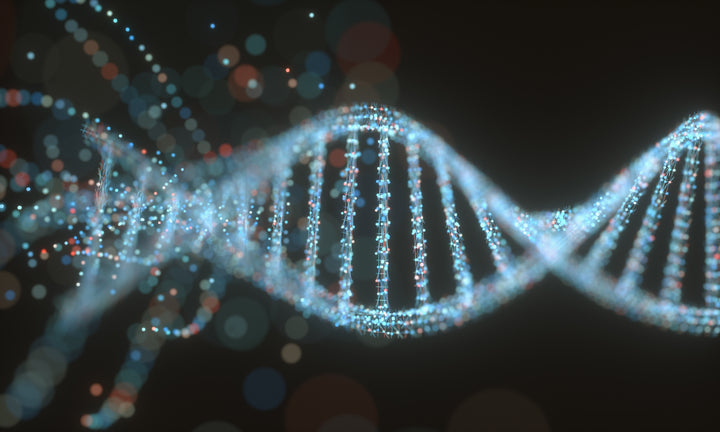
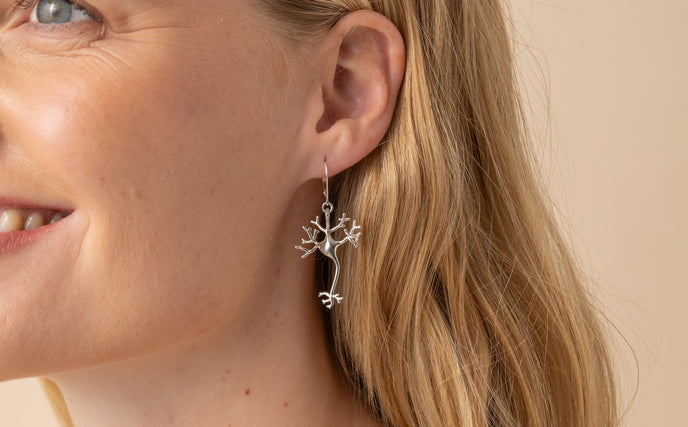
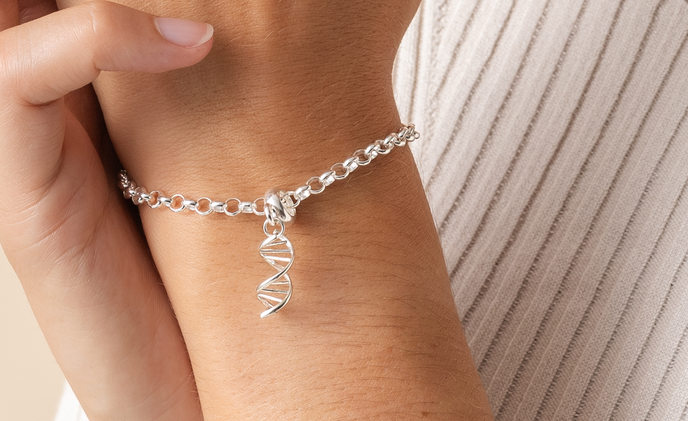
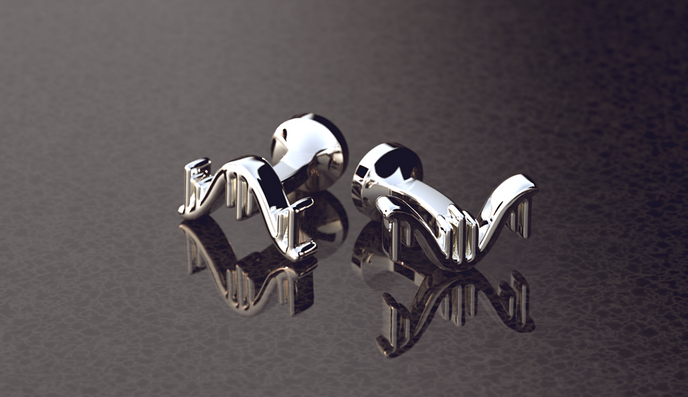
Our genetics-inspired jewelry captures the essence of life's code in striking detail. Crafted to mirror the DNA double helix, each piece is more than an aesthetic marvel—it's a tribute to the complexity of our genetic makeup. Far from ordinary, this collection combines scientific precision with artistic flair, making each item a captivating blend of form and function. It's not just an accessory; it's a meaningful representation of the miracle that is genetics.
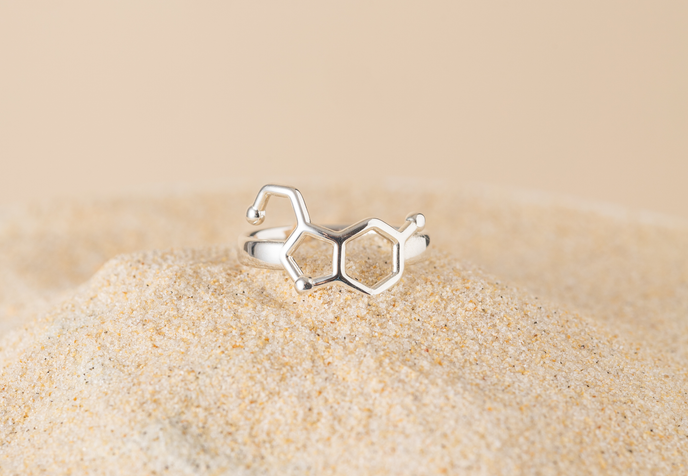
Find your perfect fit: measure an Existing Ring
Finding out your ring size at home is a simple process and can help you shop for jewelry online with confidence.
Necklace length guide