€ 210


Still questions? Contact us
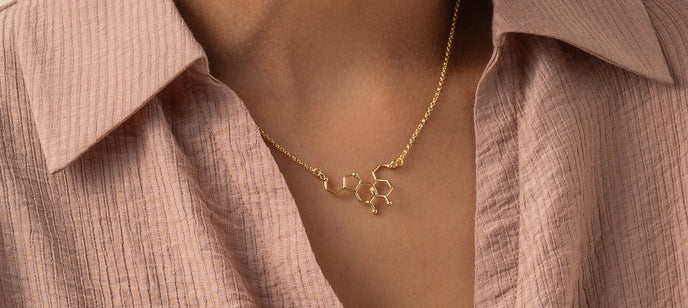
Fz3 atomic orbital necklace | gold vermeil
Across the 15 lanthanides, the 3+ ion shrinks by about a sixth, from 103 picometres in lanthanum to 86 in lutetium, while gaining 14 electrons. A rare-earth chemist with an Fz3 orbital necklace in gold vermeil knows where they go: into her subject, the 4f orbitals, which shield the growing nuclear charge poorly. That mostly explains the contraction.
Who It's For
- a PhD student in inorganic chemistry
- a quantum or computational chemist
- a chemistry or physics lecturer
- a daughter or niece studying chemistry
- yourself, if the f block is your field
How the 4f and 5f Orbitals Differ
The f orbitals fill in two rows of the periodic table, the 4f across the lanthanides and the 5f across the actinides. The 5f orbitals reach further from the nucleus than the 4f and can share in bonding with the atoms around them, at least early in the row. Unlike the lanthanides, many actinides have several oxidation states within easy reach. Uranium compounds are known from +2 to +6, and neptunium and plutonium reach +7. Across the row the 5f orbitals contract, and most actinides after plutonium settle in the +3 state, where their chemistry starts to resemble that of the lanthanides.
Explore Related Physics Jewelry
- Fz3 atomic orbital necklace | silver
- atom necklace | gold vermeil
- atom necklace 3D | gold vermeil
- psi necklace | gold vermeil
FAQ
How big is the pendant, and how does it sit?
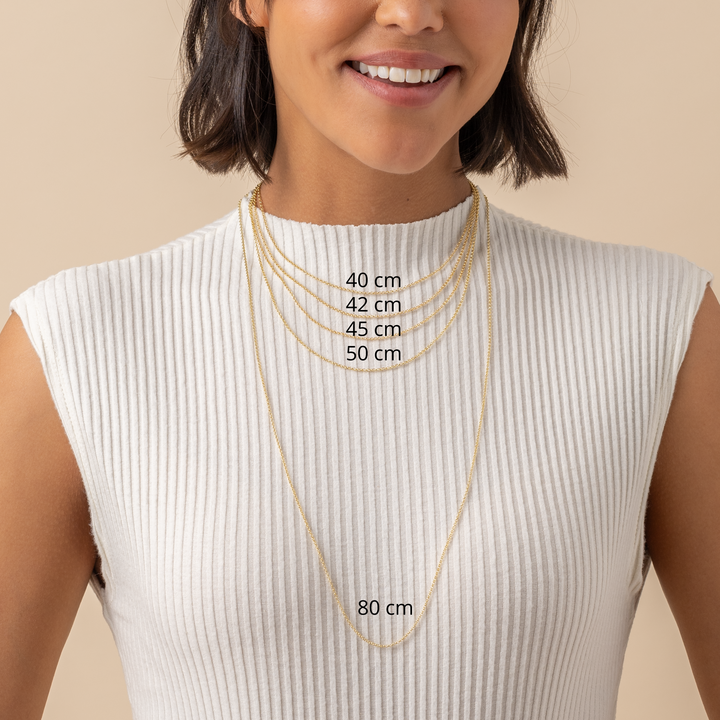
The pendant measures 23 mm (about 0.9 inch), 2.75 mm less than the width of a 2-euro coin (25.75 mm). It hangs upright from a small ring at its top and sits below the collarbone on a 45 cm (17.7 inch) gold vermeil chain with a 5 cm (2 inch) extender. Our vermeil is 2.5 microns of 18K gold over solid sterling silver.
Is there a sterling silver version?
Yes. The Fz3 orbital necklace comes in 18K gold vermeil and in sterling silver, both with a 23 mm pendant on a 45 cm chain with a 5 cm extender. Choose the finish the recipient already wears. The design is the same in both finishes. There are no Fz3 earrings or rings, only the two necklaces.
Will it arrive in time, and what if it isn't right?
DHL Express delivers it free worldwide in 1-5 business days, and we pay the import duties and taxes, so nothing is due at the door. It arrives in a ready-to-gift jewelry box and festive envelope. If it isn't right, our 30-day “Love It or Return It” policy applies.
Why did Coster and Hevesy look for element 72 in zircon, not among the rare earths?
Because theory placed element 72 below zirconium. Georges Urbain had named a new rare earth celtium in 1911 and later claimed it as element 72. In 1921 Charles Bury predicted that element 72 would resemble zirconium, and Niels Bohr's theory pointed the same way. In Copenhagen, Dirk Coster and George de Hevesy took Norwegian zircon from the Geological Museum and examined it by X-ray spectroscopy. The lines of element 72 were there. In their Nature letter of January 1923 they named it hafnium, after Hafnia, the Latin name for Copenhagen.
Math & Physics
Unlock the elegance of the abstract with our math and physics-inspired jewelry collection. These carefully crafted pieces mirror the profound equations and natural laws that shape our understanding of the universe. Experience the allure of fractals, the rhythmic beauty of pi, and the celestial wonder of astral formations—each piece serves as a wearable homage to the artistry inherent in scientific inquiry.
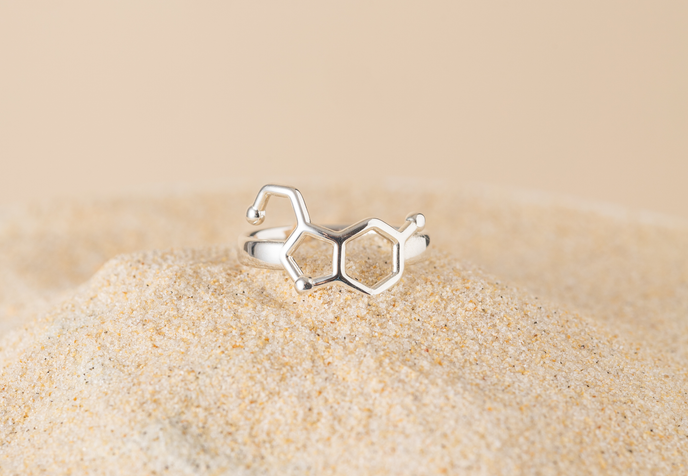
Find your perfect fit: measure an Existing Ring
Finding out your ring size at home is a simple process and can help you shop for jewelry online with confidence.
Necklace length guide