€ 255


Still questions? Contact us
Larynx necklace | 18K gold vermeil
Every word anyone has ever said started in a small structure at the front of the throat. This larynx necklace in 18K gold vermeil is a gift for the speech therapist, ENT surgeon or voice teacher in your life, or for anyone whose work begins with a voice.
Who It's For
- your mother, a speech therapist, for her birthday
- your sister, an ENT doctor, when she finishes her training
- a speech-language pathologist, when she qualifies
- a singer or voice teacher, after a big performance
- yourself, if gold vermeil is what you wear every day
“I bought it for my mother who's a speech therapist and she adored it.” (Arendse A., from a review of the silver version)
“Bought this for my sister who is an ENT doctor and she absolutely loved it.” (Lottie S., from a review of the silver version)
How Fast Your Voice Vibrates
When you speak, air from the lungs pushes through the vocal folds and sets them vibrating, opening and closing in a fast, regular rhythm. In conversation an adult woman's folds do this around 200 times a second, and an adult man's around 120. Pitch rises as the folds stretch thinner and tighter, the way a guitar string sounds higher when tuned up. A soprano singing high C pushes them past 1,000 vibrations a second. What we hear as a voice is that buzz, shaped by the throat, mouth and nose.
Explore Related Human Anatomy Jewelry
- larynx necklace | silver
- inner ear anatomy necklace | gold vermeil
- lungs necklace | gold vermeil
- anatomical heart necklace | gold vermeil
FAQ
How big is the pendant, and what chain comes with it?
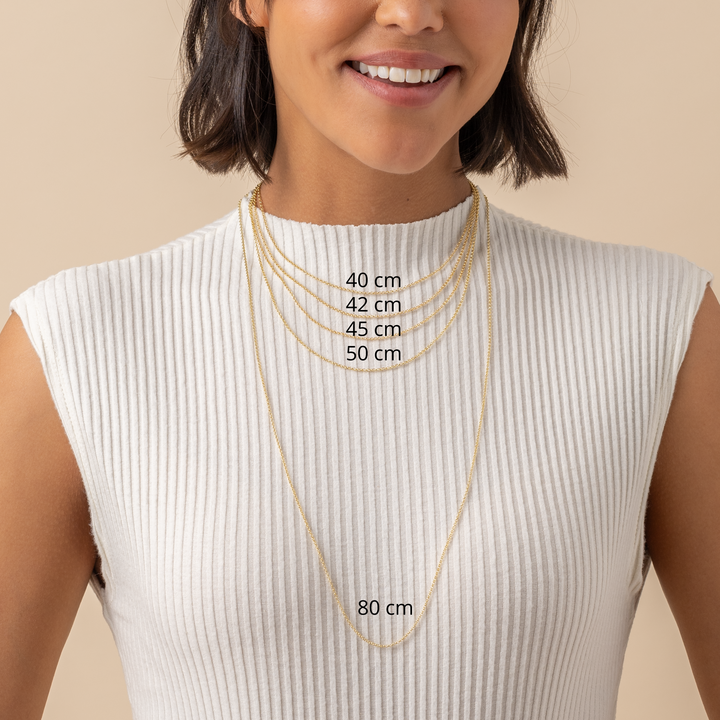
The pendant is 21 mm (about 0.8 inches), about the size of a US nickel and a little smaller than a 1-euro coin. It hangs from the chain at the top and sits just below the collarbone. The chain is 45 cm (17.7 inches) of gold vermeil with a lobster clasp and a 5 cm (2 inch) extender. 18K gold vermeil means 2.5 microns of 18K gold over solid sterling silver, nickel-free and hypoallergenic.
Is there a silver version?
Yes. The larynx necklace also comes in sterling silver, at the same 21 mm on the same 45 cm chain with a 5 cm extender, and sits just below the collarbone in the same way. Choose the finish the recipient already wears: the design is the same in both.
Is delivery free, and what if it isn't right?
Yes. DHL Express delivers free in 1-5 business days worldwide, and we pay the import duties and taxes, so nothing is due at the door. It arrives in a ready-to-gift jewelry box and festive envelope. If it isn't right, our 30-day “Love It or Return It” policy applies.
Who first watched his own vocal folds make a sound?
A singing teacher, not a doctor. In 1854 Manuel García, a Spanish baritone then visiting Paris, wanted to see how a voice is made. He held a small mirror at the back of his throat and used a hand mirror to bounce sunlight onto it. In the reflection he watched his own vocal folds open and close as he breathed and sang. He described what he saw to the Royal Society in London the next year, and his mirror method helped start modern laryngology.

Human Anatomy
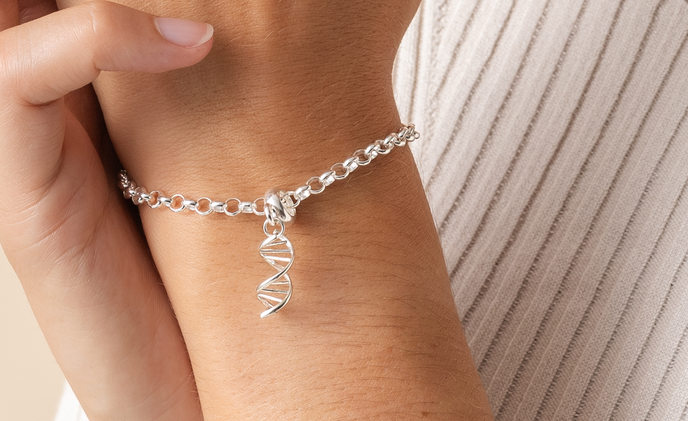
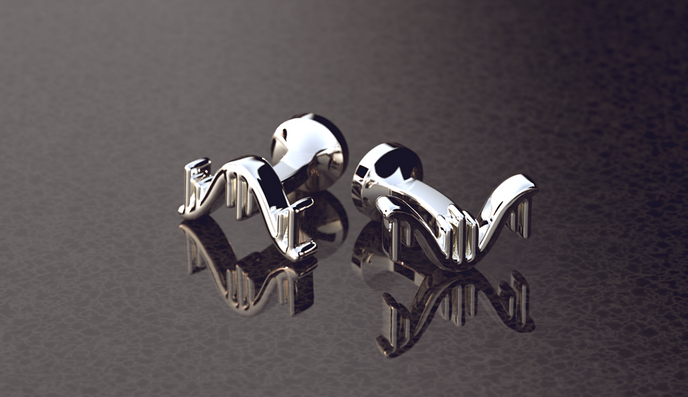
Anatomical wonders have never been so elegantly articulated. Our anatomical collection embodies the intricate and awe-inspiring structures that make us who we are. From DNA double helices to neuronal networks, our pieces don't merely imitate—they interpret. The collection serves as a tangible tribute to the hidden beauty within us all, elevating the realms of biology and medicine into wearable art. With exquisite attention to detail, each piece is a dialogue between form and function, revealing the enigmatic eloquence of the human body.
Find your perfect fit: measure an Existing Ring
Finding out your ring size at home is a simple process and can help you shop for jewelry online with confidence.
Necklace length guide