

€ 145


Still questions? Contact us
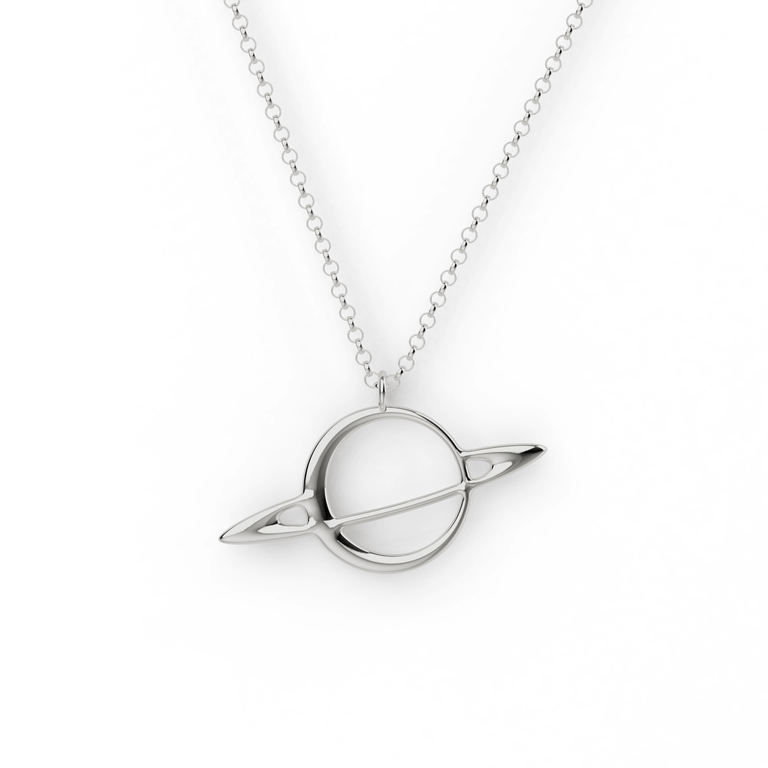
saturn necklace | sterling silver
In 2005, Michele Dougherty's Cassini magnetometer team first detected an atmosphere on Enceladus, as a bend in Saturn's magnetic field. A space physicist with her silver Saturn necklace has magnetic fields like that one as her subject.
Who It's For
- a daughter who is mad about space
- a sister who works in space science
- a friend who owns a telescope
- a physics or astronomy graduate
- yourself, if you love the night sky
Ann Y., in a review of this silver necklace: “Delicate and mysterious”.
The Science Behind Saturn
Saturn is mostly hydrogen and helium, the two elements that make up most of the Sun, and it is the only planet in our solar system with an average density lower than water's. It also holds the record for moons. In March 2025, the International Astronomical Union recognised 128 new ones, found by a team led by Edward Ashton with the Canada-France-Hawaii Telescope. They are only a few kilometres across, likely fragments of a smaller number of captured moons that collisions broke apart. Those finds took Saturn to 274 confirmed moons, and the count has risen again since.
Explore Related Astronomy Jewelry
- Saturn necklace | gold vermeil
- saturn ring | silver
- telescope necklace | silver
- orion necklace L | silver
FAQ
How big is the pendant, and how does it sit?
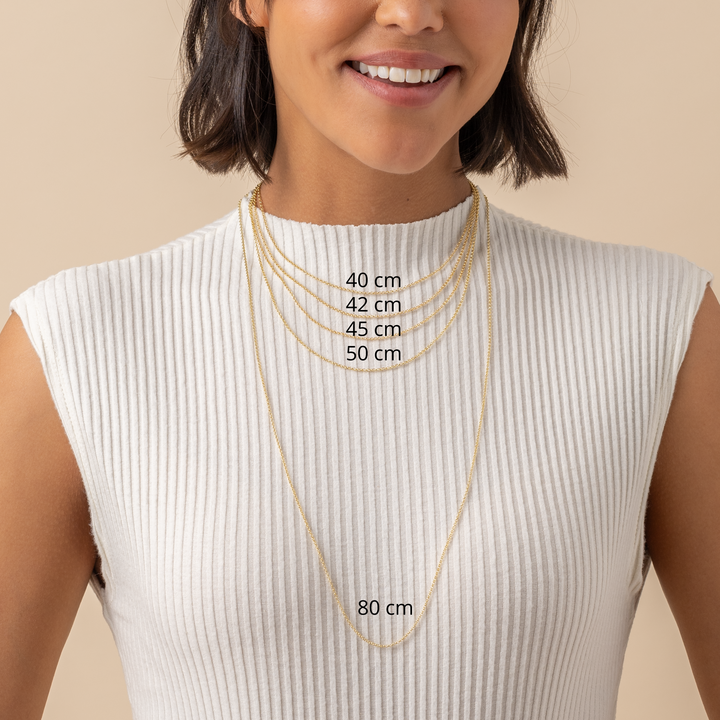
The pendant measures 37 mm (about 1.46 inches), 12.74 mm wider than a US quarter (24.26 mm). It hangs from a small ring at the top of the planet, with the chain running through that ring, and sits below the collarbone on a 45 cm (17.7 inch) sterling silver chain with a 5 cm (2 inch) extender. Our 925 sterling silver is nickel-free and hypoallergenic.
Does it come in gold vermeil, and is there a Saturn ring?
Yes. The Saturn necklace also comes in gold vermeil, with the same 37 mm pendant on a 45 cm gold vermeil chain with a 5 cm extender. Choose the finish the recipient already wears. The design is the same in both finishes. There is also a Saturn ring, in sterling silver only. For a second silver astronomy necklace, the telescope necklace has a 31 mm pendant on the same 45 cm chain.
Will it arrive in time, and what if it isn't right?
DHL Express delivers it free worldwide in 1-5 business days, and we pay the import duties and taxes, so nothing is due at the door. It arrives in a ready-to-gift jewelry box and festive envelope. If it isn't right, our 30-day “Love It or Return It” policy applies.
How did James Clerk Maxwell work out that Saturn's rings can't be solid?
With mathematics, long before a telescope settled it. Maxwell took the question on for Cambridge's Adams Prize in the mid-1850s, and his essay was the only entry. He showed that no solid or liquid ring could stay stable, and concluded in the essay, published in 1859, that the rings must be countless separate particles, each orbiting at its own speed. In April 1895, James Keeler at the Allegheny Observatory measured the rings with a spectroscope and found the inner edge moving faster than the outer, as separate particles would.
Math & Physics
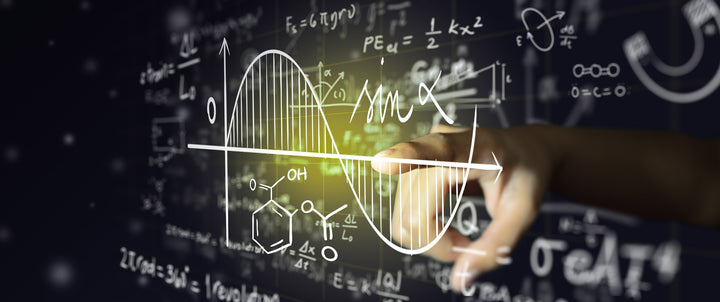
Unlock the elegance of the abstract with our math and physics-inspired jewelry collection. These carefully crafted pieces mirror the profound equations and natural laws that shape our understanding of the universe. Experience the allure of fractals, the rhythmic beauty of pi, and the celestial wonder of astral formations—each piece serves as a wearable homage to the artistry inherent in scientific inquiry.
Find your perfect fit: measure an Existing Ring
Finding out your ring size at home is a simple process and can help you shop for jewelry online with confidence.
Necklace length guide