€ 185


Still questions? Contact us
atlas necklace | 18K gold vermeil
An atlas necklace honours the first bone of the neck, the one that holds up your head. One osteopath and chiropractor, reviewing the silver version, called the atlas the most important vertebra in their profession. It is a gift for a woman whose hands look after necks and spines.
Who It's For
- a friend retiring from a career in chiropractic
- your wife, if she loves science
- a partner whose collection of science jewelry keeps growing
- yourself, to wear every day
And if your own neck or spine has a story, it is a quiet way to acknowledge it.
Lorraine G., from a review of the silver version: “I gave this to a dear friend and she was so happy.” Anna I., on the gold vermeil version: “Beautiful necklace. I never take it off!”
The Anatomy of the Atlas
The atlas is the only vertebra with no body. It is a ring of bone with a thick lateral mass on each side, and the skull rests on those two masses. The small nod of a yes happens mainly at that joint, between the skull and the atlas. The no works differently. The dens, a peg of bone rising from the second vertebra, the axis, is held against the front of the ring by the transverse ligament, and the atlas turns around it. Roughly half of the neck's rotation happens at that one level.
Explore Related Anatomy Jewelry
- atlas necklace | silver
- cervical vertebra necklace | gold vermeil
- spine necklace | gold vermeil
- skull necklace | gold vermeil
FAQ
How big is the pendant, and how does it sit?
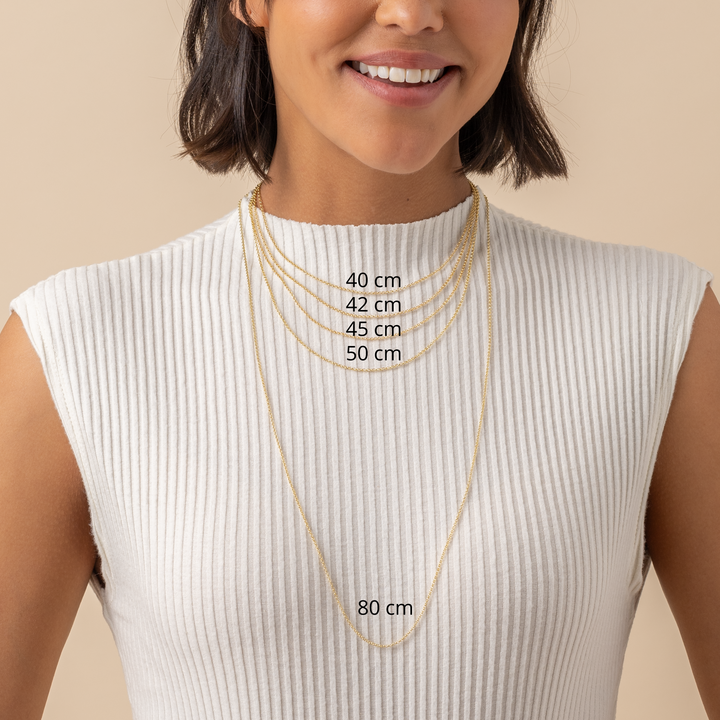
The pendant measures 26 mm (about 1 inch), close to the size of a 2-euro coin (25.75 mm). It hangs level, wider than it is tall, with the chain attached at each side, and sits below the collarbone on a 45 cm (17.7 inch) gold vermeil chain with a 5 cm (2 inch) extender. Longer chains up to 80 cm can be added on this page. The pendant is 2.5 microns of 18K gold over solid sterling silver, nickel-free and hypoallergenic.
Is there a silver version, or other vertebrae?
Yes. The same 26 mm atlas comes in sterling silver, on a 45 cm silver chain with a 5 cm extender. Choose the finish the recipient already wears. The design is the same in both. The cervical vertebra (24 mm), thoracic vertebra (24 mm) and lumbar vertebra (27 mm) necklaces and the full spine (60 mm) also come in both gold vermeil and silver.
Will it arrive in time, and what if it isn't right?
DHL Express delivers free in 1-5 business days worldwide, and we pay the import duties and taxes, so nothing is due at the door. It arrives in a ready-to-gift jewelry box and festive envelope. If it isn't right, our 30-day “Love It or Return It” policy applies.
Why is C1 called the atlas?
It is named after the Titan Atlas, who in Hesiod's Theogony holds up the wide heaven “with unwearying head and arms”. The name took centuries to settle on the right bone. Galen called it simply the first vertebra, while his contemporary Julius Pollux, in a word list, used atlas for the seventh, at the base of the neck. It first appeared in print in 1501, and in the early 1520s the anatomist Jacopo Berengario da Carpi moved it to the top of the neck, where it stays.

Human Anatomy
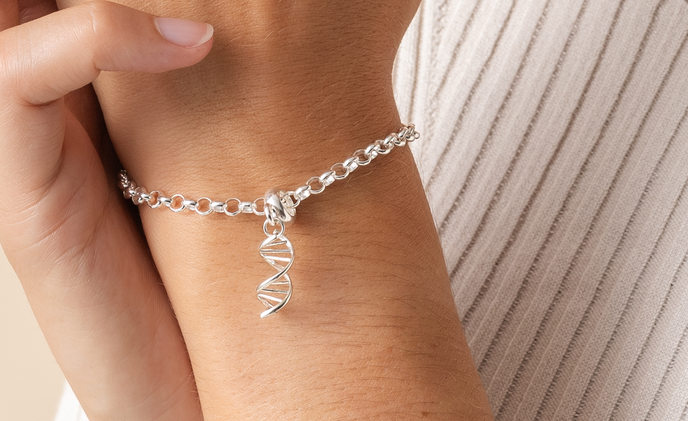
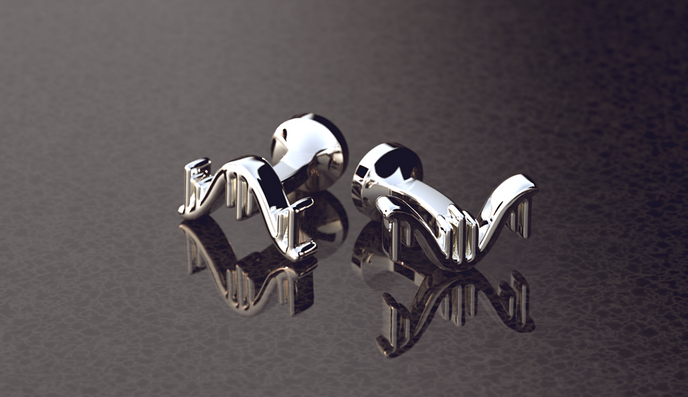
Anatomical wonders have never been so elegantly articulated. Our anatomical collection embodies the intricate and awe-inspiring structures that make us who we are. From DNA double helices to neuronal networks, our pieces don't merely imitate—they interpret. The collection serves as a tangible tribute to the hidden beauty within us all, elevating the realms of biology and medicine into wearable art. With exquisite attention to detail, each piece is a dialogue between form and function, revealing the enigmatic eloquence of the human body.
Find your perfect fit: measure an Existing Ring
Finding out your ring size at home is a simple process and can help you shop for jewelry online with confidence.
Necklace length guide