€ 245


Still questions? Contact us
Buckyball necklace | 18K gold vermeil
The 1996 Nobel Prize in Chemistry recognised the discovery that opened the third allotrope of carbon and started the entire field of carbon nanostructures. The 18K gold vermeil version of C60, at 25 mm on an 80 cm chain, the milestone-gift companion to the silver buckyball.
The Science Behind the Buckyball
Buckminsterfullerene (C60) was discovered in 1985 by Robert Curl, Harold Kroto, and Richard Smalley at Rice University, using laser ablation of graphite to vaporise carbon clusters and time-of-flight mass spectrometry to identify the resulting C60 peak. The truncated icosahedron geometry, twelve pentagons interlocking with twenty hexagons, was named for Buckminster Fuller's geodesic-dome architecture. The Nobel Prize in 1996 marked the moment carbon nanostructures became a working field. Carbon nanotubes (Iijima 1991) and graphene (Geim and Novoselov, Nobel 2010) followed in the same family, with sp2-hybridised carbon arranged in closed cages, hollow tubes, or single-atom-thick sheets. The whole nanocarbon field traces its working chemistry back to what C60 first demonstrated. Modern applications include drug delivery vehicles, organic photovoltaics, and superconductor research.
The Audience
- materials chemists and chemical physicists at career milestones
- nanocarbon researchers working on fullerenes, nanotubes, or graphene
- solid-state physicists and crystallographers
- partners and family of working materials scientists looking for a gold gift
Most often given on a chemistry or materials science graduation, where the gold version reads as recognition for working at the carbon-nanostructure frontier.
Explore Related Math and Physics Jewelry
- Buckyball necklace | silver
- Diamond crystal structure necklace | gold vermeil
- Atom necklace | gold vermeil
- Feynman scattering necklace | gold vermeil
- Integral necklace | gold vermeil
FAQ
Why pick the gold buckyball over the silver?
The most common reason is the milestone framing. Gold reads as recognition where silver reads as daily wear. Same 25 mm pendant, same 80 cm chain, same C60 cage geometry. The choice is about what the gift is meant to mark, not what fullerenes do in materials chemistry. Often given at the end of a chemistry graduation or a long career in nanocarbon research.
Why does the buckyball matter to a working materials chemist forty years on?
Because it founded the working framework for thinking about carbon nanostructures. Carbon nanotubes, graphene, and the broader family of sp2-hybridised carbon allotropes all sit on the conceptual foundation C60 established: closed-cage, tube, or sheet geometries built from the same kind of bonding network. Modern research on photovoltaics, superconductors, drug-delivery vehicles, and quantum-dot cousins still references the original C60 chemistry as the benchmark structure. The molecule is the textbook anchor for an entire active field.
What size is the pendant and what chain comes with it?
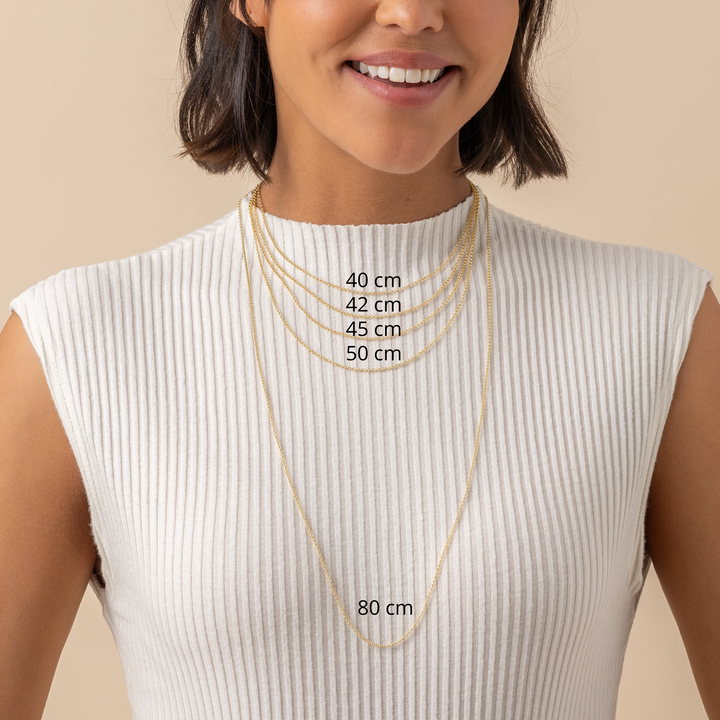
18K gold vermeil over a sterling silver core, 25 mm pendant on an 80 cm gold vermeil chain (ø 1.8 mm) with lobster clasp. The longer chain sits at sternum height when worn over a sweater or a layer, which suits the spherical pendant geometry. Nickel-free and hypoallergenic. Free worldwide DHL Express in 1-5 business days, with all import duties and taxes covered. 30-day “Love It or Return It” returns.
Is there a silver version?
Yes. The same buckyball is available in sterling silver at the same 25 mm size and same 80 cm chain length. Silver tends to suit daily wear, gold tends to suit graduation, retirement, or a major academic appointment in materials chemistry or solid-state physics.

Math & Physics
Unlock the elegance of the abstract with our math and physics-inspired jewelry collection. These carefully crafted pieces mirror the profound equations and natural laws that shape our understanding of the universe. Experience the allure of fractals, the rhythmic beauty of pi, and the celestial wonder of astral formations—each piece serves as a wearable homage to the artistry inherent in scientific inquiry.
Find your perfect fit: measure an Existing Ring
Finding out your ring size at home is a simple process and can help you shop for jewelry online with confidence.
Necklace length guide