€ 200


Still questions? Contact us
Fz3 atomic orbital necklace | gold vermeil
There are seven 4f orbitals, and unless you spent serious time learning what they look like, you probably can't tell them apart by eye. The fz3 is the one with the doughnut around its waist. It belongs to a small group of people who can recognise it on sight.
The Science Behind the Fz3 Atomic Orbital
Atomic orbitals are the spatial probability distributions of electrons around a nucleus, derived as solutions to the Schrödinger equation. Each orbital is characterised by three quantum numbers: principal (n), angular momentum (l), and magnetic (ml). The 4f orbitals (n=4, l=3) appear in elements with atomic numbers 57 to 71 (lanthanides) and 89 to 103 (actinides). The fz3 specifically has its maximum probability density along the z-axis with a toroidal region around the equator. The mathematical form derives from spherical harmonics, the angular component of the wavefunction. The 4f orbitals are directly observable through X-ray absorption spectroscopy and dominate the electronic and magnetic properties of f-block compounds.
A Quiet Symbol For
Quantum chemistry has a small, devoted readership.
- quantum and computational chemists
- inorganic chemists working with lanthanides or actinides
- theoretical and atomic physicists
- anyone whose dissertation contains the phrase 'spherical harmonics'
Most often a graduation gift for a chemistry PhD, or a milestone marker for someone whose research lives in the f-block.
Explore Related Math and Physics Jewelry
- Fz3 atomic orbital necklace | silver
- Atom necklace 3D | gold vermeil
- Psi necklace | gold vermeil
- Feynman scattering necklace | gold vermeil
FAQ
Will a quantum chemist actually recognise this?
Quickly. Once you have stared at orbital plots for a while, the fz3 is unmistakable. It is also a bit niche, which is part of the appeal. Anyone who recognises it has done time in atomic structure or theoretical chemistry.
What is the practical relevance of the 4f orbitals?
They drive the electronic, magnetic, and optical properties of the lanthanides and actinides. Neodymium magnets, lanthanide-based MRI contrast agents, and the spectroscopy of nuclear fuel cycles all trace back to how 4f electrons behave in different chemical environments.
What are the size, material, and chain specs?
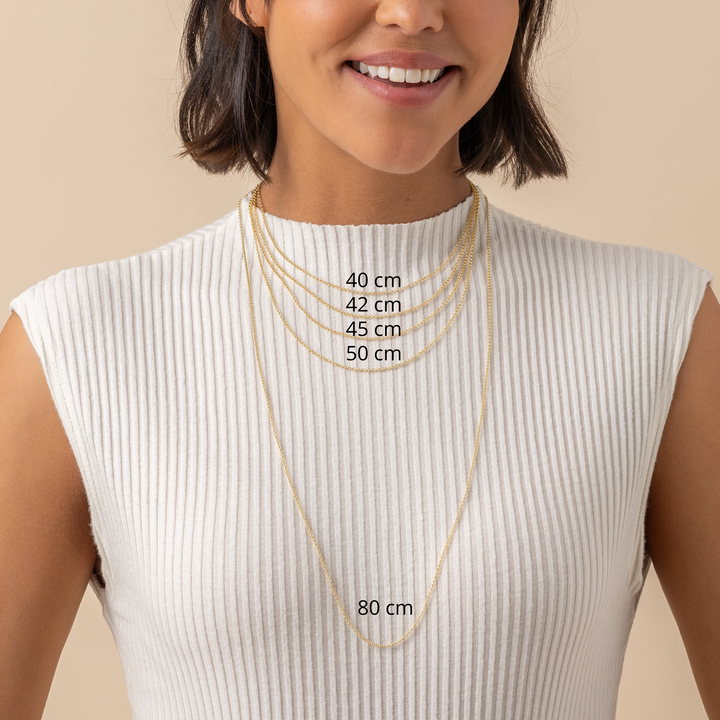
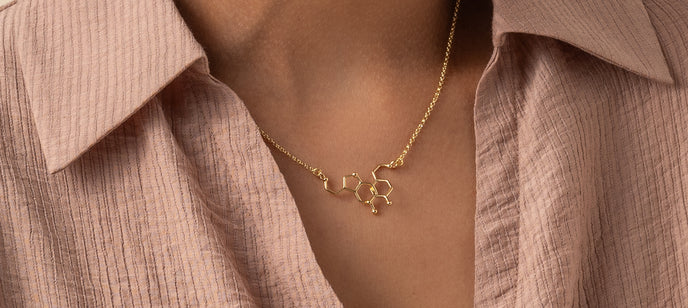
23 mm pendant in 18K gold vermeil (sterling silver core, 2.5 micron gold plating), nickel-free. 45 cm gold vermeil chain with a 5 cm extender. Free worldwide DHL Express, 1-5 business days, all duties and taxes covered. 30-day “Love It or Return It” policy.
How does the gold compare to the silver fz3?
Same orbital, same 23 mm size. The gold is sterling silver core with 2.5 micron 18K gold plating. The silver is solid 925 sterling. The gold tends to be picked for milestone gifts. The silver tends to go as daily wear.
Math & Physics
Unlock the elegance of the abstract with our math and physics-inspired jewelry collection. These carefully crafted pieces mirror the profound equations and natural laws that shape our understanding of the universe. Experience the allure of fractals, the rhythmic beauty of pi, and the celestial wonder of astral formations—each piece serves as a wearable homage to the artistry inherent in scientific inquiry.
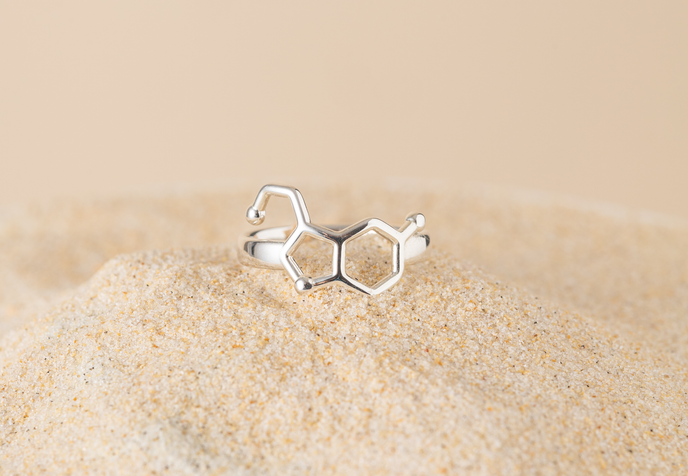
Find your perfect fit: measure an Existing Ring
Finding out your ring size at home is a simple process and can help you shop for jewelry online with confidence.
Necklace length guide