€ 145


Still questions? Contact us
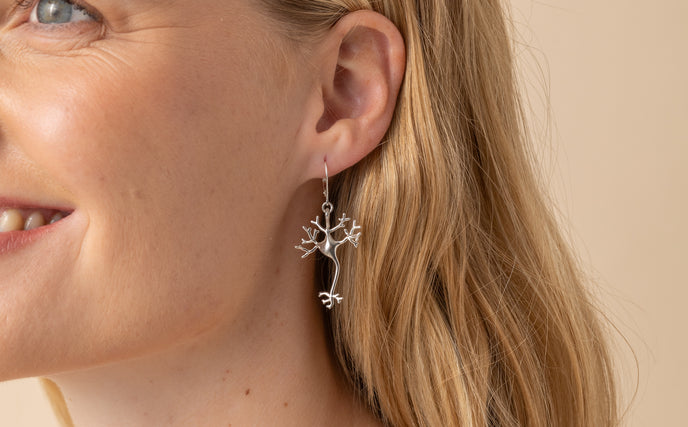
Spindle neuron necklace | 18k gold vermeil
There are only about 80,000 to 200,000 spindle neurons per human hemisphere, out of 86 billion neurons total. They appear almost nowhere else in the animal kingdom except in great apes, elephants, cetaceans, and a small number of other socially complex species. Rarity and function together.
The Science Behind Spindle Neurons
Spindle neurons, or Von Economo neurons, were formally described by Constantin von Economo and Georg Koskinas in 1925. They are large, bipolar neurons located primarily in the anterior cingulate cortex and frontoinsular cortex, brain regions linked to empathy, self-awareness, emotion processing, and social decision-making. Their long axons enable rapid, long-distance signal transmission. Their distribution across species correlates strongly with social complexity and brain size. Their function remains an active area of neuroscience research. Degeneration of spindle neurons is selective and early in frontotemporal dementia, suggesting their importance in preserving self-awareness and emotional continuity. Their evolutionary emergence and restricted distribution make them one of the most active topics in contemporary cognitive neuroscience.
Who Tends to Wear This
- neuroscientists studying consciousness, empathy, and social cognition
- psychiatrists and neurologists interested in dementia and neural degeneration
- primatologists and evolutionary biologists researching cognition
- anyone drawn to the biological basis of what makes us human
Explore Related Neuroscience Jewelry
- Spindle neuron necklace | silver
- Neuron necklace | gold vermeil
- Brain necklace | silver
- Dopamine necklace V | silver
FAQ
Is this a meaningful gift for a neuroscientist?
Yes. Spindle neurons are rare, distinctive, and a historically recent discovery. The gold vermeil version signals that this is a milestone piece for someone who studies the neurobiology of consciousness and empathy. It marks a specialist who has invested deeply in understanding what makes humans unique.
Why are spindle neurons so rare?
They are large, metabolically expensive, and appear to be related to advanced social cognition. Their restriction to a small group of species with large, complex brains suggests they evolved relatively recently and specifically for functions tied to self-awareness and emotional processing. Their rarity is part of what makes them biologically interesting.
What size, material, and chain come with this?
37 mm pendant in 18k gold vermeil (sterling silver core with 2.5 micron gold plating), nickel-free and hypoallergenic. 45 cm gold vermeil chain with 5 cm extender. Ships free worldwide via DHL Express in 1-5 business days. Comes ready-to-gift with the 30-day “Love It or Return It” policy.
Is there a silver version at the same size?
Yes. Spindle neuron is available in sterling silver at 37 mm. Same neuron, same neuroscience, same scale. Many neuroscientists collect both versions or pair them as personal pieces and mentor gifts.

Neuroscience
Dive into the intricacies of the human mind with our neuroscience-inspired jewelry collection. Each piece is a tactile ode to the neural networks that shape our thoughts, memories, and consciousness. Crafted with meticulous attention to detail, our designs mirror the dendritic branches and synaptic connections that form the basis of mental activity. With these elegant pieces, wear the enigma of cognition close to your skin, offering a subtle yet profound exploration of what it means to be sentient.
Find your perfect fit: measure an Existing Ring
Finding out your ring size at home is a simple process and can help you shop for jewelry online with confidence.
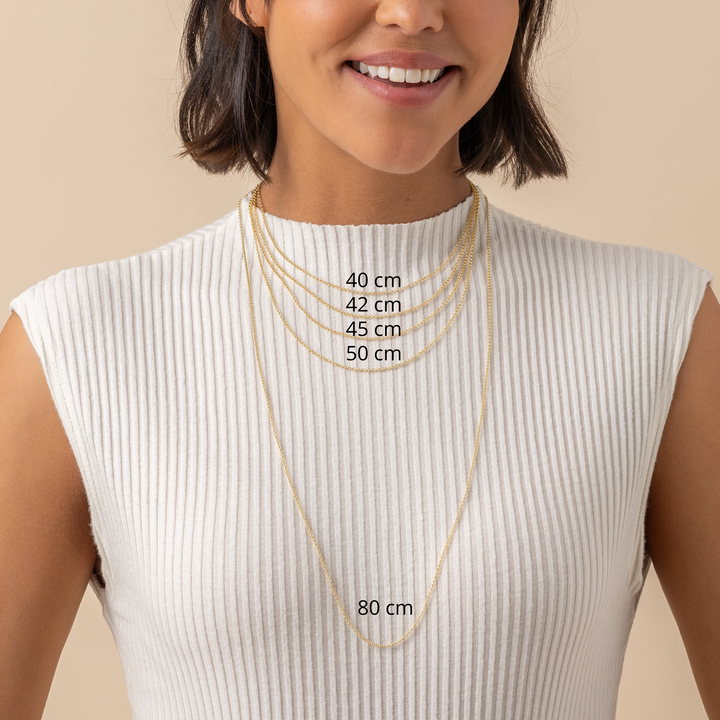
Necklace length guide