€ 165


Still questions? Contact us
Dopamine necklace H | gold vermeil
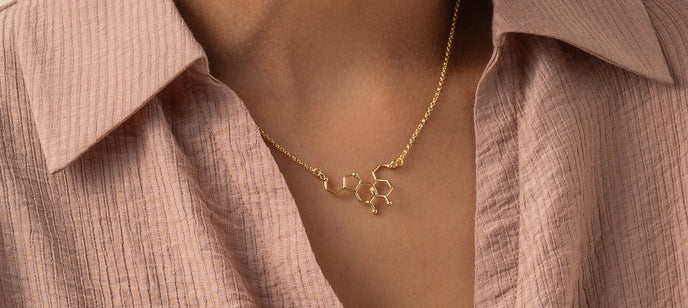
A dopamine necklace is a small piece of science she can wear anywhere. This one, in gold vermeil, is a birthday present for a girlfriend or partner, a gift for a daughter who is a biologist or a scientist friend, or something to keep for yourself.
Who It's For
- a girlfriend or partner, for her birthday
- a fiancée, when you want a beautiful but simple necklace
- a daughter who is a biologist
- a scientist in your life, as a present
- a granddaughter, when you want to give her something special
- yourself, as a small pendant to wear every day
Gonzalo C. gave it for a birthday: “It is small and minimalist, so it's very versatile. I would see it fit perfectly both at a get-together or university event.”
Dopamine and the Thinking Brain
In the prefrontal cortex, behind the forehead, dopamine helps the brain hold a thought. It acts on D1 receptors in the nerve cells that keep information in mind for a few seconds, the job called working memory. The dose matters. Too little dopamine signal and working memory suffers, but too much harms it as well, a pattern researchers call the inverted U. In 2007 a Yale team recorded single neurons in monkeys doing a memory task. A little D1 stimulation sharpened the neurons' preference for one remembered location, while a lot weakened their firing and eroded it. Clear thinking needs dopamine in a sweet spot, not at a maximum.
Explore Related Molecules Jewelry
- dopamine necklace H | silver
- dopamine necklace V | gold vermeil
- dopamine studs | gold vermeil
- dopamine serotonin necklace H | gold vermeil
FAQ
How big is the pendant, and how does it sit?
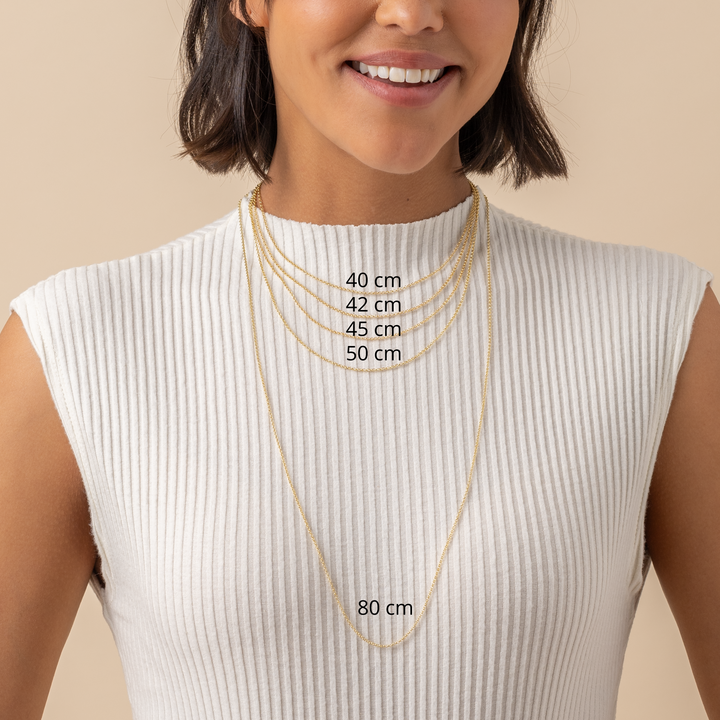
The pendant measures 20 mm (about 0.8 inch), the size of a 10-cent euro coin and a little larger than a US dime. The chain runs through both ends, so the pendant sits horizontally around the collarbone, on a 45 cm (17.7 inch) gold vermeil chain with a 5 cm (2 inch) extender. Extra chains from 40 to 80 cm can be added here. The pendant is 2.5 microns of 18K gold over solid sterling silver, nickel-free and hypoallergenic. Store it dry and wipe it with a soft cloth.
Is there a silver version, or a vertical one?
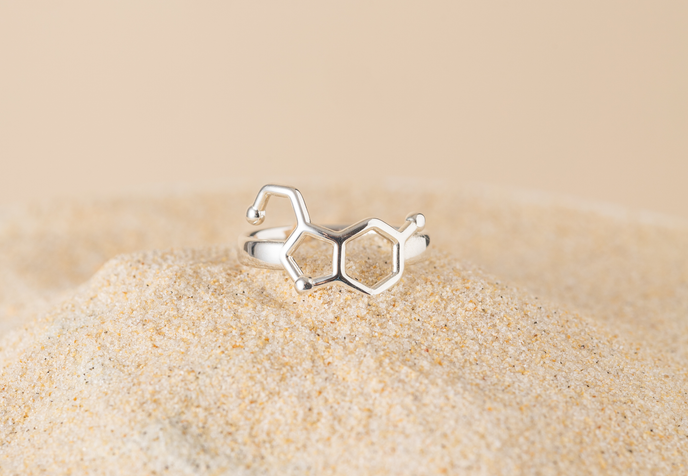
Yes. The same 20 mm pendant comes in sterling silver. There is also a vertical dopamine necklace, where the pendant hangs upright, in gold vermeil and silver at the same 20 mm. Choose the finish she already wears. The design is the same in both finishes. To match it, there are dopamine studs in gold vermeil or silver (15 mm), and a dopamine ring and a dopamine bracelet in silver.
Will it arrive in time, and what if it isn't right?
DHL Express delivers it free worldwide in 1-5 business days, and we pay the import duties and taxes, so nothing is due at the door. It arrives in a ready-to-gift jewelry box and festive envelope. If it isn't right, our 30-day “Love It or Return It” policy applies.
Who showed that dopamine matters for thinking?
Thomas Brozoski, Patricia Goldman (later Goldman-Rakic) and colleagues at the US National Institute of Mental Health. In 1979 they reported in Science that depleting dopamine in a small area of prefrontal cortex in rhesus monkeys impaired a spatial memory task nearly as much as removing that area altogether. L-DOPA, which the brain turns into dopamine, and apomorphine, which mimics it, reversed the deficit. At the time, dopamine was known mainly for its role in movement, through Parkinson's disease.
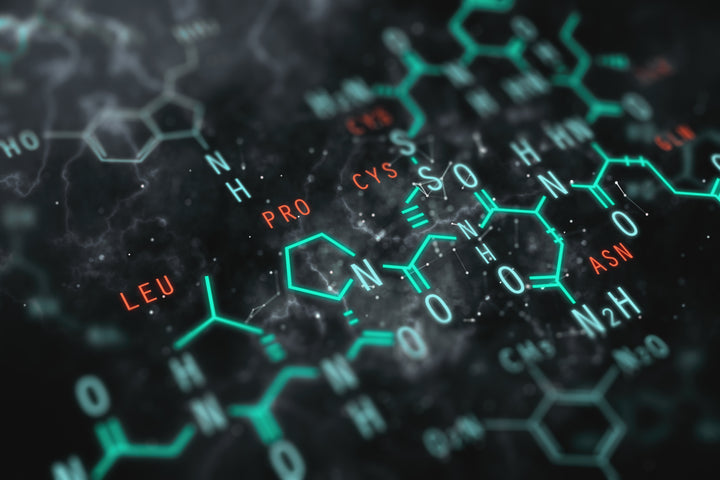
Molecules
Delve into the hidden elegance of science with our meticulously crafted jewelry, inspired by the intricate structures of chemical molecules. Each piece serves as a tactile tribute to the building blocks of life and matter, capturing the allure of atoms and bonds in precious metals. A harmonious fusion of art and science, these creations are more than mere accessories; they're a celebration of the enigmatic beauty that underpins our universe.
Find your perfect fit: measure an Existing Ring
Finding out your ring size at home is a simple process and can help you shop for jewelry online with confidence.
Necklace length guide