€ 200


Still questions? Contact us
Circle of Willis necklace | gold vermeil
One reviewer bought a circle of Willis necklace in silver, a gift for their daughter. At the ring, each internal carotid artery ends by splitting in two. One branch, the anterior cerebral artery, joins the circle. The larger one, the middle cerebral artery, runs out sideways to feed most of the outer surface of that half of the brain.
Who It's For
- your girlfriend, once she has matched into a neurosurgery residency
- your wife, for her birthday
- your son's girlfriend
- a vascular neurologist you love
- a health professional who works with stroke patients
- yourself, if you are a medical student
From reviews of the silver version: Valorie M.: “I bought this as a gift for my son's girlfriend. She and I were both very pleased with the quality of the piece.” Wittmann D., who bought one to keep: “I'm a medical student and I bought it for myself. It's just the right size and weight.”
Where the Circle of Willis Sits
The circle of Willis lies on the underside of the brain and surrounds the optic chiasm, where the two optic nerves meet and partly cross. Its front link, the anterior communicating artery, is only about 4 mm long and runs just above the chiasm and the stalk of the pituitary gland. From the ring and the first stretch of its branches, many fine perforating arteries rise straight into the brain. They feed deep structures such as the hypothalamus, part of the thalamus and the internal capsule. On average, an adult human brain of about 1,350 grams takes in slightly more than 700 millilitres of blood a minute.
Explore Related Neuroscience Jewelry
- circle of Willis necklace | silver
- brain necklace | gold vermeil
- sagittal brain necklace | gold vermeil
- ventricular system necklace | gold vermeil
FAQ
How big is the pendant, and how does it sit?
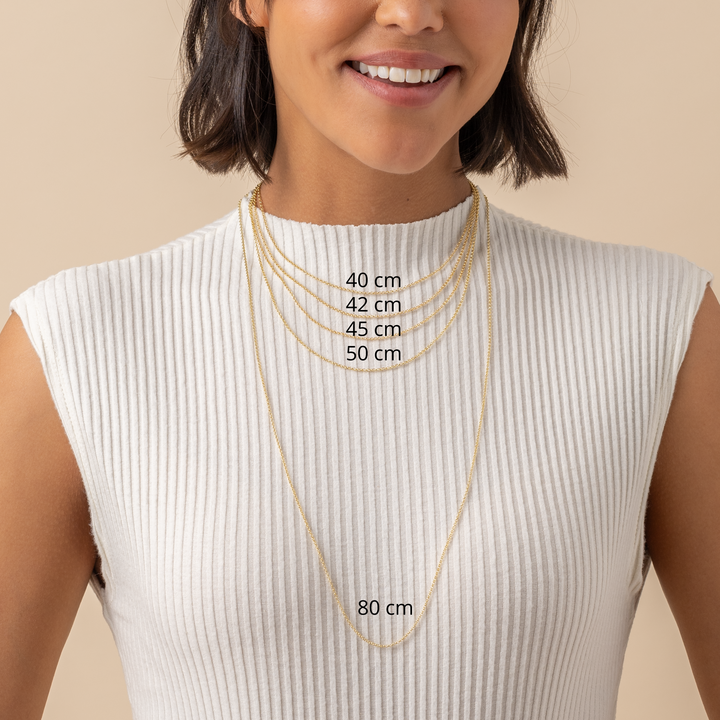
The pendant measures 43 mm (about 1.7 inches), about 17 mm more than a 2-euro coin (25.75 mm). It hangs from a small ring at its top and sits below the collarbone on a 45 cm (17.7 inch) gold vermeil chain with a 5 cm (2 inch) extender. Our vermeil is 2.5 microns of 18K gold over solid sterling silver. An extra chain, for layering or another pendant, can be added on this page: 40, 42, 45 or 50 cm with the extender, or 80 cm.
Is there a silver version, or matching earrings?
Yes, there is a sterling silver version, but there are no circle of Willis earrings. The circle of Willis necklace comes in 18K gold vermeil and in sterling silver, both with a 43 mm pendant on a 45 cm chain with a 5 cm extender. Choose the finish the recipient already wears. The design is the same in both finishes. If she would prefer a smaller pendant, the brain necklace measures 18 mm, in gold vermeil and in sterling silver.
Will it arrive in time, and what if it isn't right?
DHL Express delivers it free worldwide in 1-5 business days, and we pay the import duties and taxes, so nothing is due at the door. It arrives in a ready-to-gift jewelry box and festive envelope. If it isn't right, our 30-day “Love It or Return It” policy applies.
Who traced how the circle of Willis forms before birth?
Dorcas Hager Padget, a medical illustrator who became an embryologist, in a study published in 1948. Without a college degree, she trained under Max Brödel at Johns Hopkins, and from the late 1920s she was medical artist to the neurosurgeon Walter Dandy. With Dandy's encouragement, she began studying human embryos from the Carnegie Collection. After Dandy died in 1946 she turned to research full time. Her reconstructions follow the arteries of the embryo's head stage by stage, and the series ends on the circle of Willis.

Human Anatomy
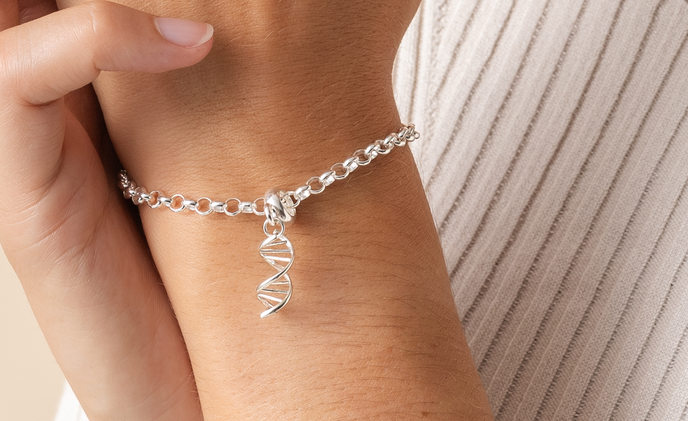
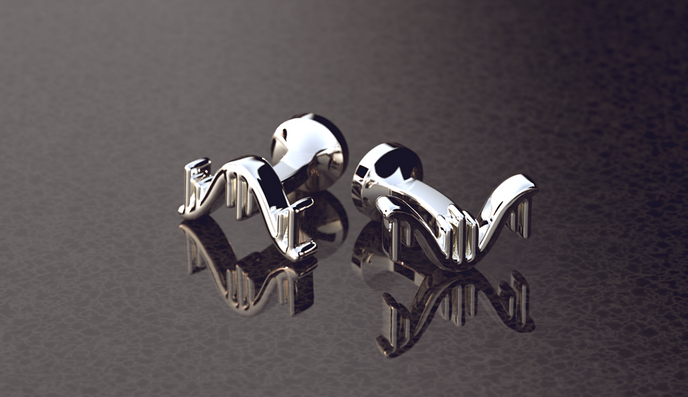
Anatomical wonders have never been so elegantly articulated. Our anatomical collection embodies the intricate and awe-inspiring structures that make us who we are. From DNA double helices to neuronal networks, our pieces don't merely imitate—they interpret. The collection serves as a tangible tribute to the hidden beauty within us all, elevating the realms of biology and medicine into wearable art. With exquisite attention to detail, each piece is a dialogue between form and function, revealing the enigmatic eloquence of the human body.
Find your perfect fit: measure an Existing Ring
Finding out your ring size at home is a simple process and can help you shop for jewelry online with confidence.
Necklace length guide