€ 150


Still questions? Contact us
Anthocyanin necklace | sterling silver
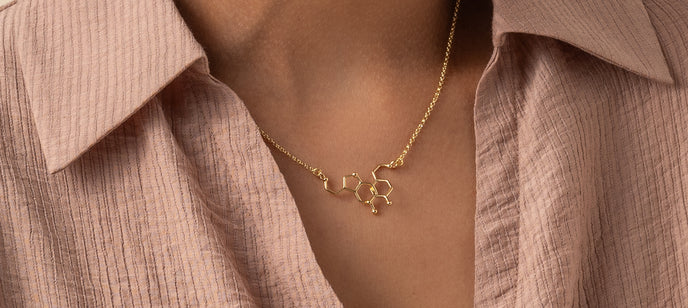
If you have spent enough time in plant biochemistry to think of red cabbage as a pH indicator before you think of it as cabbage, you already know what this molecule does. Anthocyanins produce the red-purple-blue spectrum of berries, autumn leaves, red wine, and most flower colours that are not yellow. Worn here as a 32 mm sterling silver pendant.
The Science Behind Anthocyanins
Anthocyanins are glycosylated flavylium cations. Their colour comes from the extended conjugated pi system of the flavylium ring, which absorbs visible light selectively depending on pH. In acidic conditions, the cation is red. As pH rises, the molecule undergoes structural changes that shift it through purple to blue-green. This is why red cabbage juice turns green when baking soda is added and red again with vinegar, the classic chemistry-class demonstration that runs entirely on anthocyanin photochemistry. In plants, anthocyanins act as UV screens for photosynthetic tissue, attractants for pollinators and seed dispersers, and chemical defences against pathogens. More than 600 individual anthocyanin structures have been catalogued, with cyanidin, delphinidin, and pelargonidin as the most common aglycone cores.
Who Will Recognise It
- plant biochemists and natural product chemists
- food scientists and nutritional researchers
- science educators who use anthocyanin as a pH indicator
- anyone for whom the chemistry of plant colour is more interesting than the colour itself
For someone who looks at a blueberry and thinks about flavylium cation photochemistry.
Explore Related Molecules Jewelry
- Chlorophyll necklace | silver
- Capsaicin necklace | silver
- Juniper necklace | silver
- Theobromine necklace | silver
- Tocopherol necklace | silver
FAQ
Why anthocyanin instead of chlorophyll?
Chlorophyll handles photosynthesis. Anthocyanin handles the rest of the plant's optical work: signalling to pollinators, screening UV, marking ripeness, and the autumn colour shift after chlorophyll is degraded and other pigments become visible. People who work on plant secondary metabolism, food chemistry, or the molecular basis of flower and fruit colour reach for anthocyanin specifically because it covers the parts of plant biology that chlorophyll does not.
Why are anthocyanins so pH-dependent?
Because the flavylium cation's protonation state changes with pH, and that changes the wavelength the molecule absorbs. The conjugated pi system is sensitive to small changes in electron distribution. In acid, the cation form dominates and absorbs in the green-blue, transmitting red. In base, the molecule shifts to a quinoidal form that absorbs in the yellow-red and transmits blue. The colour shift is dramatic and reversible, which is exactly what makes anthocyanins useful as natural pH indicators.
What size is the pendant and what chain comes with it?
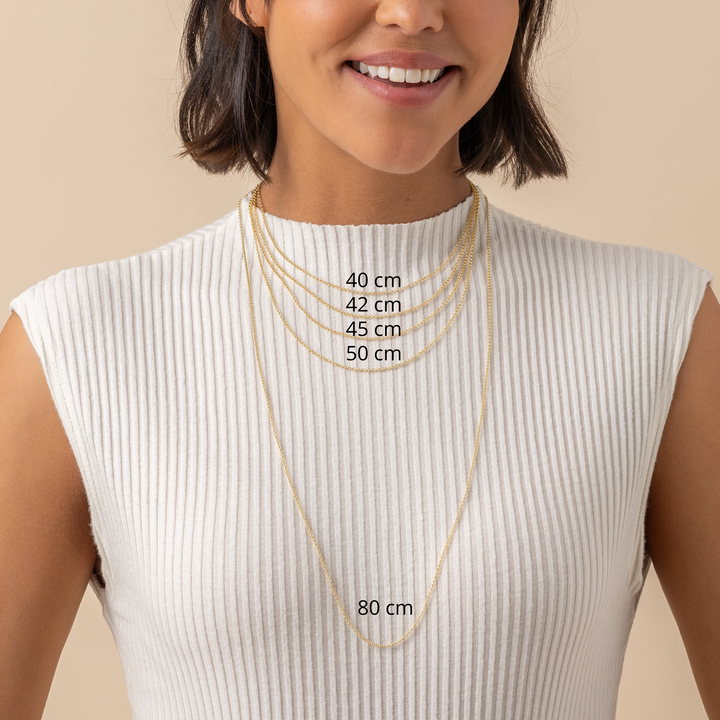
925 sterling silver, 32 mm pendant on a 45 cm sterling silver chain with a 5 cm extender. Nickel-free and hypoallergenic. Free worldwide DHL Express in 1-5 business days, with all import duties and taxes covered. 30-day “Love It or Return It” returns.
Is there a gold version?
Yes. The same anthocyanin pendant is available in 18K gold vermeil. Same molecule, different metal, different occasion.
Molecules
Delve into the hidden elegance of science with our meticulously crafted jewelry, inspired by the intricate structures of chemical molecules. Each piece serves as a tactile tribute to the building blocks of life and matter, capturing the allure of atoms and bonds in precious metals. A harmonious fusion of art and science, these creations are more than mere accessories; they're a celebration of the enigmatic beauty that underpins our universe.
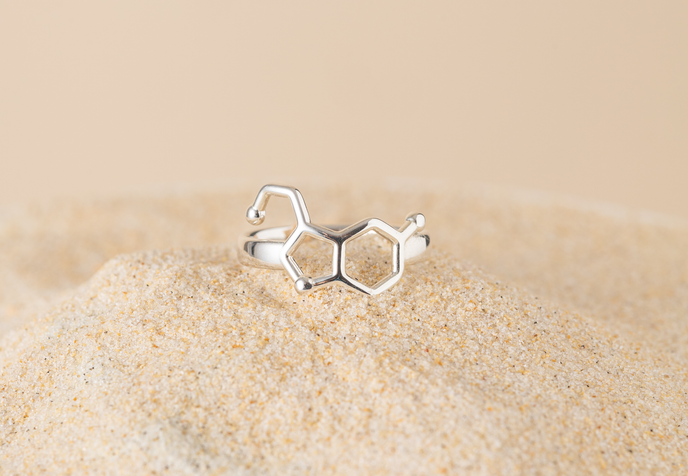
Find your perfect fit: measure an Existing Ring
Finding out your ring size at home is a simple process and can help you shop for jewelry online with confidence.
Necklace length guide