€ 165


Still questions? Contact us
Feynman scattering necklace | gold vermeil
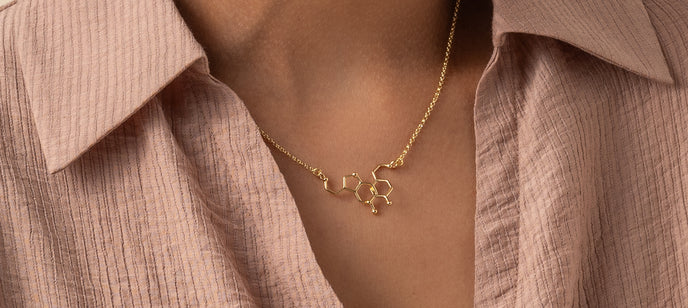
A Feynman diagram on a chain, in 18K gold vermeil. The geometry is the simplest possible electron-photon interaction: two incoming particles, an exchange, two outgoing particles. The diagram is the calculation, not just a drawing of it. The pendant carries that idea at 34 mm.
The Science Behind the Scattering Diagram
Richard Feynman introduced his diagrammatic notation for quantum electrodynamics in the late 1940s. Each diagram corresponds to a term in a perturbation expansion: lines for particle propagators, vertices for interactions, an integral over internal momenta. Two electrons exchanging a photon is one of the simplest non-trivial cases. The shape on this pendant is the lowest-order contribution to electron-electron scattering, and the calculation derived from it agrees with experiment to many decimal places. Feynman shared the 1965 Nobel Prize with Schwinger and Tomonaga for the broader theory. The diagram has since become the standard visual grammar of particle physics.
A Quiet Symbol For
Physicists, theorists, and people whose training included a semester of QED.
- particle physicists and theoretical physicists
- physics graduate students working through Peskin and Schroeder
- quantum field theory researchers and high-energy experimentalists
- physics teachers who have explained the simplest non-trivial scattering one too many times
Buyers split into two groups: physicists ordering for themselves, and partners or colleagues ordering for someone whose career has been spent on a perturbation expansion.
Explore Related Math and Physics Jewelry
- Feynman scattering necklace | silver
- Atom necklace | gold vermeil
- Saturn necklace | silver
- Orion necklace | silver
- CubeSat necklace | silver
Frequently Asked Questions
What scattering process does the diagram represent?
Two electrons (or other charged fermions) exchanging a single virtual photon, the lowest-order contribution to electron-electron scattering in quantum electrodynamics. It is the textbook starting point for almost every QED calculation.
Why a Feynman diagram on jewelry?
Because the diagram is itself a calculation, not an illustration of one. People who have worked through QED tend to find the geometry meaningful in a way a stylised atom is not. The diagram represents the actual mathematical object.
What are the specs and what is the return policy?
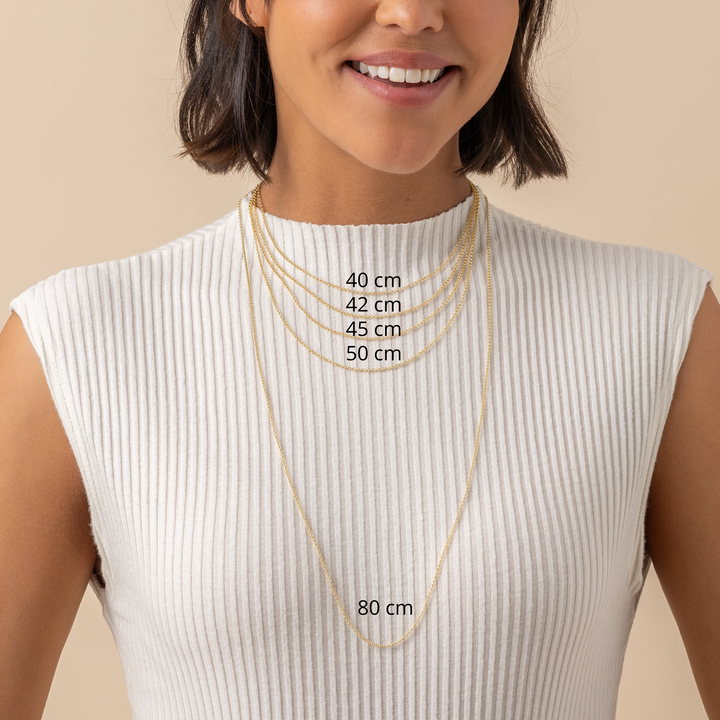
18K gold vermeil with sterling silver core and 2.5 micron gold plating, 34 mm pendant, 45 cm chain with a 5 cm extender. Nickel-free and hypoallergenic. Ships free worldwide via DHL Express in 1-5 business days, with all import duties and taxes covered. 30-day “Love It or Return It” returns.
Is this also available in silver?
Yes. The same 34 mm Feynman scattering pendant is available in 925 sterling silver at the same size and chain length.
Math & Physics
Unlock the elegance of the abstract with our math and physics-inspired jewelry collection. These carefully crafted pieces mirror the profound equations and natural laws that shape our understanding of the universe. Experience the allure of fractals, the rhythmic beauty of pi, and the celestial wonder of astral formations—each piece serves as a wearable homage to the artistry inherent in scientific inquiry.
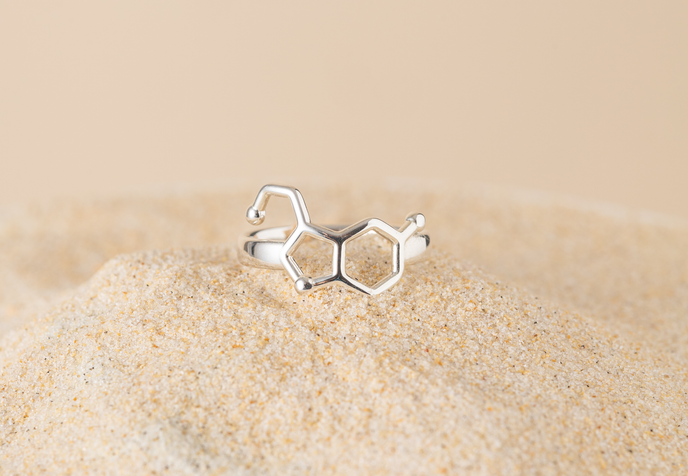
Find your perfect fit: measure an Existing Ring
Finding out your ring size at home is a simple process and can help you shop for jewelry online with confidence.
Necklace length guide