

€ 165


Still questions? Contact us
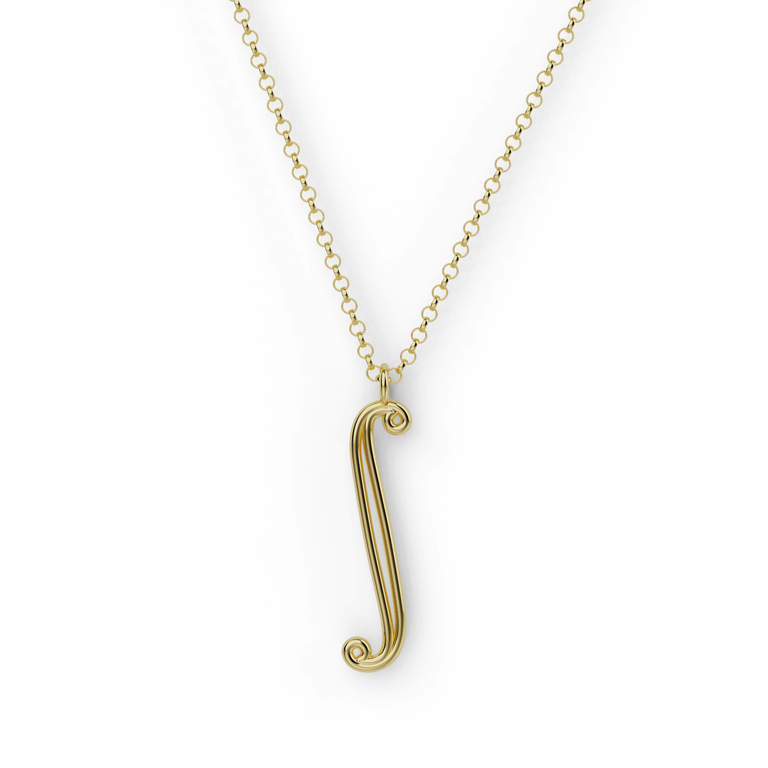
Integral necklace | 18K gold vermeil
The gold version of the symbol that runs through most of physics and engineering, in 18K gold vermeil at 32 mm. The integral is the second half of calculus, the operation that builds up a total from infinitesimal pieces. Most often given as a milestone gift to a mathematician or physicist whose career has been spent summing them.
The Science Behind the Integral
Calculus was developed independently by Isaac Newton and Gottfried Wilhelm Leibniz in the 1660s and 1680s, one of the most consequential parallel discoveries in the history of science. Newton called his version the method of fluxions. Leibniz developed the notation, including the elongated S that became ∫ (from Latin summa, sum) and the dx differential, which mathematicians still use today. Integration is the inverse of differentiation. Where a derivative finds the instantaneous rate of change, an integral finds the total accumulation. The fundamental theorem of calculus establishes the link, and applied work since has used integrals for area, volume, work, electric flux, and the solutions to differential equations governing physical systems.
Worn By
- mathematicians and applied mathematicians at career milestones
- physicists, engineers, and statisticians marking a graduation or fellowship
- partners and family of working mathematicians looking for a meaningful gold gift
- anyone for whom calculus was the start of a longer career
Most often given on a maths or physics graduation, where the gold version reads as recognition rather than daily wear.
Explore Related Math and Physics Jewelry
- Integral necklace | silver
- Pi necklace | gold vermeil
- Phi necklace | gold vermeil
- E=mc² necklace | gold vermeil
- Golden ratio necklace | gold vermeil
FAQ
Why pick the gold integral over the silver?
Two reasons in roughly equal measure. The first is the milestone framing: gold reads as recognition where silver reads as daily wear. The second is straightforward aesthetic preference. Same 32 mm pendant, same chain length, same symbol. The choice is about what the gift is meant to mark, not what an integral does.
Why was the Newton-Leibniz priority dispute so heated?
Because the development was simultaneous and the priority claim cut to the question of which scientific tradition could claim calculus as its own. Newton developed his method of fluxions earlier (around 1666) but published later. Leibniz developed his notation independently and published first. The Royal Society later sided with Newton, partly because Newton was its president, but modern historians of science generally accept the work as genuinely independent. The notation that survived is Leibniz's, which is why ∫ and dx are what people write today.
What size is the pendant and what chain comes with it?
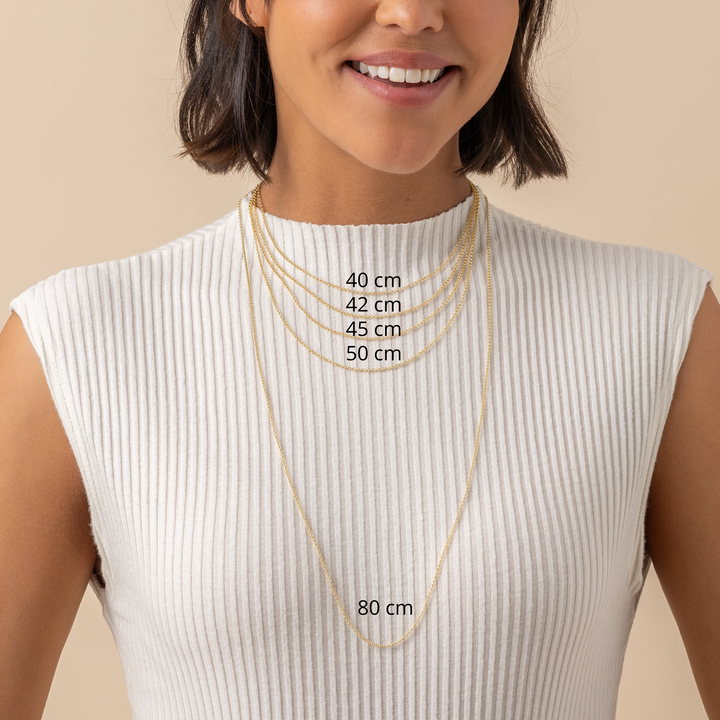
18K gold vermeil over a sterling silver core, 32 mm pendant on a 45 cm gold vermeil chain with a 5 cm extender. Nickel-free and hypoallergenic. Free worldwide DHL Express in 1-5 business days, with all import duties and taxes covered. 30-day “Love It or Return It” returns.
Is there a silver version?
Yes. The same 32 mm integral pendant comes in sterling silver at the same chain length. Silver tends to suit daily wear, gold tends to suit graduation, retirement, or a major academic appointment.
Math & Physics
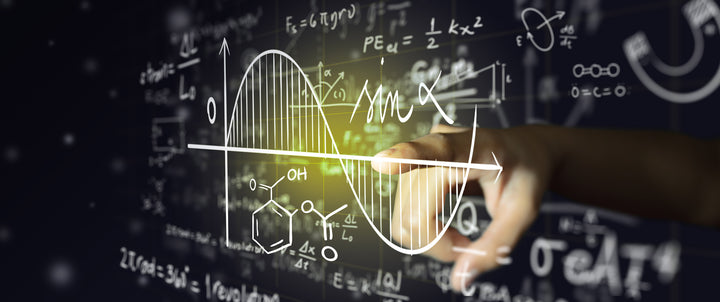
Unlock the elegance of the abstract with our math and physics-inspired jewelry collection. These carefully crafted pieces mirror the profound equations and natural laws that shape our understanding of the universe. Experience the allure of fractals, the rhythmic beauty of pi, and the celestial wonder of astral formations—each piece serves as a wearable homage to the artistry inherent in scientific inquiry.
Find your perfect fit: measure an Existing Ring
Finding out your ring size at home is a simple process and can help you shop for jewelry online with confidence.
Necklace length guide