€ 175


Still questions? Contact us
Orion necklace S | 18K gold vermeil
Wherever your daughter grew up, in the north or the south, Orion was in her sky. The hunter sits on the celestial equator, so he rises over Sydney as surely as over Stockholm. This small Orion necklace in gold vermeil carries that shared sky, for her, a friend who knows her stars, or yourself.
Who It's For
- your daughter
- someone with a birthday coming up who knows her constellations
- an astronomy or physics student
- an amateur astronomer who spends clear nights behind a telescope
- yourself, if you would rather wear a small piece of the sky than a large one
“I am so in love with this necklace! It is absolutely perfect; it's beautiful and I love the fit.” (Susana, from a review of the large silver version)
Why Orion's Brightest Stars Differ in Colour
On a clear night, two of Orion's stars show their colour even to the naked eye: Betelgeuse glows orange-red, Rigel blue-white. The difference is temperature. A star's colour works like the glow of heated metal, red while it is cooler, then yellow and white as it gets hotter, and the hottest stars go on to blue. Betelgeuse, a red supergiant, has a surface temperature of about 3,300 °C, cooler than our Sun's 5,500 °C. Rigel's surface is close to 12,000 °C. Betelgeuse makes up for its cool surface with size. It is hundreds of times wider than the Sun and gives out roughly a hundred thousand times as much energy.
Explore Related Astronomy Jewelry
- orion necklace S | silver
- orion necklace L | gold vermeil
- orion necklace L | silver
- cassiopeia necklace | gold vermeil
FAQ
How big is it, and how does it sit?
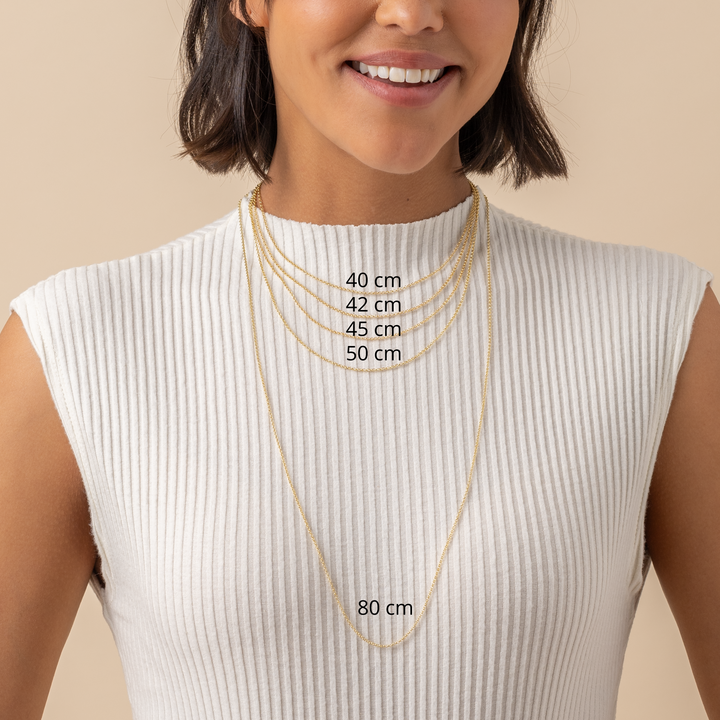
The pendant measures 21 mm (about 0.8 inches), nearly 5 mm smaller than a 2-euro coin. It is fixed to the chain at both sides and sits on the chest, below the collarbone. The chain is 45 cm (17.7 inches) of gold vermeil with a lobster clasp and a 5 cm (2 inch) extender. 18K gold vermeil means 2.5 microns of 18K gold over solid sterling silver, nickel-free and hypoallergenic. To keep the gold bright, wipe it with a soft cloth and store it dry.
Is there a silver version, or a larger one?
Yes, both. This small Orion necklace also comes in sterling silver, at the same 21 mm. Choose the finish the recipient already wears: the design is the same in both. For a bolder piece, the Orion necklace L has a 42 mm pendant and comes in gold vermeil and in sterling silver.
Will it arrive in time, and what if it isn't right?
DHL Express delivers free in 1-5 business days worldwide, and we pay the import duties and taxes, so nothing is due at the door. It arrives in a ready-to-gift jewelry box and festive envelope. If it isn't right, our 30-day “Love It or Return It” policy applies.
Why did Betelgeuse fade in 2020?
In late 2019 Betelgeuse began to dim, and by February 2020 it had lost more than half of its usual brightness, a change stargazers could see without a telescope. Some wondered whether it was about to explode. By April it was back to its usual brightness. Images from the European Southern Observatory's Very Large Telescope helped explain what happened. In 2021 a team led by Miguel Montargès reported that part of the star's surface had cooled, and gas it had thrown off condensed into a dust cloud that veiled it.

Math & Physics
Unlock the elegance of the abstract with our math and physics-inspired jewelry collection. These carefully crafted pieces mirror the profound equations and natural laws that shape our understanding of the universe. Experience the allure of fractals, the rhythmic beauty of pi, and the celestial wonder of astral formations—each piece serves as a wearable homage to the artistry inherent in scientific inquiry.
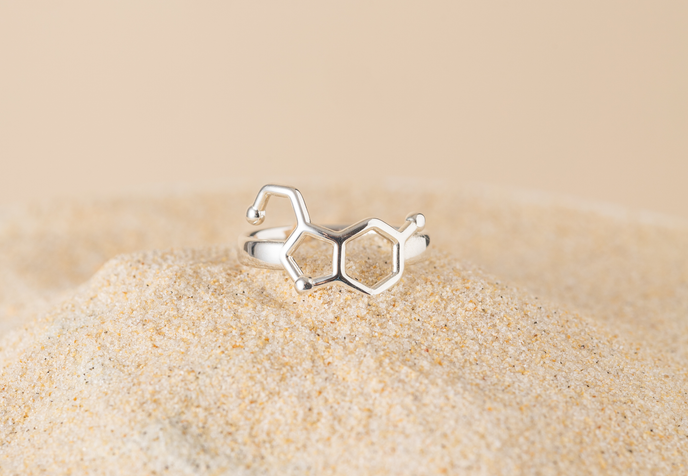
Find your perfect fit: measure an Existing Ring
Finding out your ring size at home is a simple process and can help you shop for jewelry online with confidence.
Necklace length guide