$312


Still questions? Contact us
Darwin's phylogenetic tree necklace | gold vermeil
UNESCO added the Charles Darwin Archive to its Memory of the World Register in April 2025. A palaeontologist who buys herself a Darwin's phylogenetic tree necklace in gold vermeil studies the history of life that Darwin sketched as a branching tree, in one of those notebooks, in 1837.
Who It's For
- a wife who taught biology
- someone heading to an evolution conference
- a daughter finishing a master's in evolutionary biology
- yourself, if you love evolutionary theory
From a review of the silver version, Lena L.: “Beautiful and much appreciated by the receiver. Perfect gift to a biology teacher.” Mary B., who kept the gold vermeil one: “I love my necklace nearly as much as I love evolutionary theory.”
Watching a New Branch Form
On Daphne Major, a small island in the Galápagos, Rosemary and Peter Grant studied Darwin's finches for 40 years in a row. In 1981 they noticed an immigrant male with an unusual song. Genome sequencing later showed he was a large cactus finch from Española, more than 100 km away. He bred with a resident medium ground finch, and within a few generations his descendants mated only with each other, partly because sons learn their father's song. In a paper published in Science in late 2017, the team described this lineage, nicknamed Big Bird, as a possible new species that had formed while they watched.
Explore Related Evolution and Genetics Jewelry
- Darwin's phylogenetic tree necklace | silver
- phylogenetic tree necklace | gold vermeil
- Mendel's peas necklace | gold vermeil
- trilobite necklace | gold vermeil
FAQ
How big is the pendant, and how does it sit?
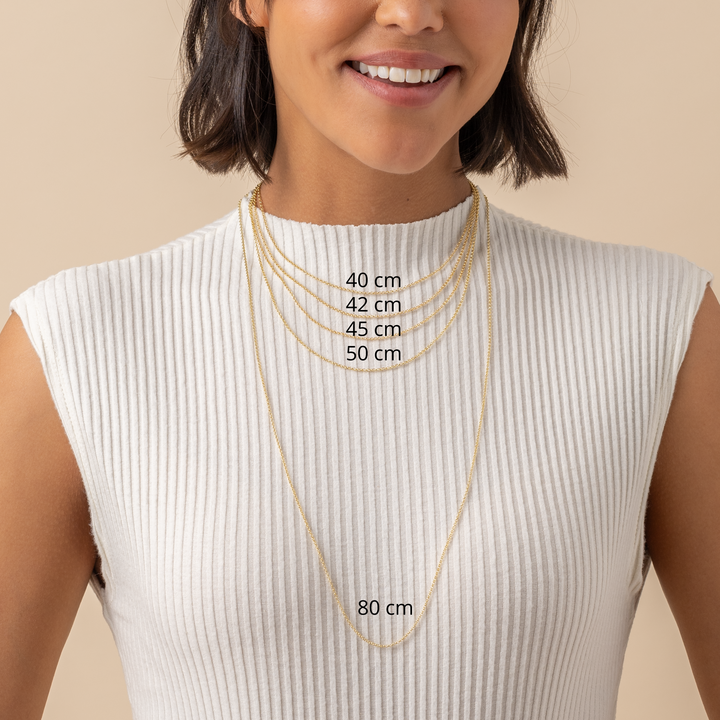
The pendant measures 41 mm (1.6 inches), about 15 mm wider than a 2-euro coin (25.75 mm). It is fixed to the chain at both ends, so it lies sideways across the upper chest, on a 45 cm (17.7 inch) gold vermeil chain with a 5 cm (2 inch) extender. Our vermeil is 2.5 microns of 18K gold over solid sterling silver, nickel-free and hypoallergenic. The branches are slender and can bend at the midpoint with little force, so take it off for sleep and sport, and store it flat.
Is there a silver version?
Yes. The same Darwin's phylogenetic tree necklace comes in sterling silver, also 41 mm and fixed at both ends, on a 45 cm silver chain with a 5 cm extender. Choose the finish the recipient already wears. The design is the same in both finishes. The phylogenetic tree necklace is a separate design: a 34 mm pendant that hangs from a ring at the top of its stem, in gold vermeil and in sterling silver.
Will it arrive in time, and what if it isn't right?
DHL Express delivers it free worldwide in 1-5 business days, and we pay the import duties and taxes, so nothing is due at the door. It arrives in a ready-to-gift jewelry box and festive envelope. If it isn't right, our 30-day “Love It or Return It” policy applies.
What is the only illustration in the first edition of On the Origin of Species?
A branching diagram of descent, a lithograph by William West in the chapter on natural selection. Darwin let A to L stand for the species of one large genus and traced their offspring upward as dotted lines that fork or stop. Each interval between the horizontal lines, he wrote, may represent a thousand generations. Very few of the original species, he added, would still have offspring by the fourteen-thousandth. Most lines end, and every living species sits at the tip of one that did not.

Other
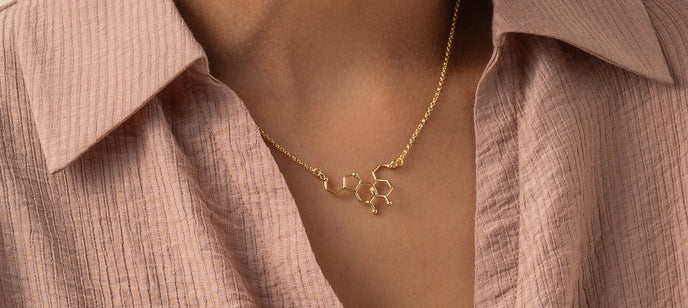
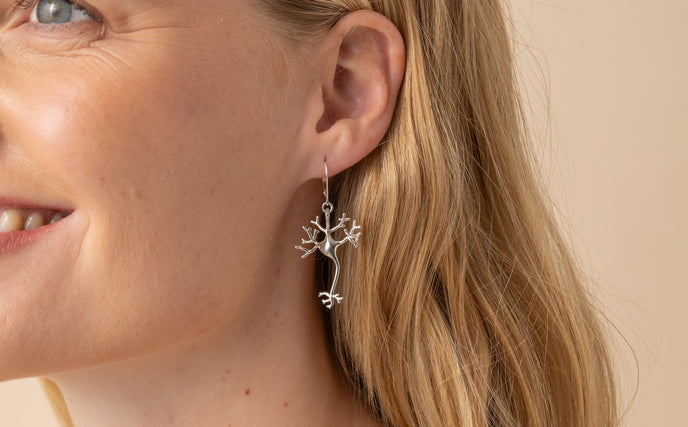
In a world where art and science often exist in separate realms, our "Curiosities" collection serves as a harmonious confluence. Drawing inspiration from an eclectic range of scientific phenomena not covered elsewhere. Each piece is meticulously crafted to evoke a sense of wonder. It's jewelry that doesn't just adorn; it educates and fascinates, sparking conversations about the lesser-explored but equally awe-inspiring facets of our universe.
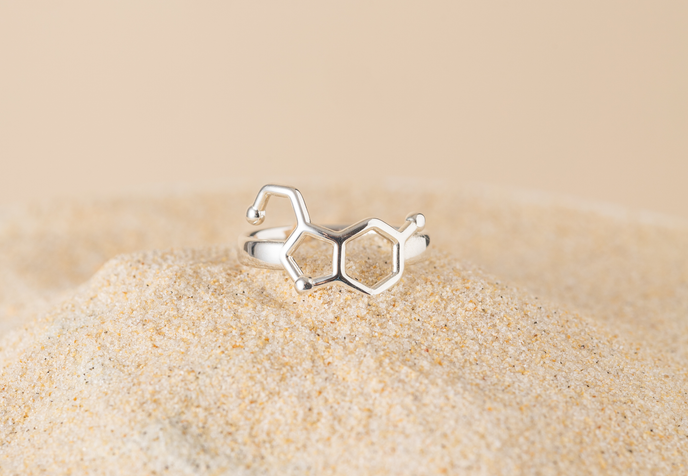
Find your perfect fit: measure an Existing Ring
Finding out your ring size at home is a simple process and can help you shop for jewelry online with confidence.
Necklace length guide