€ 155


Still questions? Contact us
phylogenetic tree necklace | sterling silver
Every living thing, past and present, belongs to one family tree, and phylogenetics is the science of drawing it. A phylogenetic tree necklace carries that idea every day. It is a thoughtful gift for a daughter who has just finished her biology degree, or for anyone who loves how life fits together.
Who It's For
- a daughter graduating in biology, at bachelor's or master's level
- a friend finishing her doctorate in population genetics or evolution
- a wife or partner training to teach science
- a biology teacher or lecturer whose students ask about evolution
- yourself, for your own PhD defence or the field you love
Daniel S.: “The Phylogenetic necklace was loved instantaneously by my wife who is studying to be a science teacher for kids.” Jenny S., who bought it for herself: “I also like the size, which is big enough to make a statement but retains a delicacy that makes it easy to pair with both everyday and more formal outfits.”
How to Read a Phylogenetic Tree
A phylogenetic tree maps how species are related. The tips are the groups being compared, and each point where two branches meet stands for a common ancestor. Kinship is read from where branches join, not from which tips happen to sit side by side. Most trees today are built by comparing DNA or protein sequences: as a rough rule, the more differences two groups have built up, the longer ago their lines split. They also turn up surprises. In 1993, Sandra Baldauf and Jeffrey Palmer compared several proteins and found that animals and fungi share a more recent ancestor than either does with plants. A mushroom is closer kin to you than any plant is.
Explore Related Evolution Jewelry
- phylogenetic tree necklace | gold vermeil
- Darwin's phylogenetic tree necklace | silver
- Darwin's phylogenetic tree necklace | gold vermeil
- trilobite necklace | silver
FAQ
How big is it, and how does it sit?
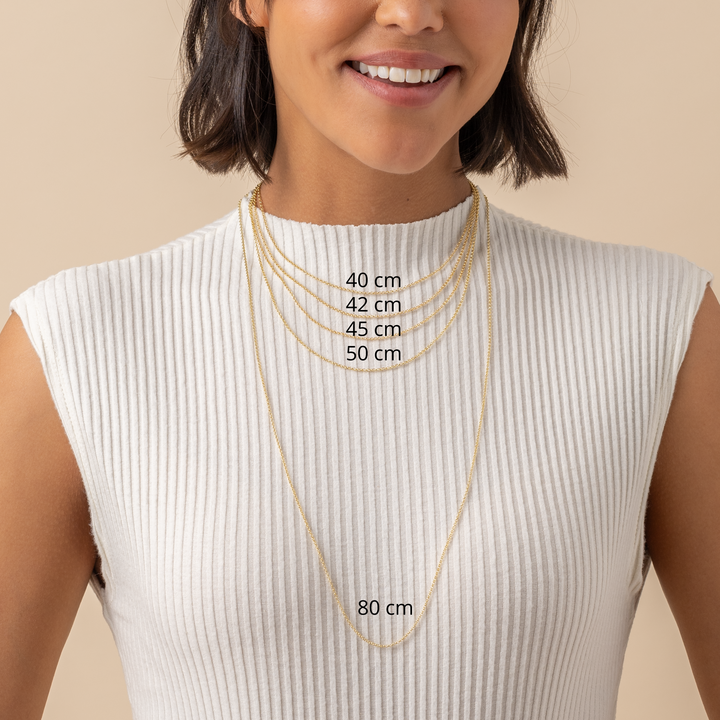
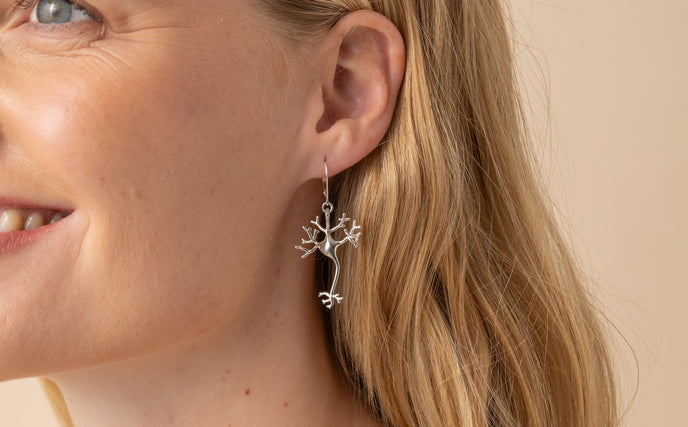
The pendant measures 34 mm (1.3 inches), about a third larger than a 2-euro coin: a statement piece, not a small charm. It hangs on a 45 cm (17.7 inch) sterling silver chain with a 5 cm (2 inch) extender and sits on the upper chest. This page also sells extra chains of 40, 42, 45 or 50 cm, each with a 5 cm extender, or 80 cm. It is 925 sterling silver, nickel-free and hypoallergenic. The branches are fine and open, so take it off for sleep and sport.
Is there a gold version, or Darwin's tree?
Yes. The same phylogenetic tree necklace comes in gold vermeil, also 34 mm. Choose the finish the recipient already wears: the design is the same in both. If she would rather wear a piece named for Darwin, Darwin's phylogenetic tree necklace is a separate design, 41 mm, in sterling silver and in gold vermeil.
Will it arrive in time, and what if it isn't right?
It ships free worldwide with DHL Express and arrives in 1-5 business days. We pay the import duties and taxes, so there is nothing to pay on delivery. It comes in a ready-to-gift jewelry box and festive envelope. If it isn't right, our 30-day “Love It or Return It” policy applies.
How did Lynn Margulis change the tree of life?
In 1967 Lynn Margulis, an assistant professor at Boston University then publishing as Lynn Sagan, argued that the mitochondria in our cells and the chloroplasts in plants began as free-living bacteria taken in by another cell. The idea was older, but she built the case for it. She later recalled that about fifteen journals turned the paper down. In 1978 Robert Schwartz and Margaret Dayhoff compared sequences and found her explanation the most likely. It is now standard in biology textbooks: some branches of the tree of life merged.

Other
In a world where art and science often exist in separate realms, our "Curiosities" collection serves as a harmonious confluence. Drawing inspiration from an eclectic range of scientific phenomena not covered elsewhere. Each piece is meticulously crafted to evoke a sense of wonder. It's jewelry that doesn't just adorn; it educates and fascinates, sparking conversations about the lesser-explored but equally awe-inspiring facets of our universe.
Find your perfect fit: measure an Existing Ring
Finding out your ring size at home is a simple process and can help you shop for jewelry online with confidence.
Necklace length guide