$269


Still questions? Contact us
Adenine-thymine earrings | sterling silver
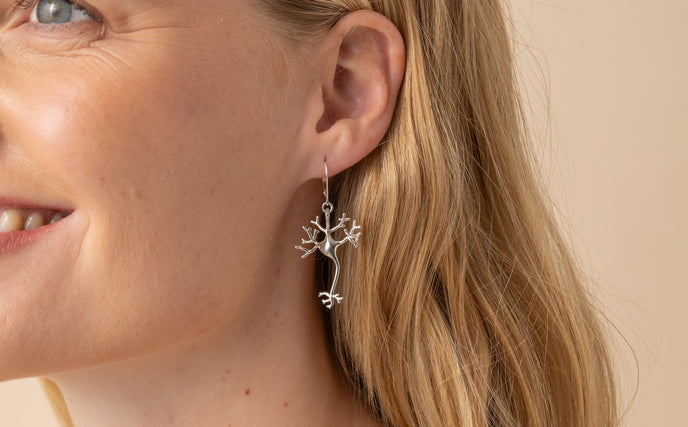
A with T, C with G. The pairing rule usually comes in the first lesson on DNA, and for some people it turns into a career. These adenine thymine earrings carry its first half, the A-T pair, one base on each ear, for a friend who made that career.
Who It's For
- a geneticist friend
- your partner, if she works in a sequencing lab
- a biochemist who studies how DNA is copied
- yourself, if you like your earrings with a little science behind them
Bonds or Shape? How DNA Gets Copied Right
Adenine and thymine pair through two hydrogen bonds, and for a long time those bonds were seen as the reason a cell puts the right letter opposite each A when it copies DNA. In 1997 Eric Kool's group at the University of Rochester tested that idea with a stand-in for thymine: a molecule of almost the same size and shape, with little ability to form hydrogen bonds. Built into DNA, it paired poorly with every base. Yet a bacterial DNA polymerase, the enzyme that copies DNA, placed it opposite adenine almost as selectively as real thymine. The result suggested that shape matters more than had been believed, and it started a debate that ran for years.
Explore Related Genetics Jewelry
- adenine - thymine earrings | gold vermeil
- adenine necklace | silver
- thymine necklace | silver
- cytosine - guanine earrings | silver
FAQ
How big are they, and how do they go on?
Each earring measures about 12 mm (roughly half an inch), not counting the hoop, about 4 mm smaller than a 1-cent euro coin (16.25 mm). It hangs from the bottom of a thin 17.5 mm sterling silver hoop, just below the earlobe. To put one in, open the small hinged section, pass the hoop through the piercing and press until it clicks shut. That last step can be fiddly at first, so give them a try at home before wearing them out. Our sterling silver is nickel-free and hypoallergenic.
Is there a gold vermeil version, or a necklace to match?
Yes. The adenine-thymine earrings also come in 18K gold vermeil, with the same 12 mm pendants on 17.5 mm gold vermeil hoops. Choose the finish the recipient already wears. The design is the same in silver and gold vermeil. For a silver set, the adenine necklace (21 mm) and the thymine necklace (19 mm) each carry one of the two bases. The cytosine-guanine earrings carry the other base pair on the same hoops, in sterling silver and gold vermeil.
Will they arrive in time, and what if they aren't right?
DHL Express delivers them free worldwide in 1-5 business days, and we pay the import duties and taxes, so nothing is due at the door. They arrive in a ready-to-gift jewelry box and festive envelope. If they aren't right, our 30-day “Love It or Return It” policy applies to unworn earrings.
Do adenine and thymine always pair the Watson-Crick way?
Not always. In 1959 K. Hoogsteen, a crystallographer at Caltech, studied crystals of adenine and thymine, each with a methyl group where it would normally join the sugar of the DNA backbone. The two bases did pair, but differently: adenine was flipped over and bonded to thymine with another edge. Today these Hoogsteen pairs are known to form briefly in ordinary DNA, about 0.1 to 1 per cent of the time in the sequences studied, each lasting around a millisecond.
Molecules
Delve into the hidden elegance of science with our meticulously crafted jewelry, inspired by the intricate structures of chemical molecules. Each piece serves as a tactile tribute to the building blocks of life and matter, capturing the allure of atoms and bonds in precious metals. A harmonious fusion of art and science, these creations are more than mere accessories; they're a celebration of the enigmatic beauty that underpins our universe.
Find your perfect fit
Necklace length guide