€ 200


Still questions? Contact us
Buckyball necklace | sterling silver
C60 is sixty carbon atoms arranged at the vertices of a truncated icosahedron, the same geometry as a soccer ball: twelve pentagons interlocking with twenty hexagons. The shape that opened up the third allotrope of carbon and earned the 1996 Nobel Prize in Chemistry. Worn here as a 25 mm sterling silver pendant on an 80 cm chain.
The Science Behind the Buckyball
Buckminsterfullerene was discovered in 1985 by Robert Curl, Harold Kroto, and Richard Smalley at Rice University, using laser ablation of graphite to vaporise carbon clusters and time-of-flight mass spectrometry to identify the resulting C60 peak. The structure was named for Buckminster Fuller, whose geodesic-dome architecture suggested the same closed-cage geometry. C60 is the third allotrope of pure carbon, alongside graphite and diamond, with sp2-hybridised carbon atoms forming a closed cage that exhibits aromatic-like delocalisation across the surface. The discovery was unexpected and reshuffled solid-state chemistry overnight. Carbon nanotubes followed within a decade, graphene a decade after that. The 1996 Nobel Prize in Chemistry recognised the original discovery as the moment carbon nanostructures became a working field.
The Audience
- materials chemists and chemical physicists
- researchers working on fullerenes, nanotubes, or graphene
- chemistry educators who use the geometry as a teaching anchor
- science enthusiasts drawn to the soccer-ball symmetry of pure carbon
For someone who looks at a soccer ball and sees the truncated icosahedron before the sport.
Explore Related Math and Physics Jewelry
- Buckyball necklace | gold vermeil
- Diamond crystal structure necklace | silver
- Graphite necklace | silver
- Atom necklace | silver
- Feynman scattering necklace | silver
FAQ
Why was the buckyball such a surprise in 1985?
Because nobody was looking for a third stable allotrope of carbon. Graphite and diamond had been understood for centuries. The Curl-Kroto-Smalley experiment was originally probing carbon clusters in interstellar conditions, not searching for new molecules. The unexpectedly stable C60 peak in the mass spectrum is what tipped them off. The closed-cage geometry only became obvious when they tried to draw a structure that could explain the stability, and the soccer-ball arrangement turned out to be the unique answer for sixty atoms with three-bond carbon and pentagonal-plus-hexagonal symmetry.
What does the buckyball geometry have to do with carbon nanotubes and graphene?
The same kind of sp2-hybridised carbon network can roll into a closed cage (buckyball), a tube (nanotube), or stay flat as a single sheet (graphene). The buckyball was the first example of a closed nanoscale carbon structure to be characterised, and it primed the field for the discovery of nanotubes (Iijima 1991) and the isolation of graphene (Geim and Novoselov, Nobel 2010). The whole nanocarbon family traces its working chemistry to what C60 first demonstrated.
What size is the pendant and what chain comes with it?
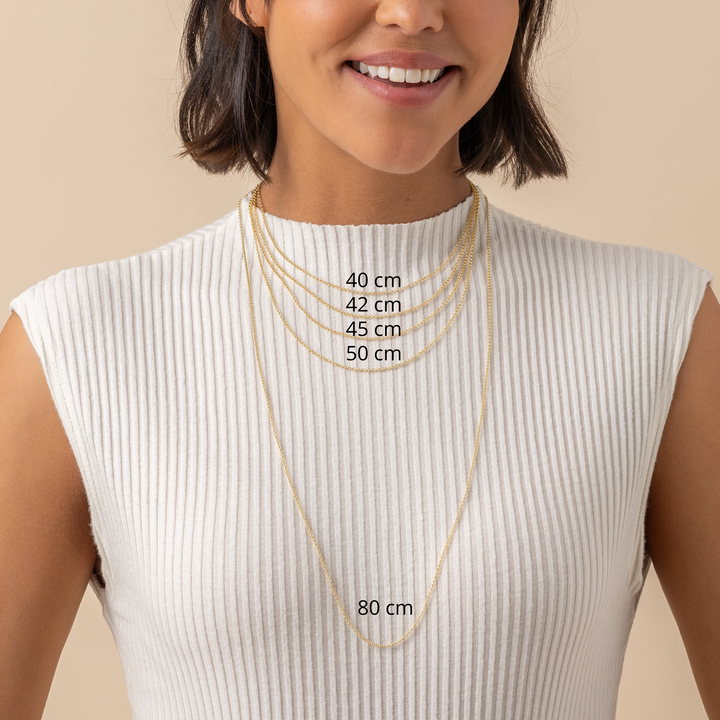
925 sterling silver, 25 mm pendant on an 80 cm sterling silver chain (ø 1.8 mm) with lobster clasp. The longer chain sits at sternum height when worn over a sweater or a layer, which suits the spherical pendant geometry. Nickel-free and hypoallergenic. Free worldwide DHL Express in 1-5 business days, with all import duties and taxes covered. 30-day “Love It or Return It” returns.
Is there a gold version?
Yes. The same buckyball is available in 18K gold vermeil at the same 25 mm size. Same C60 cage, different metal, different occasion. For someone who recognises the truncated icosahedron at sight.

Math & Physics
Unlock the elegance of the abstract with our math and physics-inspired jewelry collection. These carefully crafted pieces mirror the profound equations and natural laws that shape our understanding of the universe. Experience the allure of fractals, the rhythmic beauty of pi, and the celestial wonder of astral formations—each piece serves as a wearable homage to the artistry inherent in scientific inquiry.
Find your perfect fit: measure an Existing Ring
Finding out your ring size at home is a simple process and can help you shop for jewelry online with confidence.
Necklace length guide