€ 150


Still questions? Contact us
Fz3 atomic orbital necklace | sterling silver
Atomic orbitals are the real shapes electrons take around a nucleus, not the simple circles that show up on chemistry textbook covers. The Fz3 has one of the more complex geometries in the standard set. Most chemistry students never look at it directly, even though it's there in every lanthanide they study.
The Science of the Fz3 Orbital
The 4f orbitals appear in elements with electrons in the f-subshell, which is the lanthanides and actinides. There are seven of them, distinguished by their magnetic quantum numbers. The Fz3 has the angular form proportional to z(5z² − 3r²), which gives it three lobes along the z-axis and a doughnut-shaped node ring perpendicular to it. The geometry matters: the spatial distribution of f electrons determines bonding behaviour in lanthanides and actinides, which in turn shapes the chemistry of every nuclear reactor fuel and most rare-earth magnets in modern electronics. The orbitals you can't easily picture are doing the work behind half the periodic table.
Who Reaches For This
Mainly chemists who actually use f-orbital chemistry, plus a smaller group who simply love the geometry.
- physical chemists and quantum chemistry researchers
- inorganic chemists working with lanthanides or actinides
- materials scientists in rare-earth magnetism
- chemistry students celebrating finishing physical chemistry
Most often given to graduate students at thesis defence or to physical chemistry teachers who shaped the recipient's first encounter with quantum mechanics.
Explore Related Math & Physics Jewelry
- Fz3 atomic orbital necklace | gold vermeil
- atom necklace 3D | silver
- voronoi ring | silver
- saturn necklace | silver
FAQ
What kind of person actually wears an Fz3 orbital?
Someone who recognises the shape on sight. That's a narrow population: physical chemists, inorganic chemists working with rare earths, quantum chemistry researchers, plus a fairly devoted group of chemistry students who fell in love with f-orbital geometry during a physical chemistry course. The piece reads like a peer signal in those circles.
What does the z(5z² − 3r²) actually mean?
It's the angular part of the wavefunction. Squared, it gives the probability density of finding the f electron at any direction around the nucleus. The function takes large positive values along the z-axis and zero values on a horizontal plane through the nucleus, which is why the orbital has lobes pointing up and down with a node ring around the equator.
Size, material, chain length?
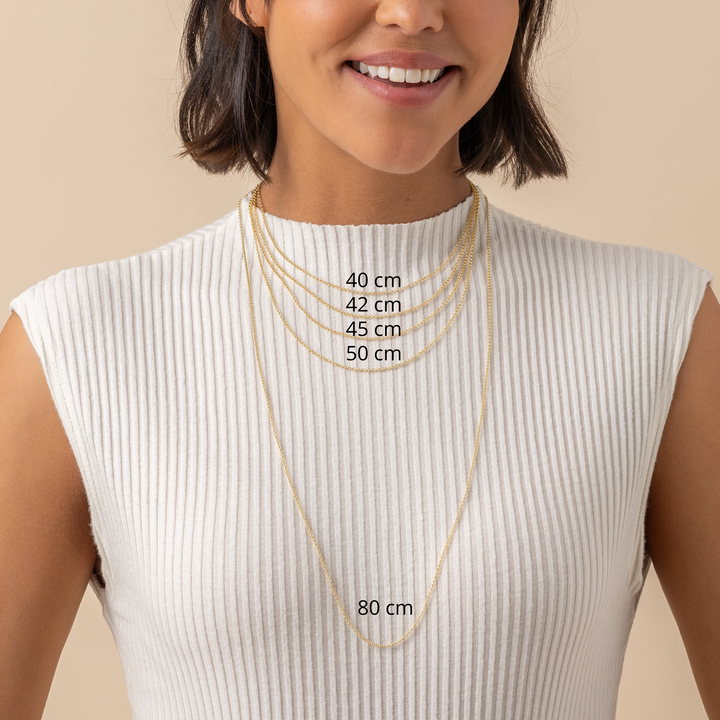
23 mm pendant in 925 polished sterling silver, nickel-free and hypoallergenic, on a 45 cm sterling silver chain (1.8 mm diameter) with lobster clasp and a 5 cm extender. Free DHL Express shipping worldwide in 1-5 business days, all duties and taxes covered, 30-day “Love It or Return It” policy.
Is there a gold version?
Yes. The Fz3 atomic orbital necklace exists in 18k gold vermeil at the same 23 mm size. Same design, material is the only difference.

Math & Physics
Unlock the elegance of the abstract with our math and physics-inspired jewelry collection. These carefully crafted pieces mirror the profound equations and natural laws that shape our understanding of the universe. Experience the allure of fractals, the rhythmic beauty of pi, and the celestial wonder of astral formations—each piece serves as a wearable homage to the artistry inherent in scientific inquiry.
Find your perfect fit: measure an Existing Ring
Finding out your ring size at home is a simple process and can help you shop for jewelry online with confidence.
Necklace length guide