€ 140


Still questions? Contact us
Phi necklace | sterling silver
Phi (φ) is the most irrational number there is. (1+√5)/2, roughly 1.618, with a continued-fraction expansion of all 1s, which is why no rational approximation comes close. The Greek letter for the golden ratio, the constant that quietly shows up wherever growth and packing optimise against rotation. Worn here as a 23 mm sterling silver pendant.
The Science Behind Phi
The golden ratio φ = (1+√5)/2 ≈ 1.618 is the irrational number whose continued-fraction representation is purely 1s, which is why it resists rational approximation more strongly than any other constant. It is the limit of consecutive Fibonacci ratios. In plant biology, the golden angle (≈137.5°, derived from φ) governs phyllotaxis: sunflower seed packing, pinecone scale spirals, and leaf arrangement around stems all converge on this angle because it minimises overlap between successive elements as a meristem rotates and expands. Geometrically, φ is the ratio between a regular pentagon's diagonal and its side, a relationship that gave the early Pythagoreans the irrationality result traditionally credited to Hippasus around the 5th century BC.
Who Will Recognise It
- mathematicians and math educators teaching irrationality, continued fractions, or Fibonacci sequences
- biologists and botanists working on phyllotaxis or plant morphology
- architects and designers with formal training in proportion and geometry
- physicists and computer scientists working on quasicrystals or aperiodic tilings
About a third of orders ship to working mathematicians or biology educators, the rest to people for whom φ shows up in design, architecture, or visual practice.
Explore Related Math and Physics Jewelry
- Phi necklace | gold vermeil
- Golden ratio necklace | silver
- Golden ratio earring hoops | silver
- Trefoil knot necklace | silver
- Interlocked geometry necklace | silver
FAQ
What's the difference between phi and the golden ratio designs in the catalogue?
Phi renders the Greek letter φ as the design element. The golden-ratio pendant renders the spiral construction built from successive φ-rectangles. Same underlying constant, two different visual references. Buyers tend to pick phi when they want the symbol used in the equations, and the golden-ratio spiral when they want the geometric construction. Both exist in silver and gold vermeil if the pair-partner question comes up.
Why is phi called the "most irrational" number?
Because every rational approximation to φ converges more slowly than for any other irrational number. The continued-fraction expansion is [1; 1, 1, 1, ...] all the way down, which means truncating it at any point gives the worst possible rational approximation. Pi and e have larger terms in their continued fractions, so rational approximations like 22/7 for π converge quickly. Phi has nowhere to hide. That property is also why the golden angle minimises overlap in phyllotaxis: irrationality maximises spread.
What size is the pendant and what chain comes with it?
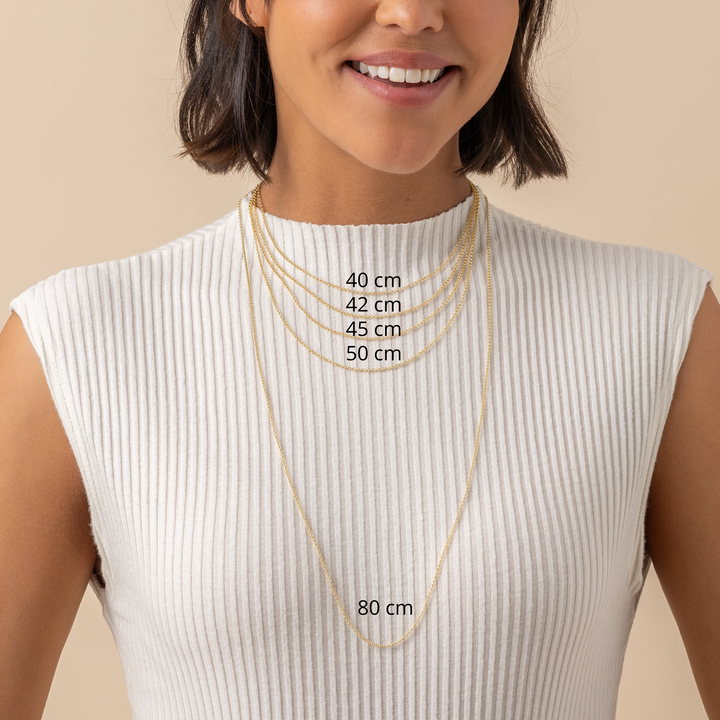
925 sterling silver, 23 mm pendant on a 45 cm sterling silver chain (ø 1.8 mm) with a 5 cm extender. Nickel-free and hypoallergenic. Free worldwide DHL Express in 1-5 business days, with all import duties and taxes covered. 30-day “Love It or Return It” returns.
Is there a gold version?
Yes. The same phi pendant is available in 18K gold vermeil at the same 23 mm size and same chain length. Silver tends to suit daily wear and teaching contexts. Gold tends to suit graduation, retirement, or a major appointment in mathematics or a math-adjacent field.

Math & Physics
Unlock the elegance of the abstract with our math and physics-inspired jewelry collection. These carefully crafted pieces mirror the profound equations and natural laws that shape our understanding of the universe. Experience the allure of fractals, the rhythmic beauty of pi, and the celestial wonder of astral formations—each piece serves as a wearable homage to the artistry inherent in scientific inquiry.
Find your perfect fit: measure an Existing Ring
Finding out your ring size at home is a simple process and can help you shop for jewelry online with confidence.
Necklace length guide