€ 205


Still questions? Contact us
Uterus necklace V | gold vermeil
A uterus necklace is a small way to honour the women who care for others through pregnancy and birth. This one is a present for a friend who is an OB-GYN, a midwife, or a colleague in obstetrics, from someone who wants her to know how much that work matters.
Who It's For
- a friend who is an OB-GYN or works in obstetrics
- a friend, for her birthday
- your daughter, as a present
- your girlfriend or wife
- yourself, as a small piece to wear every day
It can also be for you, if this organ has played its own part in your life.
Charlotte G., from a review of the larger horizontal version in silver: “A beautiful present with all details so accurate.” Sonia B., who bought the larger horizontal version in gold vermeil to keep: “I love my gold uterus.”
How the Uterus Forms
About seven weeks into development, an embryo has a pair of tubes called the Müllerian ducts, one on each side. A week later their lower parts begin to join, forming what becomes the uterus, the cervix and the top of the vagina. The upper parts stay apart and become the fallopian tubes, so the tubes and the uterus grow from the same pair of ducts. A wall divides the new cavity and usually disappears by about 20 weeks. In many other mammals the ducts join less. Rabbits keep two separate uteri, and cats and dogs have a short uterine body with two long horns. In humans and other primates the lower parts fuse into a single cavity.
Explore Related Jewelry
- uterus necklace V | silver
- uterus necklace H | gold vermeil
- fetus necklace | gold vermeil
- oxytocin necklace | gold vermeil
FAQ
How big is it, and how does it sit?
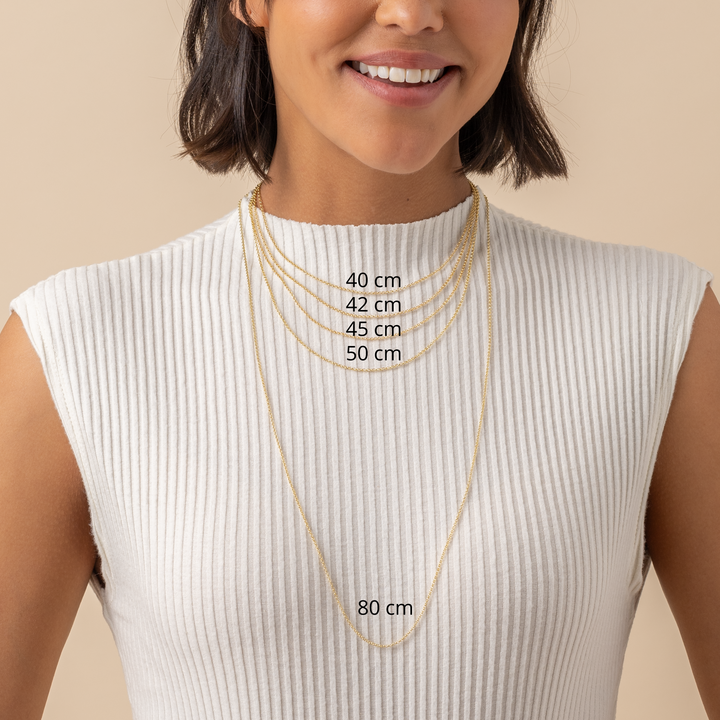
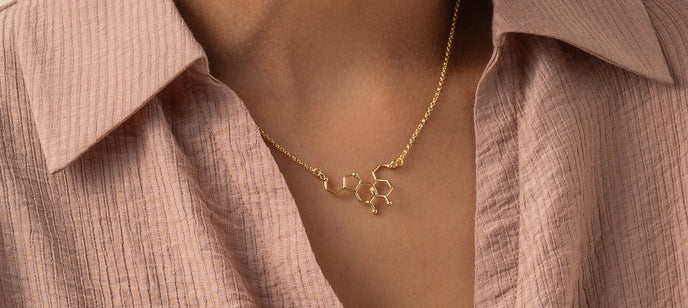
The pendant measures 18 mm (about 0.7 inches), the size of a US dime and a little smaller than a 10-cent euro coin. It hangs from a loop at the top on a 45 cm (17.7 inch) gold vermeil chain with a 5 cm (2 inch) extender and sits just below the collarbone. Extra chains in 40, 42, 45, 50 and 80 cm can be added on this page. Gold vermeil is 2.5 microns of 18K gold over solid sterling silver, nickel-free and hypoallergenic.
Is there a silver version, or a larger one?
Yes. The same 18 mm pendant comes in sterling silver. The horizontal uterus necklace is the same design at 27 mm, in gold vermeil and silver, and its chain runs through the ends of the two side arms instead of a loop at the top. Choose the finish she already wears. The design is the same in both finishes.
Will it arrive in time, and what if it isn't right?
DHL Express delivers it free worldwide in 1-5 business days, and we pay the import duties and taxes, so nothing is due at the door. It arrives in a ready-to-gift jewelry box and festive envelope. If it isn't right, our 30-day “Love It or Return It” policy applies.
Who worked out why only some embryos keep a uterus?
The French biologist Alfred Jost, and later Nathalie Josso. From 1947, Jost reported that rabbit fetuses whose developing gonads he had removed kept their Müllerian ducts, whatever their genetic sex. Testosterone did not remove the ducts, so he proposed a second testis hormone that does, now called anti-Müllerian hormone. Josso, who trained in his lab, and her team in Paris worked out its chemical nature in the 1970s and 1980s, and cloned its gene in 1986, almost at the same time as a team in Boston.

Human Anatomy
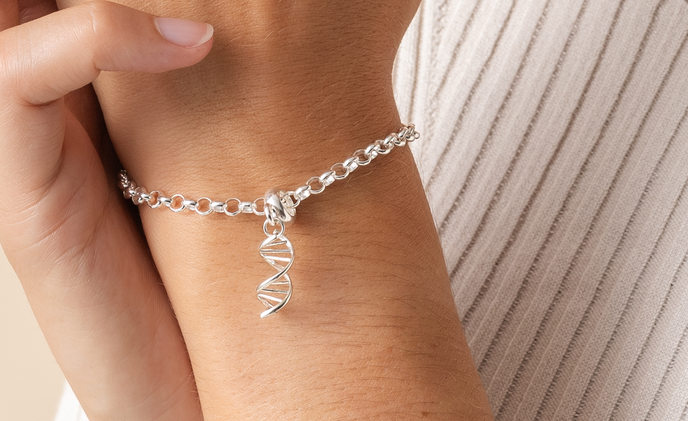
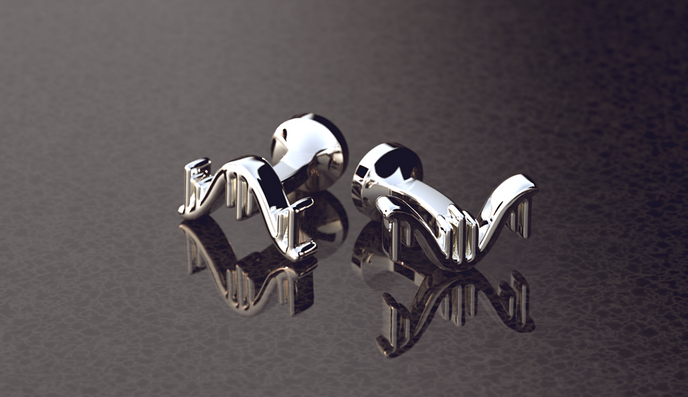
Anatomical wonders have never been so elegantly articulated. Our anatomical collection embodies the intricate and awe-inspiring structures that make us who we are. From DNA double helices to neuronal networks, our pieces don't merely imitate—they interpret. The collection serves as a tangible tribute to the hidden beauty within us all, elevating the realms of biology and medicine into wearable art. With exquisite attention to detail, each piece is a dialogue between form and function, revealing the enigmatic eloquence of the human body.
Find your perfect fit: measure an Existing Ring
Finding out your ring size at home is a simple process and can help you shop for jewelry online with confidence.
Necklace length guide