€ 185


Still questions? Contact us
Astrocyte necklace | gold vermeil
An astrocyte necklace in gold vermeil is for the woman who studies the brain's other cells, the ones that were written off as glue for a century. Give it to a neuroscientist finishing her PhD on glia, or to a friend who has always rooted for the underdog in the textbook.
Who It's For
- a colleague working in neuroscience
- someone interested in the brain, even outside the lab
- yourself, if you love a geeky piece more than ordinary jewelry
Gunnar B., on the gold version: “Perfect gift for people working in the field or that are otherwise interested!” Amy H., from a review of the silver version: “I’m not a jewelry person but I’m a geek. This is fun to wear!”
The Science of the Astrocyte
In grey matter, astrocytes are glial cells that wrap their many fine branches around synapses, the junctions where neurons pass signals. Each one keeps to its own territory, and in the human brain those territories are large. In 2009 Nancy Ann Oberheim, Maiken Nedergaard and colleagues reported that human astrocytes are about 2.6 times larger across than those of rodents, and that a single human astrocyte's territory may hold up to 2 million synapses. Within it, the astrocyte clears away used signalling chemicals and helps regulate local blood flow.
Explore Related Neuroscience Jewelry
- astrocyte necklace | silver
- neuron necklace | gold vermeil
- purkinje cell necklace | gold vermeil
- brain necklace | gold vermeil
FAQ
How big is the pendant, and how does it sit?
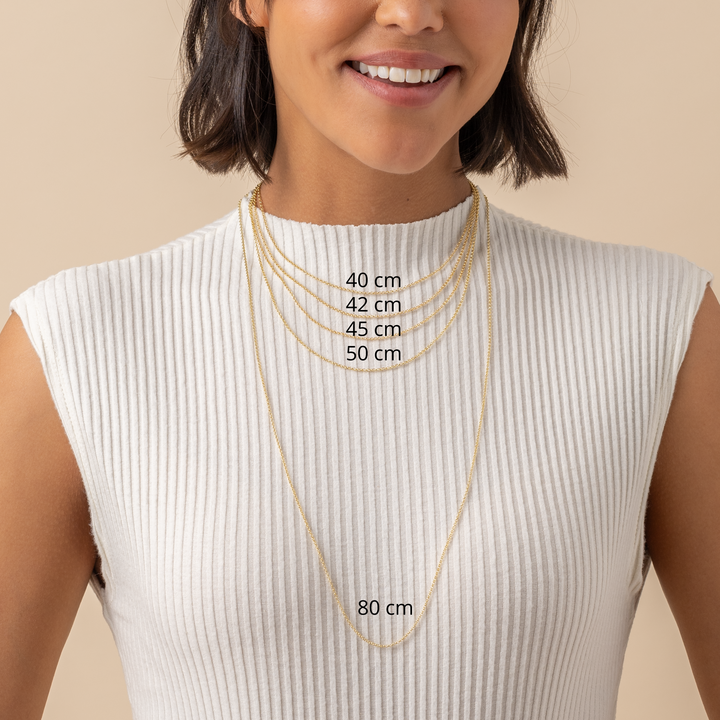
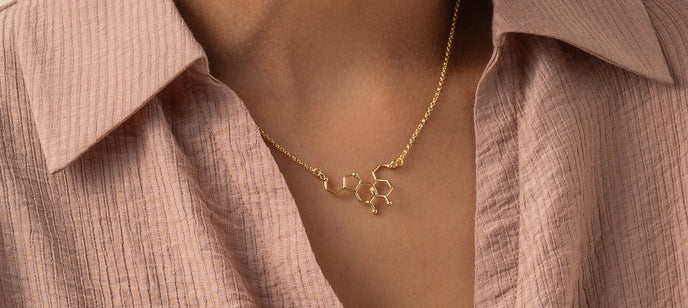
The pendant measures 29 mm (about 1.1 inches), about 3 mm more than the width of a 2-euro coin (25.75 mm). It hangs below the collarbone on a 45 cm (17.7 inch) gold vermeil chain with a lobster clasp and a 5 cm (2 inch) extender. Extra chains of 40, 42, 45 or 50 cm with extender, or 80 cm, are sold on this page. It is sterling silver with 2.5 microns of 18K gold, nickel-free and hypoallergenic.
Is there a silver version?
Yes. The same 29 mm astrocyte necklace comes in sterling silver. Choose the finish she already wears. The design is the same in both, and each comes on a 45 cm chain with a 5 cm extender in the matching metal.
Will it arrive in time, and what if it isn't right?
It ships free worldwide with DHL Express and arrives in 1-5 business days. We pay the import duties and taxes, so there is nothing to pay on delivery. It comes in a ready-to-gift jewelry box and festive envelope. If it isn't right, our 30-day “Love It or Return It” policy applies.
Why is it called an astrocyte?
Because the cell is star-shaped. In the 1850s the pathologist Rudolf Virchow described the material between neurons as Nervenkitt, nerve putty, and coined the word neuroglia. He saw it as a putty-like connective substance. In 1872 Moritz Jastrowitz described spider-like glial cells. In the 1890s the Hungarian anatomist Michael von Lenhossék named the star-shaped ones astrocytes, from the Greek astron, star, and kytos, container.
Neuroscience
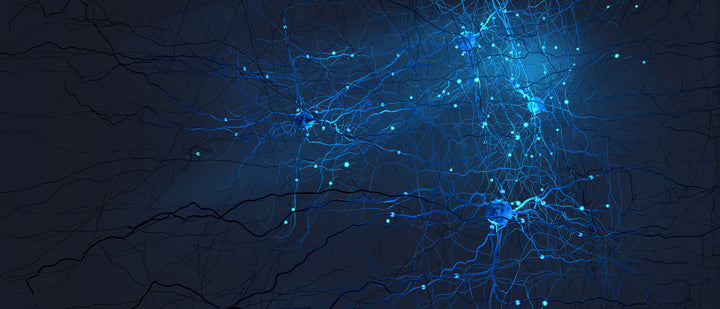
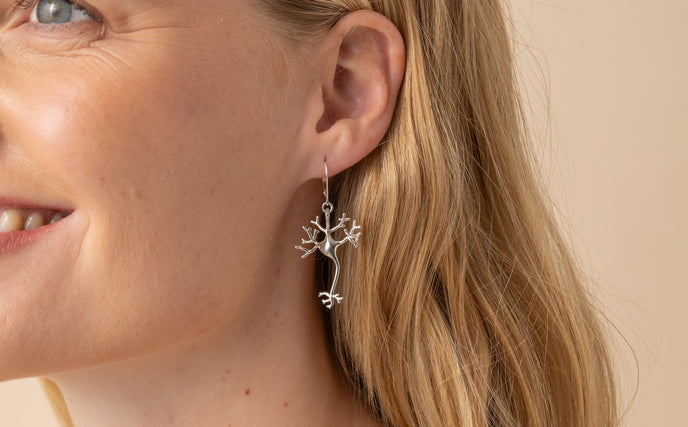
Dive into the intricacies of the human mind with our neuroscience-inspired jewelry collection. Each piece is a tactile ode to the neural networks that shape our thoughts, memories, and consciousness. Crafted with meticulous attention to detail, our designs mirror the dendritic branches and synaptic connections that form the basis of mental activity. With these elegant pieces, wear the enigma of cognition close to your skin, offering a subtle yet profound exploration of what it means to be sentient.
Find your perfect fit: measure an Existing Ring
Finding out your ring size at home is a simple process and can help you shop for jewelry online with confidence.
Necklace length guide