€ 160


Still questions? Contact us
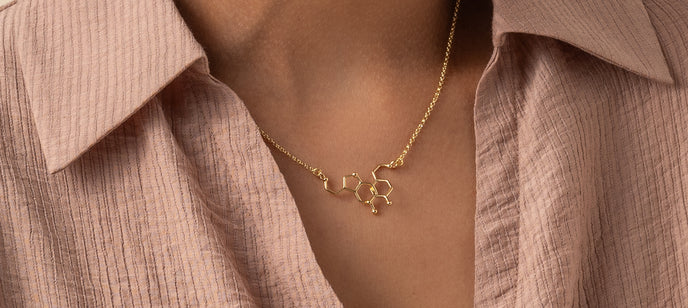
ATP necklace | sterling silver
Adenosine triphosphate is the molecule every living cell spends. Muscle contraction, nerve impulses, the copying of DNA and the pumping of ions across a membrane all draw on the same currency. A human body holds only about 250 grams of it at any moment and recycles roughly its own weight in ATP every day.
The Chemistry of ATP
ATP was isolated in 1929, twice in the same year: by Karl Lohmann in Otto Meyerhof's laboratory in Berlin, and by Cyrus Fiske and Yellapragada Subbarow at Harvard. What it was for took another decade. In 1941 Fritz Lipmann argued that its phosphate bonds carry the energy of metabolism and called it the cell's universal energy currency. The enzyme that makes it, ATP synthase, turned out to be a rotary motor: a ring of proteins spun by protons flowing back into the mitochondrion, producing three ATP per full turn. Paul Boyer worked out the mechanism, John Walker solved the structure, and in 1997 a Japanese team attached a fluorescent filament to a single enzyme and filmed it rotating.
Who Will Recognise It
Anyone who has drawn the Krebs cycle from memory, and a few who wish they could forget it.
- biochemists, cell biologists and anyone who has ever counted the ATP yield of glycolysis
- physiologists, exercise scientists and sports medicine doctors
- mitochondrial disease researchers and the families who follow their work
- medical, biology and pharmacy students marking the end of a metabolism course
A firefly's glow runs on ATP, which is why the enzyme behind it, luciferase, is still the standard laboratory test for how much ATP a sample contains.
Explore Related Molecules Jewelry
- Mitochondrion necklace | silver
- Glucose necklace | silver
- Adenine necklace | silver
- Caffeine necklace | silver
FAQ
Who is the ATP necklace for?
It reads at two levels. Anyone who took a biology class knows ATP as the energy molecule, so it works for a science-minded friend with no specialist background. For a biochemist, a physiologist or someone who studies mitochondria it is the molecule of their working life, and they will read the structure at a glance. A good fit for a graduation, a first postdoc or a marathon finish.
Is ATP really a store of energy?
Not the way a battery is. The phrase high-energy bond is a shorthand. The energy comes from the whole reaction: splitting off the last phosphate relieves the repulsion between three negative charges and lets the products settle into more stable, better hydrated forms. Under cell conditions that releases about 50 kilojoules per mole. And the cell does not stockpile ATP so much as turn it over, remaking each molecule hundreds of times a day.
What size, material and chain?
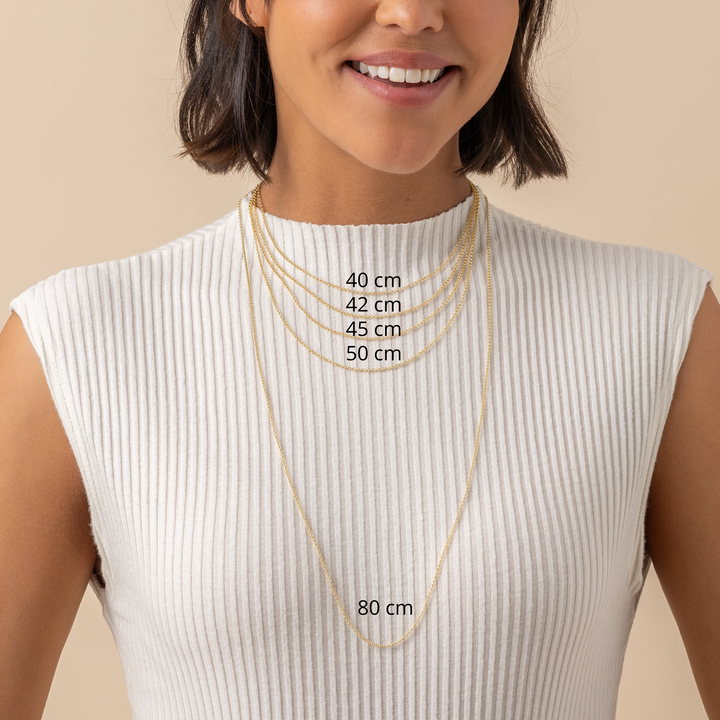
43 mm pendant in 925 polished sterling silver, nickel-free and hypoallergenic. 45 cm sterling silver chain with 5 cm extender. Ships free worldwide via DHL Express in 1-5 business days, with all import duties and taxes covered. Comes in a ready-to-gift eco-friendly box with the 30-day “Love It or Return It” policy.
Is this the same molecule as the adenine in DNA?
Part of it is. ATP is adenosine, which is adenine joined to a ribose sugar, with three phosphate groups attached in a chain. Strip the phosphates away and you have the adenosine that builds up in the brain over a waking day and makes you sleepy. Caffeine works by blocking its receptors. So the adenine necklace, the caffeine necklace and this one are three views of the same purine.
Molecules
Delve into the hidden elegance of science with our meticulously crafted jewelry, inspired by the intricate structures of chemical molecules. Each piece serves as a tactile tribute to the building blocks of life and matter, capturing the allure of atoms and bonds in precious metals. A harmonious fusion of art and science, these creations are more than mere accessories; they're a celebration of the enigmatic beauty that underpins our universe.
Find your perfect fit
Necklace length guide