€ 180


Still questions? Contact us
Eye section necklace | sterling silver
The retina is the only place in the body where you can look at live neural tissue without opening anything. Light passes through the cornea, through the lens, onto a 0.5 mm sheet of layered neural cells: the most accessible window into the central nervous system anyone has. The pendant captures the eye's overall sectional form: a spherical inner globe held within an outer envelope, with the optic nerve trailing posteriorly toward the chain.
The Internal Anatomy of the Eye
A sagittal section through the eye reveals its three concentric layers. The fibrous tunic is the structural shell: cornea anteriorly, sclera posteriorly. The vascular tunic, or uvea, sits inside it: choroid, ciliary body, and iris, all pigmented and vascular. The neural tunic is the innermost layer, the retina itself, with its photoreceptors, bipolar cells, ganglion cells, and the vasculature you actually see during a fundus exam. The lens, suspended by the zonular fibres of the ciliary body, changes shape during accommodation under the action of the ciliary muscle. The anterior chamber is filled with aqueous humour. The vitreous chamber holds the gel-like vitreous humour. Two specific points on the posterior retina are visible on the section: the fovea, packed with cone photoreceptors and responsible for the sharpest visual acuity, and the optic disc, the blind spot where the optic nerve exits the eye. Optical coherence tomography (OCT) now resolves these layers at near-cellular detail in living patients, which is how macular degeneration, diabetic retinopathy, and glaucoma get diagnosed in clinic.
A Meaningful Gift for Science Lovers
- ophthalmologists, vitreoretinal surgeons, and cataract surgeons
- optometrists and orthoptists who run OCTs and fundus exams every day
- visual neuroscientists, retinal researchers, and psychophysicists
- medical students through their first ocular anatomy block
- anyone who has had a serious ophthalmic diagnosis or a sight-saving surgery
Often the right gift for a residency completion, a fellowship in vitreoretinal surgery, or a long career in vision science.
Explore Related Anatomy Jewelry
- Eye section necklace | gold vermeil
- Eye necklace | silver
- Inner ear anatomy necklace | silver
- Brain necklace | silver
- Skull necklace | silver
FAQ
What anatomy does the pendant show?
The eye in section, evocative rather than fully labelled. You can read the spherical inner globe, the surrounding outer envelope, and the optic nerve trailing posteriorly toward the chain. The overall sectional architecture of the eye, without trying to force every retinal layer into a 32 mm pendant. For ophthalmologists, optometrists, and visual neuroscientists, that abstraction tends to work: the structure is recognisable on sight, but the piece reads as jewelry rather than as a teaching plate.
Why the section instead of a whole eye?
Because the section opens the eye up as a 3D organ. From the outside, the eye is mostly sclera and a bit of cornea. The inner architecture is hidden. The section makes the inner globe and the optic-nerve relationship readable in space. For ophthalmologists and vision researchers, the section is the working visual. The whole-eye version exists for people who want a less technical pendant. This is the piece for people who want the eye opened up.
What size is the pendant and what does it ship with?
The pendant is 32 mm in sterling silver (925), nickel-free and hypoallergenic, on a 45 cm sterling silver chain (1.8 mm width, lobster clasp) with a 5 cm extender, so it sits at the collarbone or a little below. Free worldwide DHL Express shipping in 1-5 business days, all import duties covered, in a ready-to-gift jewelry box.
Is this available in gold vermeil?
Yes. The eye section is also available in 18k gold vermeil at a slightly higher price. Both versions are 32 mm and use the same cross-section. Choose the finish the recipient already wears. Both versions carry the same design and the same meaning.

Human Anatomy
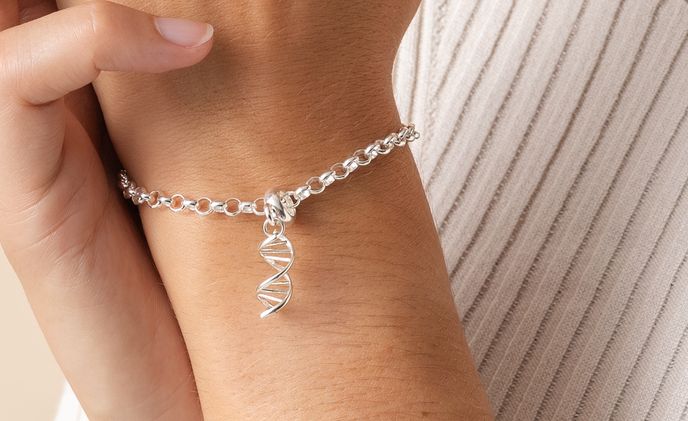
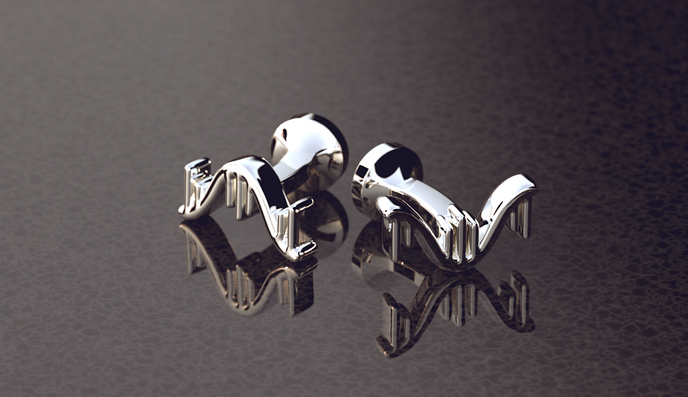
Anatomical wonders have never been so elegantly articulated. Our anatomical collection embodies the intricate and awe-inspiring structures that make us who we are. From DNA double helices to neuronal networks, our pieces don't merely imitate—they interpret. The collection serves as a tangible tribute to the hidden beauty within us all, elevating the realms of biology and medicine into wearable art. With exquisite attention to detail, each piece is a dialogue between form and function, revealing the enigmatic eloquence of the human body.



Find your perfect fit: measure an Existing Ring
Finding out your ring size at home is a simple process and can help you shop for jewelry online with confidence.
Necklace length guide